
Then & Now: Bryan Maxwell
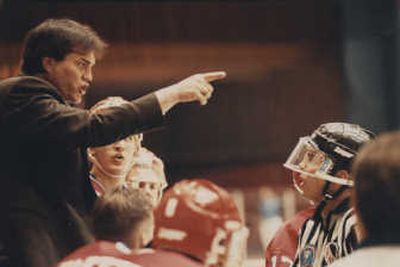
The baritone is still so deep that it has no bottom, and you have to think it is even more persuasive selling pricey resort condos than it was selling a teenage hockey player on the need to go to the body.
Really, could you resist surrendering that down payment when it’s Bryan Maxwell bearing down with the pitch?
Yet what Maxwell’s been doing for the past year and a half – selling properties for Bear Mountain Resort outside Victoria, British Columbia – is what he calls “a break.” And he’s ready for the break to be over.
He didn’t get the itch to coach again by watching the Spokane Chiefs wrap up the Western Hockey League championship in Lethbridge last week, but it certainly didn’t hurt. After sweeping the Hurricanes, the Chiefs return to the Memorial Cup tournament this week in Kitchener, Ontario, with the aim of winning the championship of major junior hockey in North America for the second time in their history. The first time was when Maxwell steered Spokane to the Cup in 1991 in perhaps the most dominant performance in tournament history.
It also remains one of the most stunning transformations of a club from pathetic to premier seen hereabouts – not that the current Chiefs renaissance is any less remarkable.
But when Maxwell was hired in 1989 to be the head coach, the Chiefs were coming off a last-place finish in the Western Hockey League’s West Division and the worst point total in the league. A fractious front office had seen both the coach and general manager sacked, and the absentee owner behind on his bills and playing hard-to-get about selling the team. The Chiefs were a civic punchline, and the veteran NHL defenseman was the no-nonsense antidote.
“I guess I just brought structure,” said the 52-year-old Maxwell, “and a work ethic. It’s really pretty simple. If you play as a team, then everybody gets rewarded and they bought into that. And we had some great players.”
All-time greats, in Spokane terms – Ray Whitney and Jon Klemm being among the six who went on to NHL careers. The ‘91 Chiefs scored 435 goals, went on a 16-1 tear through the playoffs and outscored Memorial Cup opposition 27-9 in four games.
They had done a lot of growing up in Maxwell’s first year on the job, when they were bounced in the first round of the playoffs, and only finished second in the west to Kamloops during the regular season, but got a pivotal boost when general manager Tim Speltz acquired goaltender Trevor Kidd and defenseman Bart Cote at the trading deadline.
“The best all-around team I’ve coached,” Maxwell said simply – not a lightly tossed compliment, seeing as his first WHL team – the 1987 Medicine Hat Tigers – also won the Memorial Cup.
Nor was it to be sustained –and some of the contretemps Maxwell’s hiring had calmed surfaced when his fiery side got the better of him. He tussled with Tri-City assistant coach Garry Johansson between periods of a game in Spokane, and in January 1994 abruptly resigned, citing “irreparable” differences with Speltz and owner Bobby Brett.
After a year off, he turned up in his hometown of Lethbridge as coach and general manager – where his seven-year tenure would also be stormy, marred by a 1996 incident where he was alleged to have punched referee Brent Reiber under the stands. Maxwell was suspended from coaching for a year – replacement Parry Shockey guided Lethbridge to the WHL title – and finally dismissed in the middle of the 2003 season.
“The way I act has changed,” Maxwell said, betraying a laugh. “That happens with age.”
In 2003, Maxwell signed on as coach and general manager of the expansion Victoria Salmon Kings of the East Coast Hockey League, the comically misnamed “premier AA” league. But it lasted only a season and a half after just 29 victories.
“It was difficult, starting a new franchise,” he admitted. “When I got here, there wasn’t much. I pretty much did it all – booked the rooms and the flights and all that. It wore me out in a hurry and the coaching probably suffered.”
That’s when he went to work for Bear Mountain, a resort development that features two Jack Nicklaus- designed golf courses. He’s a grandfather twice over now and his three daughters are grown, though two still live with him and his wife, Debbie.
“It’s tough to get them out of the house – the price is right,” he joked.
But he is frank about his desire to coach again.
“I don’t know if it’s about the level, but about a good opportunity,” said Maxwell, whose 397 victories are ninth-best in WHL history. “I don’t want to be the GM or the travel coordinator. I want to make a difference in coaching.”
But it’s certainly the time of year when junior hockey is most appealing, with fond memories triggered by the sweep he saw Spokane finish off in Lethbridge.
“I thought they were dominant,” said Maxwell. “They swarmed, they played great defense and the power play scored the big goal when they needed it. I think Bill Peters has done a great job.”