
In Challenger Little League, everybody can play baseball
The crack of the bat. The smell of a new leather mitt. Fields dotted with tykes in colorful uniforms. For many residents the advent of spring means the start of another Little League season. Is there anything more American than kids playing baseball?
Yet, until last year, dozens of area children were left out of America’s favorite pastime. There was no avenue for kids with special needs to play Little League.
“I have a little boy in a wheelchair,” said West Plains resident Dawn Schafer. “He loves baseball, so I asked his brother’s coach about the possibility of Mark playing on a T-ball team.” There wasn’t a T-ball team for him, but that’s when Schafer heard about Challenger Little League. She also found out her son’s coach had volunteered her to help launch this new division in the Spokane area. She said, “It’s an inclusion-type program, where everybody can play baseball.”
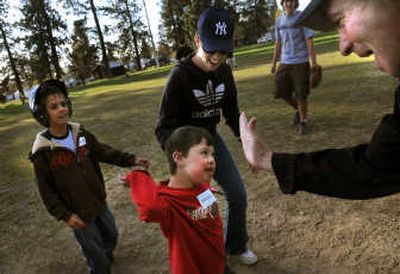
The Challenger division accepts boys and girls from 5 to 18 with all types of physical and mental disabilities. Each player gets a turn at bat. If they’re unable to connect with a pitch, players can use a tee. Every time a player hits the ball they get to run to base. No umpire is needed because there are no strikes, fouls or outs. When the bases are loaded all the kids get to run home after the final batter swings.
In its first season, the West Plains Challenger Little League had 20 players from all over Spokane and Spokane Valley. This year the number of players has more than tripled, and North and South Challenger divisions have been added.
Heather Sutherland coordinates the South Division. Her 7-year-old son, Parker, is a baseball fanatic. He can name every Seattle Mariners player and mimic Ichiro’s mannerisms. Sutherland said playing Challenger Little League baseball was the highlight of their year. “We drove all the way out to Cheney, but I would have driven farther,” she said.
The South Division has 27 players, many who drive in from Spokane Valley. The Challenger Little League hopes to add a Valley division next year.
“It’s for every child, regardless of disability,” Sutherland said. Her son suffers from a chromosomal disorder that leaves him with low-muscle tone. “He can’t really go up and down stairs yet,” she said. “And he wears hearing aids.” But none of that stops him from playing ball with his team.
Leslie Sigrah coordinates the North Division. “I got into it because both of my kids have disabilities.” She said the best thing about the league is the positive experience it creates for the children.
“I would never put my children in a place where they’d feel they couldn’t keep up,” Sigrah said.
On game day 10- to 12-year-old players from Major Little League volunteer to serve as buddies, so the parents can watch from the sidelines. Each Challenger player is assigned a buddy, who stays at bat with them, helps them navigate the bases and offers encouragement in the outfield. The Challenger players enjoy having players from the majors assist them.
Because of the wide range of special needs, parents or guardians are required to accompany their children to practices. At a recent North Side practice, sounds of cheering could be heard blocks away from Webster Park where the children gathered.
Linda Rogers had brought her son, Lance. “I never in a million years thought he would be able to do something like this,” she said. Lance has been blind since birth. She brought a special baseball that makes electronic sounds. “Atta boy, Lance,” his coach yelled as Lance connected with the ball. With his mom by his side, Lance ran to first base. “Feel the base with your foot,” she encouraged.
Then it was 9-year-old Megan Riley’s turn at bat. She gripped the bat with a determined glint in her eyes. “You can do it, Megan,” cheered the coach. She connected and took off for first. When asked if she likes baseball, Megan said, “I love it,” and beamed. “I hit the ball! I hit the ball!”
On the sidelines Diana Russell cuddled with six6-year-old Joey. Joey wasn’t feeling well but didn’t want to miss practice. His brother, Jaysen, scampered off to the infield. Russell said Challenger Little League has given her sons a chance to be normal – to be like other little boys their age. Joey has Down syndrome, and Jaysen is a high-functioning autistic.
Organizers of Challenger Little League are hoping the community will respond when they see how much fun these kids are having. They are always in need of coaches and volunteers. As Diana Russell gave 8-year-old Jaysen a quick hug, she said of her sons, “This is a chance for the community to see their disabilities don’t define them. It’s just part of who they are.”