
A softer side of cactus
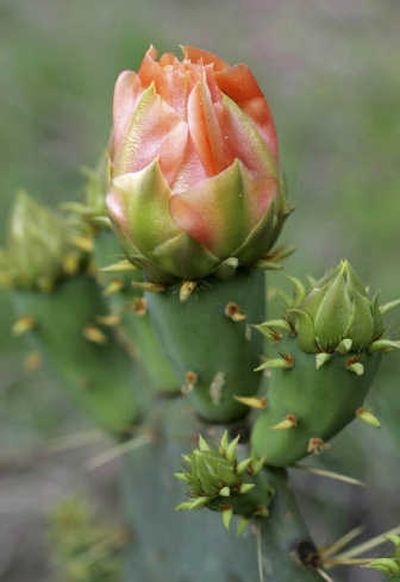

FRESNO, Calif. — The first thing that often comes to mind when one thinks of a cactus is the giant saguaro — tall arms curving upward, large spines that warn creatures not to get close.
But while many cactuses can be prickly by nature, they do come in all shapes and sizes. Many have spiny thorns, but others have fuzzy hairs. Some have smooth surfaces.
No matter the shape or size, though, all cactuses have one feature you might have not known: flowers — which, like the plants themselves, come in many varieties.
“Some have very tiny flowers that you might not notice,” says Clovis, Calif., resident Sue Haffner, president of the Fresno Cactus & Succulent Society. “Some have great big flowers. … Most cactus flowers last a day or two and bloom once a year.”
While their sometimes-scary spines might keep you away, don’t let them deter you from growing cactuses in pots on your patio.
Cactuses are succulents, but not all succulents are cactuses. What the majority of cactuses have, and what helps define them, are areoles, Haffner says. Areoles are the tiny spots “where the spines appear and also are potential growing points. They’re also where flowers appear.”
Cactuses, which are native to North and South America, come in various shapes, including small and round, such as Mammillaria candida; columnar, such as Trichocereus bridgesii; and cylindrical or barrel shaped, such as Ferocactus cylindraceus.
Other interesting characteristics that some cactuses can have include fuzzy hairs, needlelike spines and smooth pads.
As for the flowers, they come in almost any color, says Paul Mitchell, the cactus curator at the Discovery Center, an educational science center that includes the Deutsch Cactus Garden in east-central Fresno, Calif. Colors include red, pink, white, green and yellow.
“Cacti flowers are characterized by many, many petals and many, many stamens,” he says, adding that by “many,” he means more than 10 petals and stamens each.
On barrel cactuses, the flowers form a ring at the top, while on columnar cactuses, the flowers generally are tubular and bloom on the sides.
Cactus flowers can be “intense,” Haffner says. “Their petals almost seem satiny and like they glow. When they’re fully open and in the sun, they really shine.”
Most cactuses that are grown in the Valley bloom this month or next. A few, such as barrel cactuses, will flower in the summer or fall.
You can grow cactuses by seed or with cuttings. Cactuses also are available at nurseries and garden centers.
Cactuses can be grown in the ground or in pots. However, smaller cactuses, such as Mammillarias, tend to be grown in containers so they don’t get lost in the landscape. Pots also allow for easier control over the growing conditions.
Whether you grow them in the ground or in a pot, cactuses need well-drained soil. You can add about a half-and-half mixture of pumice or sponge rocks to a bag of potting soil, screening out any large pieces of wood or bark, Haffner says. If you use a container, make sure it has drainage holes at the bottom.
While cactuses are drought-tolerant and can usually grow in full-sun exposure, some shade wouldn’t hurt, especially if you’re transplanting when it’s hot. Sometimes, cactuses can get sunburned.
“Most commonly, it’ll be a bleached-out area where a green plant will turn yellowish-tannish and get scaly,” says Charlene Stebles of Clovis, who also is a member of the society and a Fresno County Master Gardener. “So you have to protect them or rotate them in the pot, turning them 180 degrees.
As for watering, “different cactuses need different amounts, but most can go weeks without water,” Mitchell says.
In general, water when the top several inches of the soil are dry, Haffner says. “If you’re not certain, wait another day to water,” she says. “It won’t die overnight.”
Feeding them fertilizer is optional. Haffner recommends a diluted 20-20-20 fertilizer several times a year in the spring and fall. In early spring, a diluted 0-10-10 fertilizer also can be used as a bloom booster.
Stebles started growing them eight years ago. She has a cactus garden that includes 300 different kinds of cactuses and other succulents.
“The plants are just so unique,” she says. “I just like to have something that’s a bit of a challenge, but not dedicate my life to them.”
She also likes that cactuses are low-maintenance. “We travel a lot,” she says. “You can go off and leave your plants. They’re fine almost any time of the year for a couple of weeks.”
As for the flowers, “I have orange, purple, pink, red, white and green ones,” she says. “They’re outdoing my roses like you couldn’t believe.”