
UW issues honorary degrees to WWII internees
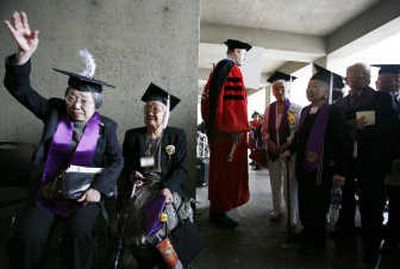

SEATTLE – More than six decades after their lives were shattered by the internment of Japanese-Americans during World War II, about 450 former University of Washington students have been awarded honorary degrees.
Relatives wept during the ceremony Sunday to honor students who were forced to leave the university in 1942. They were among 120,000 ethnic Japanese relocated under an executive order signed by President Franklin D. Roosevelt.
“The message of today’s event is a simple one, and one that I believe none of us should ever forget,” said former Secretary of Transportation Norman Y. Mineta, a former internee, in his keynote address. “It’s never too late to do the right thing. It’s never too late to rejoice that the right thing has been done. It’s never too late to be grateful to people who do the right thing.”
Before the internment, ruled illegal decades later by the Supreme Court, the University of Washington had more Japanese-American students than any college in the country except the University of California, Berkeley.
In short order they went from studying in libraries and dormitory rooms and hanging out at the Japanese Student club in the city’s University District to being confined behind barbed wire, many at Camp Harmony on the Western Washington Fairgrounds in Puyallup, east of Tacoma.
Some received diplomas from the university there a few months after being relocated after the school’s appeal to allow them to attend graduation with their classmates was rejected by the Army.
Honorary degrees were presented to at least 65 former students, mostly in their 80s, and 110 relatives representing others who had died or were unable to attend.
Many recipients recalled the turmoil after following the Japanese attack on Pearl Harbor that drew the U.S. into war Dec. 7, 1941. Evacuation notices were issued the next spring.
“It still seems like a nightmare to me,” said Teru Nakata Kiyohara.
Like many former internees, she later earned a four-year degree at another school.
The UW Board of Regents voted in February to award the honorary diplomas, partly because of a two-part series of articles that ran two years ago in the alumni magazine Columns.
Tetsuden Kashima, a professor of American ethnic studies, petitioned the Board of Regents to award the degrees after he and some library staffers researched the plight of the former students.
Awarding the degrees was the most important action any of the regents have taken during their tenure, board Chairman Stanley H. Barer said during the ceremony.
“I know this degree is called an honorary degree, but in no way should that signify that those of you (here today) did not fully earn your degree,” Barer said. “The term ‘honorary’ means that you earned it in the most honorable possible way.”