
Landmarks: Aubrey L. White Parkway
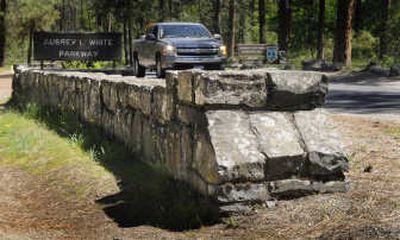
Driving or biking along the Aubrey L. White Parkway in Riverside State Park just west of Spokane is a ride through some of the region’s most striking scenery – along a rushing river, amid ponderosa pines and Douglas fir and beneath vertical basalt cliffs.
It is also a ride along miles of rock walls beautifully built by the Civilian Conservation Corps during the 1930s, a ride through a period of history that left a legacy of respect for the natural landscape. And in May, which is National Historic Preservation Month, how timely it is to look at some seemingly ordinary, but historic, structures – those rock walls – along this stretch of roadway.
After all, not all landmarks are statues, monuments or buildings.
The Aubrey L. White Parkway is a 3.3-mile semi-loop beginning at the west side portal near its intersection with Government Way, moving north, crossing the Spokane River near the Seven Mile Bridge and heading south again and ending at the east side portal near Downriver Golf Course. Much of it was originally intended to be a railway to supply ore for a smelter along the eastern banks of the river, where the Spokane Rifle Club is now located. That rail line was only partially built, but the smelter was completed sometime before 1920; however, the smelter-railroad plan never really caught hold.
Historical records show that Spokane businessman Aubrey L. White was inspired by a 1908 report prepared by the noted Olmstead Brothers landscaping firm of Boston, which called for a system of parks and scenic parkways in the Spokane area. (A centennial exhibit about the Olmstead Brothers is now at the Northwest Museum of Art and Culture.) White helped form the Spokane Parkways Association, which was instrumental in the creation of the parkway that would come to bear his name, along with Rutter Parkway, High Drive and Mount Spokane Road, among other contributions.
In 1933 the Civilian Conservation Reforestation Act was established and provided work for men during the Great Depression to help build roads and recreational facilities under the direction of the Army. CCC Company 949 was located at Camp Seven Mile on the west side of the Spokane River, and it was this group that built the parkway.
The men of Company 949 widened the old smelter road/railroad right of way to make it useable for a modern road – all done with pick and shovel. The first portion of the road was built by about 1936 and completed approximately two years later. It became the principal road through Riverside State Park, which itself was created in 1933.
The CCC constructed stone columns at the east and west end of the road as official entry portals to the parkway, as well as miles of rock walls, some as long as 1,588 feet, along the road. They were made of native basalt with occasional use of granite, and most were dry-stacked, according to a report done by Eastern Washington University’s Archaeological and Historical Services in 2006. The report, which evaluated the historical significance of the stone features along the parkway, remarked at the excellent construction of the stone structures.
Some of those rock walls are deteriorating now and some have been repaired or replaced, but they are all examples of the excellent craftsmanship that CCC workers were known for. The AHS report notes that it is quite easy to distinguish the original CCC work from the modern repairs, with the former judged to be far superior.
In the original walls, only a few are mortared, but where there is mortar, it “was done in such a way that the mortar is not visible, giving the structure the appearance of a dry stacked wall.” The report notes that the entire Aubrey L. White Parkway and the CCC-associated rock walls and portal structures are eligible for listing on the National Register of Historic Places.
This would be just the right month for such a unique group of landmarks to find an advocate for National Register listing.