
More than ‘cutting the blue wire’
WHIDBEY ISLAND NAVAL AIR STATION, Wash. – Six brass plaques with the names of six fallen sailors face visitors entering the headquarters building.
They are unusual in the way they were created – by detonating a thin sheet of explosive over a plastic template, imprinting the names and design on the brass. The only sailors who make them are explosive ordnance technicians.
This is the headquarters of the Navy’s Explosive Ordnance Detachment Mobil Unit 11, more simply called the EOD. The six were fellow bomb disposers, all killed in Iraq.
This highly select, perpetually tested band of 160 sailors are known for their cool under pressure. Their training never seems to end: underwater diving, parachuting and practicing ground warfare. They test themselves constantly to outthink bomb makers.
What attracted many to undertake the work was the chance to save lives and bring peace to people’s sense of safety by neutralizing bombs.
“What drew me toward EOD is that it’s a defensive tool. We are protecting our troops, coalition forces and the civilian population. … I wanted to do more to help America by protecting troops; someone has to watch their back,” said Lt. Nicholas Parker, 27, from Alexandria, Va., who served from October to April with EODMU 11 in Iraq.
Since the war’s inception, Whidbey’s unit has been rotating platoons in six-month deployments to Iraq. Their main job has been to hunt and remove safely the leading killer of U.S.-led forces troops as well as Iraqi civilians: the bombs planted in cars, houses or beside the road known officially as “IEDs,” or “improvised explosive devices.”
The EOD techs of Whidbey Island have paid a high price.
Navy Chief Petty Officer Gregory J. Billiter, 36, of Villa Hills, Ky.; Petty Officer 2nd Class Curtis R. Hall, 24, of Burley, Idaho; and Petty Officer 1st Class Joseph A. McSween, 26, of Valdosta, Ga., were killed April 6, 2007, when their convoy was attacked.
Two more members died on July 17, Chief Petty Officer Patrick L. Wade, 38, of Key West, Fla., and Petty Officer Jeffrey L. Chaney, 35, of Omaha, Neb., in combat. On Nov. 5, Petty Officer 2nd Class Kevin R. Bewley, 27, of Hector, Ark, was killed when an IED exploded.
While bombs like IEDs were used in Vietnam, they have become the weapon of choice for insurgents in Iraq.
“It’s an indiscriminate killer; they (insurgents) don’t care who is in a truck or who they are,” aiming the weapons at troops and civilians, adults and kids, said Petty Officer 1st Class Karl Krahn, 28, a 10-year EOD veteran from nearby Edmonds.
The most common public misconception of their methodical work comes from Hollywood, Krahn said.
“Cutting the blue wire,” he said. “They think it’s like the TV show … where people take apart bombs in their hands. It’s a little more complicated than that.”
Parker said the procedures and techniques of the IED “are generally pretty simple but the thought process, the understanding of what you are looking at, and understanding what you need to do and ordering (someone) to do it, that’s the hard part we train for.”
“Because you watch us do something on one mission doesn’t mean it will be the same on the next,” he said.
The EOD members won’t discuss details of their experiences or methods – even the number of bombs handled. Bombers and bomb disposers play a game of cat and mouse.
“A lot of times we knew we were constantly under watch and knew they wanted to find out what we were doing, and what we used and how we do it,” Krahn said. So the unit tried to keep its methods secret.
While modern technology, particularly cell phones, reportedly has been used to trigger bombs, Parker said “some of the devices are the simplest things ever seen. Just a wire, whatever they have available. Just use imagination.”
Krahn said IEDs comprise everything from artillery shells to fireworks, “anything that is modified beyond its original design to harass or maim. Simple low-tech weapons that are very effective.”
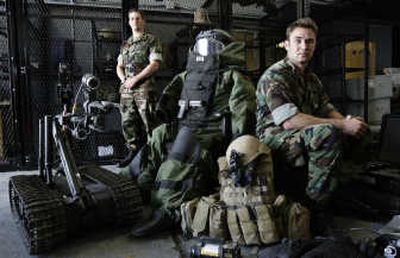
The group draws upon extensive tools they have mastered. Underwater, they have self-contained breathing apparatus that does not release bubbles, the noise from which could trigger an acoustic mine. On the ground, they use a variety of tools: devices to pry open car windows, portable X-ray machines, fiber scopes for looking under doors and in packages, robots and a heavily armored bomb suit. Each carries an M-4 rifle.
Overall, the goal is “to make a device a nonexplosive hazard as safely as possible, to protect life and property,” Parker said. “At some time if it is too dangerous or too much is unknown, it will be detonated.”
And, said Krahn, there’s a time to reach for the pliers. “If there is a bomb in a building with people inside who can’t get out, then you cut the blue wire.”
The Navy has about 1,200 officers and enlisted men in its EOD units.
It’s not an easy group to get into.
“Eighty-five percent is the minimal passing grade; most deductions in a test are 16 points, so if you get one thing wrong, you fail,” Krahn said.
Since their jobs include mine countermeasures and entering remote ground areas, they are trained in diving and parachuting. Physical standards include a 500-yard swim. A stress test includes having one’s gear messed up and tied in knots and sent to the bottom of the pool. Evaluators want to see who keeps it together to straighten out the mess calmly and who panics and shoots to the surface.
“We’re all the same, type A, a good bunch of dudes, definitely a fraternity, and it’s not easy to get into our club,” Krahn said.
His service took a toll on his personal life. Single, Krahn said that during his recent deployment “my girlfriend didn’t make it to Christmas. She couldn’t handle the separation.”