
Tutor receives national award
There’s no text messaging, answering cell phones or any sort of socializing allowed.
When Lake City High School students come to Frank “Bulldog” Bittick’s Teen Aid Project, they’re boarding Bittick’s “tight ship.” They’re expected to spend an entire hour focusing on homework and nothing else.
“If they say, ‘Why?’ I say you have 23 hours to do the socializing,” said Bittick, who started the free after-school tutoring program eight years ago. Nearly 300 Lake City students have raised Fs and Ds to Bs or better with the help of Bittick and volunteer tutors.
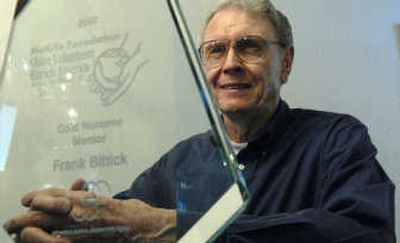
The 80-year-old Coeur d’Alene man traveled to Washington, D.C., this month where he was one of 25 senior recipients of the MetLife Foundation’s Older Volunteers Enrich America Award.
A former teacher, principal and school superintendent, Bittick began substitute teaching once he retired.
“I became really concerned about the students who are failing,” said Bittick. He researched and found only 70 percent of high school students nationwide graduate on time and more than 1 million students quit school altogether.
Locally, a quarter of Lake City High freshman had four or more Fs by the time they were midway through the school year, Bittick said.
He started Teen Aid, which he said is a program that works.
About 60 to 70 percent of students who stay with the program six weeks or longer improve their grades, he said.
“These students have no direction,” he said. “They don’t have a clue as to what’s important. If they don’t like the subject they don’t do the homework. If they don’t like the teacher they don’t do the homework. So they fail.”
Failure, Bittick said, breeds failure.
Teen Aid, which runs solely on donations and grants, teaches students to focus and stay on task, he said.
They arrive each afternoon when school lets out, load up a plate with snacks prepared by volunteers and get to work, one-on-one with a volunteer tutor. There are about 40 volunteers, Bittick said, including retired teachers, engineers, doctors and dentists.
“They’re people who are really interested in students’ progress and helping students get through these difficult years,” he said. In his awards speech, Bittick said he thanked those volunteers. He said they, too, deserve credit for the program’s success.
“I think in the long run we have made a difference in their lives,” Bittick said. “We’ve shown them we care. We give them a chance of securing a job and making it in the adult world.”