
Elegant treehouse may be torn down
FALL CITY, Wash. – The moon told Pete Nelson where to build a treehouse.
He and his wife, Judy, were visiting the property they had recently bought on the Raging River near Fall City.
As they looked across the wooded hillside, a circle of moonlight illuminated the trunk of an old-growth Sitka spruce. “That’s a sign,” Nelson said when he awoke the next morning. “I have to build in this tree.”
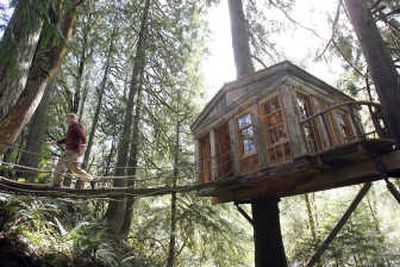
Now Nelson, perhaps the world’s best-known promoter, designer and builder of treehouses, is in trouble with King County code enforcement officials for wrapping an elegant one-room house around the spruce, 20 feet above the ground.
They say Nelson built the house in a flood-prone area where construction is prohibited, and have ordered him to tear down, by June 30, the structure he calls the Temple of the Blue Moon. He’s appealing the order.
Nelson’s situation has some Metropolitan King County Council members wondering if they should make treehouses legal in “critical areas” such as river buffers and steep hillsides where all construction is now banned. Their decision could help define the vague legal status of a new generation of luxury perches built by adults for adults.
Reached by an “Indiana Jones”-style suspension bridge, the rustic red-cedar exterior of Nelson’s treehouse echoes the lines of the Parthenon. The interior showcases yellow-cedar window frames, walnut floors, a walnut-and-cherry cabinet, a queen-size bed with a frame of salvaged redwood, an incinerator toilet and windows with a luscious view of foliage, river and deer.
If built for a paying customer, such a treehouse would cost about $100,000.
The county Department of Development and Environmental Services ordered Nelson to stop work on the house in 2006, but he decided to keep building. “I’m never going to get anybody to agree with this kind of structure if they can’t see it,” he figured. “I’ll finish it knowing there’s a risk they’ll make it come down.”
Nelson admits the treehouse isn’t legal because it’s within 165 feet of the river, but he thinks the law should be changed to allow treehouses as an environmentally benign, low-impact use.
The Nelsons, who have lived in Fall City for 14 years, bought the nearly four-acre Raging River property in 2006 with the intention of operating a bed-and-breakfast that could accommodate small retreats, group dinners, treehouse-building workshops and the occasional wedding. They would put up guests in treehouses as well as in a conventional house on the land they call TreeHouse Point.
To DDES officials, the immediate issue is simple: Nelson violated laws that protect environmentally sensitive shorelines and keep people safe during floods so powerful they change the shape of rivers.
“You can build treehouses. That’s not the issue. It’s the location of them,” said DDES Director Stephanie Warden.
The Nelsons first attracted attention from the county after cutting down two cottonwood trees Nelson feared would drop limbs or topple onto his driveway. They didn’t have a permit to cut trees in a river buffer, and county inspectors paid a visit.
Over the following months, inspectors found other violations, among them enlarging a shop building to include a small apartment, and opening a bed-and-breakfast and an events center without meeting required conditions.
As “a spontaneous guy,” Nelson says, he was too impatient to wait for permits for the bed-and-breakfast. “I was going to beg for forgiveness rather than ask for permission. … I made a mistake and I’m anxious to correct that.”
Nelson, 45, has written four books on treehouses since 1994 that have drawn a growing number of kids and adults into the forest canopy. His first book, “Treehouses: The Art and Craft of Living Out on a Limb,” has sold 150,000 copies, and he is now writing a fifth book. When Nelson, a commercial homebuilder who first built treehouses as a child in New Jersey, got his first book contract, he assembled a team to build a circular, wood-shingled structure high in a Douglas fir on a friend’s property on Salt Spring Island, British Columbia.
In 1997, he and Jake Jacob, a timber-frame builder and wood recycler, formed TreeHouse Workshop. Since Nelson went full-time with the business three years ago, the partners and their small team of carpenters have built 100 treehouses, from the simple to the complex, in 30 states. Last year the company, the largest for-profit treehouse builder in the country, grossed $1 million, he says.
People who build treehouses for fun or profit rarely seek government approval.
Nelson, whose appeal is to go before a hearing examiner, says it’s embarrassing to find himself on the wrong side of the law but adds, “It’s kind of an outlaw’s game; it’s got that Huck Finn thing to do with it.”
He leaves it to his customers to decide whether to apply for a building permit but advises them to at least make sure their neighbors have no objections. DDES chief Warden said she isn’t aware of any treehouse in the county built with a permit.
The County Council amended the law last year so building permits are no longer required for treehouses no larger than 200 square feet (or about 14 feet by 14 feet) “used for play and similar uses.” Nelson last year framed, but hasn’t completed, a house in a cedar at TreeHouse Point that appears to comply with the law.
At 256 square feet, however, the Temple of the Blue Moon is big enough to require a permit. It’s also in a no-build river buffer and “channel migration area” where officials believe the river could carve a new bed. Nelson agrees the treehouse is within the buffer but says his own survey shows it’s outside the channel migration area.
Nelson’s land-use consultant, Paul Carkeek, claiming that treehouses have no environmental impact, has lobbied the County Council to allow them in critical areas on a trial basis. Democratic Council members Bob Ferguson and Larry Phillips have responded that they will study the issue. Republican Kathy Lambert, of Redmond, who represents Fall City, is enthusiastic about the idea.
Nelson won’t tear down the Temple of the Blue Moon as long as he has hope the County Council and county executive will legalize it.
“It’s about treehouses,” he says, “it’s not about Pete and Judy. It’s about being allowed to enjoy that kind of property. … For that to be taken away from all of us seems a little bit draconian. They’re treehouses, for crying out loud.”