
McCain needs Bush, but at an arm’s length
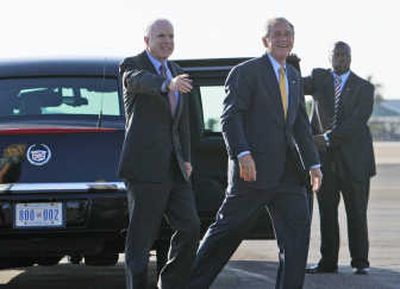
SCOTTSDALE, Ariz. – When President Bush ventured here for a private fundraiser with John McCain Tuesday night, his first real campaign appearance with the presumptive GOP nominee, the event was closed to the news media and featured only a brief photo op on an airport tarmac.
The same ground rules will cover Bush’s trip to Utah today, where he will appear with former presidential candidate Mitt Romney to woo big-money Republican donors to McCain’s cause.
The fleeting public appearances of an unpopular president on behalf of the potential heir to leadership of the Republican Party underscores the delicate balance for McCain, who is trying to appeal to a restless GOP base that continues to embrace the president while reaching out to moderates and independents who want to move beyond the Bush administration. For now, the senator from Arizona remains locked in a tight race for the White House – evidence that Americans see him as a brand apart from the GOP.
Whether McCain can continue soaring above his ailing party or find himself crashing down to Earth with it, could determine whether Republicans retain control of the White House next year.
“That’s the $64,000 question,” said House Minority Leader John Boehner, R-Ohio.
“It’s the million-dollar question,” said House Democratic Caucus Chairman Rahm Emanuel, D-Ill. “Nobody knows.”
McCain’s polling numbers are strikingly at odds with those of his party and his president. In a Washington Post-ABC News poll this month, voters said, by a 53 percent to 32 percent margin, that the Democratic Party is better positioned than the GOP to deal with the country’s main problems. But asked who they favored more for the presidency, Democratic front-runner Barack Obama or McCain, Obama had a substantially smaller edge, 51 to 44 percent.
“John McCain is a tremendous asset for us,” said Rep. Tom Cole, R-Okla., chairman of the National Republican Congressional Committee, which is charged with electing Republicans to the House. “He’s running better in this environment than most Republicans because he’s established a reputation for integrity and a bias for action.”
To Democrats, and some Republicans, McCain’s current act of levitation is ephemeral. The protracted Democratic nomination battle has allowed him to maintain his independent brand and minimized incoming fire from Democrats.
Bush is mired in the lowest sustained approval ratings in polling history. The war in Iraq is as unpopular as ever. Eight in 10 Americans see the nation as on the wrong track. And the teetering economy makes the election of a member of Bush’s party exceedingly unlikely, according to statistical models of past elections.
“McCain at least has the credibility with independents to get them to take a second look,” said Glen Bolger, a Republican pollster. But, he added, “things will get worse for McCain.”
From now until November, much of the presidential campaign will revolve around Democrats trying to equate a McCain victory with a third Bush term and McCain trying to remain a breed apart.
“It’s not a matter of, quote, separating,” McCain said recently. “I think it’s more a matter of presenting my own plan of action.”
In the early stages of his general election campaign, McCain is opting to avoid a sharp rupture with the White House: He has offered critiques of Bush on the response to Hurricane Katrina, global warming and the interrogation of terrorism suspects – and on Tuesday he presented a nuanced difference on nonproliferation policy – while backing the president’s general approaches to Iraq, health care and tax policy.
But as this week’s events make clear, McCain also plans to take advantage of Bush’s considerable fundraising muscle to replenish his coffers for a tough general election campaign in which he appears likely to be at a financial disadvantage.