
Empowering elementary school readers
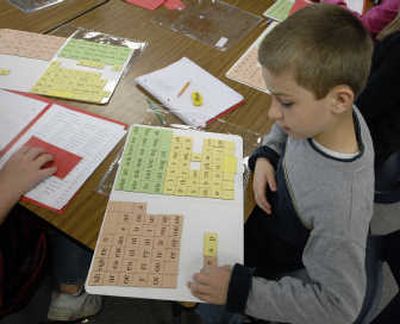
A pilot reading program at Trentwood Elementary School has been going gangbusters in its first year, with some students more than doubling the number of words they can read correctly in a minute.
The school’s Power Readers program is one of only four in the state paid for by a two-year Washington State Lorraine Wojahn Dyslexia Pilot Reading Program grant. The grant gives each school $60,000 per year to run a reading program for students with dyslexia or some of the characteristics of dyslexia. The money pays for a teacher and supplies.
The school had a strong K-2 reading program, but was lacking in grades three through five, said program coordinator Kasey Pitts. The Power Readers program helps 32 students in the upper grades. Nineteen of those meet with Pitts in small groups, others use the district’s Read Naturally program to practice their reading skills. “Some kids just need that, they need practice reading,” she said.
“All of them increased their fluency,” Pitts said. “It’s really good.”
One third-grade student who read 47 words correctly in one minute at the beginning of the year can now read 105 words per minute correctly. A fourth-grade student has increased from 57 to 135 words per minute. Some students show smaller gains, but all have improved.
Students get into the program based on how well they perform on district reading assessments. Struggling readers are referred for either small group sessions or Read Naturally. The students come to Pitts’ classroom an average of 45 minutes per day four days a week.
“It’s very exciting,” said Principal Sigrid Brannan. “We get kind of silly about it, actually, how exciting it is.”
None of the students in the program has been diagnosed with dyslexia, Pitts said, but they show some characteristics of it. Dyslexia is not simply reading words backward. Readers with dyslexia take each letter individually and reorder them in their head rather then just sight reading the word as a whole. Students who read letter by letter are extremely slow and sometimes forget what they’ve read by the time they get to the end of a sentence, Brannan said. “It’s so laborious.”
There is evidence from brain scans taken of people with dyslexia to indicate that it’s a problem with the brain. “There is a genetic component,” Pitts said. “Their brain has been miswired. It can be rewired. You can teach it to work correctly.”
Part of what Pitts teaches her small groups is to visualize words. They work with phonic sounds, and she has them spell nonsense words just to get them used to how different letters sound together. “We do a lot of oral language exercises,” she said.
During a recent session with a group of students, Pitts had them pull out magnetic boards with letters and groups of letters on tiles. “Spell oyks,” she said, giving a made-up word. Students also practiced saying a list of phrases like “play it again” and “our best things.” “They need to practice sight words but they need to practice sight words in phrases,” she said.
A handful of cards with words such as horse and dog made their way around the group several times until Pitts quickly flashed the cards at students to see if they could recognize them quickly. Fourth-grader Dallas Beckett said she loves coming to Pitts’ classroom for Power Readers. “It’s really fun because we can actually learn,” she said. Beckett said she used to be a slow reader, but now her reading skills have improved so much that she reads books for fun outside of school. “I think (I’m) a lot faster than I was before,” she said.
Her mother, Monica Beckett, said she has noticed a huge improvement in her daughter’s reading skills. “Before I couldn’t get her to read,” she said. “She didn’t enjoy reading. I could tell that when she read out loud there were a lot of common words she didn’t know. Now she’s so much better. We’ve been going to the library and checking out books. I have to yell at her at night to turn off her light and stop reading.”
Beckett said her daughter’s improved reading skills have also helped her spelling and other subjects that require a lot of reading. “It has brought up her grades,” she said. “I think it has made a big improvement. I’m just thankful the school did get the grant and she was able to benefit from this.”