
Coastal creatures
Finally a planned trip to the Pacific coast arrives with the crashing waves, salty air, sandy beaches, spectacular rocky shorelines and warm sunshine.
After settling into overnight accommodations and walking on the beach what else is there to do? There are always gift shops and maybe even outlet stores. Tide pools and the creatures found there are another adventure to enjoy at the ocean.
They are called tide pools. Low tide will temporarily expose animals and plants in pools and on rocks that we in Idaho are not accustomed to seeing. Officially they are called intertidal areas. Some of the creatures are beautiful if you can find them. Oregon State Parks has identified 25 locations that offer some of the best places to explore.
From Ecola State Park near Cannon beach on the northern Oregon Coast stretching south to Winchuck Beach near the California border, these rocky places provide great tide pools to explore.
It never occurs to the first-time visitors watching the waves break over the scenic rocks and haystacks that there may actually be creatures clinging and living in such a hostile place. The interpretive ranger at Harris State Park, Angela Stewart, on a recent nature walk said that living things in tide pools are exposed to and withstand ocean waves that can create up to a million pounds of pressure per square inch. The rocks are pounded again and again as the waves crash over them.
Then there is the tidal rhythm and twice a day whatever is living there is either completely submerged or completely above the water line vulnerable to the hot sun, drying out and visible to predators like birds or raccoons looking for a seafood dinner. But searching these intertidal, rocky pools at low tide will reveal an amazing number and variety of plants and animals.
A tidal table is essential for successful tide pool exploring. The table gives the times when twice a day (a.m. and p.m.) the tide is at its highest and lowest. The chart shows two numbers for each tide, the expected highest and the lowest tide. The best tide pool exploration is when there is a minus tide like minus 1.0 or 2.0 feet. Although if the sea is calm (no waves) a foot or two positive low tide may reveal some pools.
It is a little confusing with some of the animals looking like plants and well, is a sea cucumber a plant or an animal? Some of the creatures are recognizable like sea stars (most of us who are landlocked still call them star fish). They seem to come in two colors: red and purple.
In either color they are called Ochre sea stars. They eat the mussels found on the rocks. Just when you think you know all about sea stars it is pointed out that there are also leather, troschel, six ray, bat, giant, sunflower, stimpson sun and Esmark’s brittle stars. Although the other stars are found less frequently than the very common and obvious Ochre they also can be found in the tidal pools. It is interesting how they can cling onto a smooth rock while being smashed by the powerful waves.
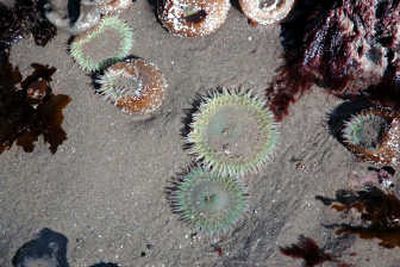
Another “tough guy” frequently found that seems deceptively delicate is the anemone. Found in lower tidal pools it is hard to miss because of its bright green color. This creature is round (up to 10 inches) with tentacles covering and circling its central mouth. It looks similar to a green sunflower. The tentacles have barbs that “harpoon” its prey and slowly move it to the central mouth for digestion.
The sea cucumber is an amazing animal. It does appear to belong on the dinner table, but is definitely an animal. It is able to travel and gathers food with tentacles found around its mouth.
The list of things to see in a tide pool is long: purple shore crabs, barnacles, urchins, mussels, oysters, limpets and many more. The best way to explore the pools is to have a field book with you containing photos or drawings and names with descriptions.
Even the 25 selected locations along the Oregon Coast can be disappointing if you arrive at the wrong times. Tide charts can be found all along the coast. Learn to read them and look for the negative low tides. Sometimes when the tide is low it still isn’t low enough to isolate the pools. To begin looking choose an ebb tide or follow the waves out as the water recedes. As the water drops the pools slowly appear below the surf.
Safety should always be on your mind. Never turn your back to the ocean. An usually large wave may come in and trap you against rocks, cliffs or drift logs piled high on the beach.
It is extremely temping to collect whatever you find. In a word – don’t. In most places along the coast it’s illegal. There are game wardens who can be watching, and it is considered poaching. The sea stars are probably the most vulnerable. Taking one home and expecting it to dry is simply wrong. It will only rot and smell very bad. Also they should be left for the next visitors to that tide pool. It’s not even recommended that you pick up the creatures because they won’t have a chance to reattach themselves to rocks before the next tide and waves.
Also take a pair of rubber boots with you. They will come in handy. Watch what you are stepping on when in a pool so that you don’t tread on the sensitive small animals. Take along a camera and capture lots of photos.
Finding tide pools ranks right up there with beach combing. It is an activity that is entertaining, fun and cheap. Consider going tide pooling on your next trip to the West Coast.