
Struggle with math adds up to crisis
The tab at the Spokane Valley hardware store came to $33.17.
The customer paid with a pair of twenties, and the cash register calculated the change.
But then the customer pulled two pennies from his pocket and placed them on the counter.
The clerk scribbled some figures on a notepad, scratched them out, wrote some more figures, and then apologized as she handed over the change.
“I think that’s right – is it?” she asked. “I’m no good at math.”
She speaks for a nation.
We’ve heard it so many times that it should come as no surprise that Americans are terrible at math and science.
It could be we’ve always had trouble figuring change and interest rates and making the conversion from Celsius to Fahrenheit. But now we’ve got standardized tests to provide proof, and global competition to make it matter more than ever.
And the results are ugly.
Take the WASL. Fearing that many kids wouldn’t earn their diplomas, Gov. Chris Gregoire last year delayed making the science and math portions of the state’s standardized test a high school graduation requirement. Last school year, 49 percent of sophomores passed in math and 40 percent in science.
And 46 percent of Washington students who go directly from high school into community or technical colleges are so ill-prepared that they must take remedial math. Many who go into four-year schools need help, as well – 13 percent at Washington State University.
Idaho students do better on their state’s standardized math test than Washington kids do on the WASL. Yet, when fourth-graders from both states are given a nationwide test administered by the National Center for Education Statistics, those from Washington did slightly better. Meanwhile, the Idaho Department of Education reports a “troubling trend” in which math proficiency rates drop between fourth and 10th grades.
Still, there are hopeful signs that the education system is responding to what an increasing number of scientists, educators, politicians and corporate titans are calling a crisis.
A few local examples:
•Gonzaga University’s School of Engineering and Applied Science has nearly doubled enrollment in 10 years and recently blessed a new science center. And Whitworth University is launching a drive to build a $37 million science building to accommodate a surge in students – from 40 majoring in the physical sciences in 2004 to 98 this year.
•At Odessa High School, 81 percent of sophomores passed the science WASL last year. Most Odessa students take physics, although it’s not a graduation requirement.
The town’s only science teacher, Jeffery Wehr, gets much of the credit for his students’ success and was named an “American Star of Teaching” in September.
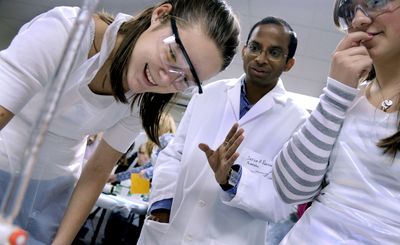
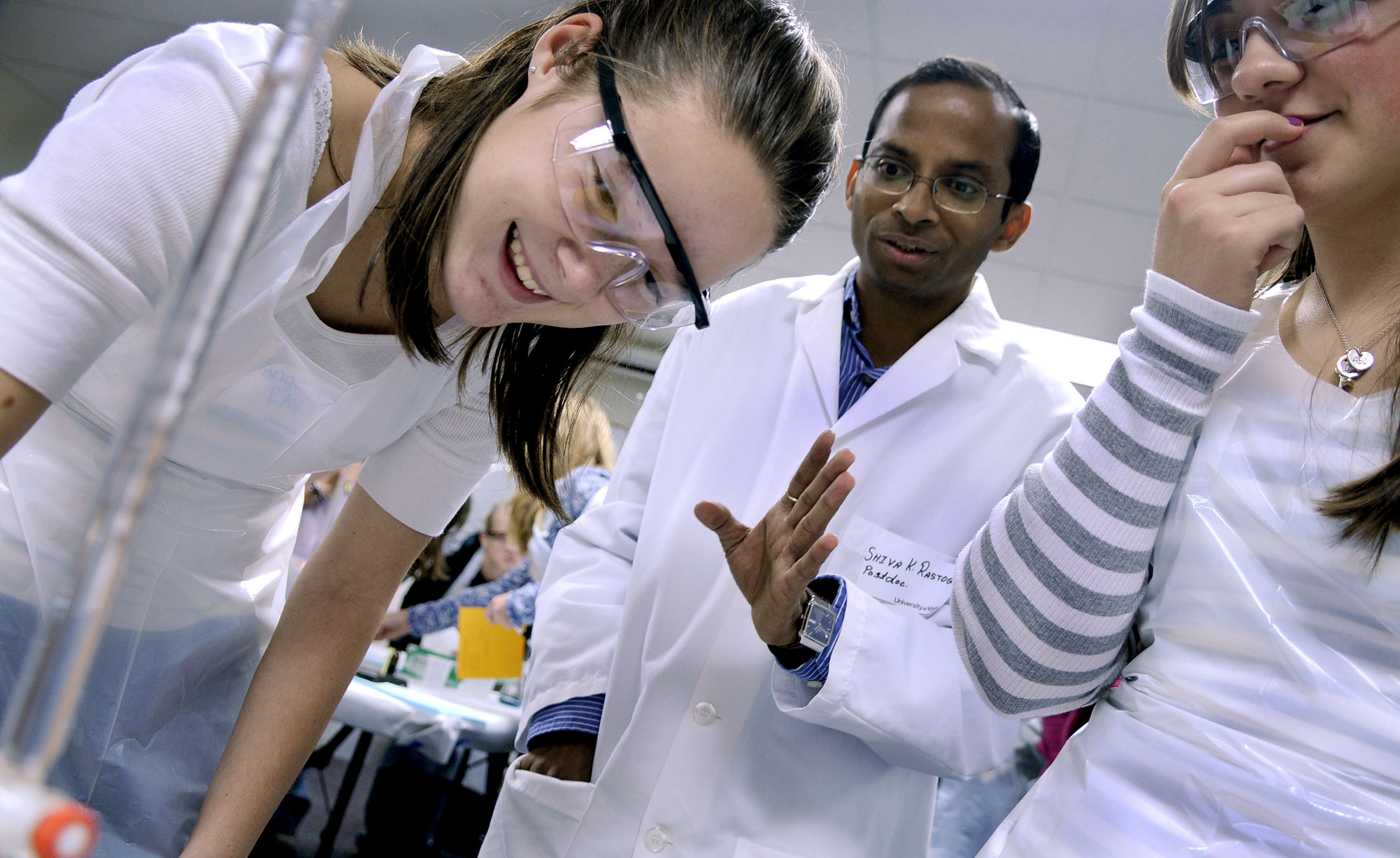
•With women representing a small percentage of math and science students nationwide – 20 percent, in the case of engineering – colleges are working to achieve balance and debunk the myth that girls are bad at math. The University of Idaho holds annual Women in Science workshops, including one recently for 150 girls from North Idaho high schools.
“Our country needs you, Uncle Sam needs you,” the girls heard from Scott Wood, interim dean of the UI College of Science.
Where the jobs are
“I love math and science!” Patricia Peterson, a sophomore from Post Falls High School, said at the Women in Science workshop. Following that passion might be good for the country, as Wood says. It certainly would be good for Peterson.
“There’s a plethora of jobs out there and the pay is good,” said Howard Peavy, associate dean for academics at the UI College of Engineering.
That’s especially true in Washington, which leads the nation in creation of jobs in math and the sciences because of companies such as Microsoft and Boeing, but ranks 38th among states for residents obtaining those degrees.
Last year, three-quarters of the seniors in WSU’s College of Engineering either had job offers at the time of graduation or were headed into graduate school, said associate dean Bob Olsen. Many others hadn’t yet started looking, he said.
More recently, staff at the College of Engineering had to start turning away employers after 140 signed up for a career fair.
In response to the demand, the state’s 2006 supplemental budget included $3.7 million to increase math and science enrollments at WSU and the University of Washington.
And starting with this year’s crop of high school juniors, the state wants to make a deal with top-tier math and science students who come from middle-class families. The payoff if they agree to study those subjects in college and then take an in-state job related to those fields: up to four years of free college tuition. So far, $5 million in taxpayer money and $1.28 million in private donations have been earmarked for the program.
The gathering storm
Kamesh Sankaran is the kind of success story America loves. Although his parents did not finish high school, he earned a doctorate in aerospace engineering and plasma physics from Princeton University while working under contract with NASA to help design electromagnetic plasma propulsion systems for spacecraft.
Along the way, he met Bill Robinson, president of Whitworth University. The two hit it off, and Sankaran has been teaching physics at the Spokane school for five years while continuing his NASA research, mostly during summer.
Born and raised in India, Sankaran came to the United States in 1993. He grew up admiring the country for putting a man on the moon and leading the world in aviation and nuclear physics.
Now Sankaran is among those sounding the warning about America’s decline relative to other countries.
“Throughout history there’s a very strong connection between economic might and technological superiority,” he said. “Those that had the chariots beat out those that didn’t. Those that had fire beat out those that didn’t. Those that had steel and iron beat out those that didn’t.
“It’s as simple as that.”
Speaking to a group of Whitworth supporters in September, Sankaran drew heavily from a 2005 National Academy of Sciences report titled “Rising Above the Gathering Storm.”
Commissioned by Congress, the report was written by a panel that included Nobel laureates, CEOs and university presidents, and was headed by Norm Augustine, the retired chairman and chief executive officer of Lockheed Martin Corp.
Among other things, the panel noted that a third of fourth-graders could not perform “even the most basic mathematical computations”; that half as many Americans received bachelor’s degrees in physics in 2004 as in 1956; and that foreign students receive more than half the doctoral degrees in engineering handed out by American universities.
Yet optimism was the response of many who read the report, because its 20 recommendations seemed so achievable. Among those related to education:
•Recruit 10,000 science and math teachers by awarding four-year scholarships.
•Offer $100 “mini-scholarships” to high-school students who pass AP science and math tests.
•Provide scholarships or fellowships for 30,000 people to specialize in math or the sciences in college.
Spurred into action, Congress last year passed the America Competes Act to take some of those steps, including teacher recruitment.
But once the fanfare died, money to start the work fell from a key budget bill. Augustine predicts that “a modest amount” of the needed $43 billion will be approved in the next six months, but nothing for the education initiatives.
“Frankly, it’s been disappointing when you see the amount of money we have to save banks and so on that we can’t invest some money to solve the fundamental problems the country faces,” Augustine said.
And what’s happened in the three years since the National Academy of Sciences unveiled its report? While the United States hesitated to act, other nations took the report’s recommendations to heart, Augustine said.
Saudi Arabia this year opened a new research university with a $10 billion endowment – as much as has been accumulated since 1861 by MIT. Britain has vowed to increase money for research and development by 25 percent. China is sending an ever-increasing number of students overseas to study engineering.
And in September, European scientists threw the switch on the world’s largest particle accelerator, a step that had physicists swooning. The United States scrapped a similar project in 1993 after spending $2 billion.
“U.S. scientists now are going to Switzerland and France, rather than the rest of the scientists coming here,” Augustine said.
Hope in the classroom
Ultimately, the hope for America’s future in technology rests not in Washington, D.C., but in Lake City High School, where sophomore Claire Lundeby takes honors science and math classes while planning a career in biochemistry.
It’s in West Valley High School, which this year began offering engineering classes, prompted in part by the popularity of the school’s fledgling robotics club.
It’s in Shadle Park High School, where Linda Hutchinson received a 2007 Presidential Award for Excellence. All of her students had passed the AP calculus test the previous year, and she’s inspired some to pursue careers as math teachers.
And it’s at Odessa High School, where junior Jessica Heimbigner is working on lead-free X-ray shields, which she plans to test at WSU and Odessa Memorial Hospital.
“I was thinking of infusing polymers or rubber with some sort of metal,” Heimbigner said. “But I’m now researching the element bismuth because that’s more cost-effective.”
Heimbigner spoke at the assembly where teacher Wehr learned he’d won the American Star of Teaching award. It’s because of him, she said, that Odessa students are taking advanced courses that aren’t required for graduation.
Wehr said he can tell when a student has decided science is fun. “You know you’ve got ’em when they (voluntarily) come in before school and finish a lab.”