
Your Guide to Green Gowns
From fabrics to fitting, here’s what one bride learned about walking the aisle in eco-friendly fashion
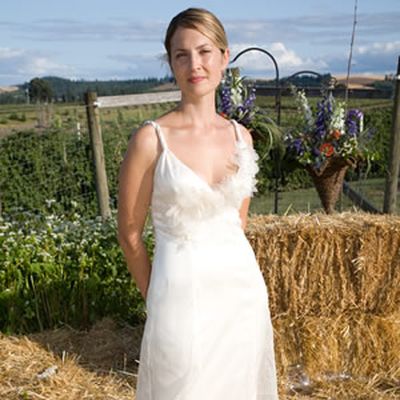
On my wedding day this past August, I wore a green wedding dress. Not green in the sense that I looked like a giant, feminine leprechaun – but, rather, “green” because the fabric used for my dress was both eco- and labor-friendly.
Now, I’d like to say that I walked into my initial meeting with Terri Spaeth-Merrick – owner and designer for both Embellish and Olivia Luca, two custom design studios in Portland, Ore. – with the health of our planet and fairness to its workers foremost in my mind, but mostly I was just trying to fit acquiring a wedding dress in with everything else I had to do. Not knowing what to expect at a home-based studio, I was thrilled when I entered a wonderland of white, cream and ivory dresses, all of which were so beautiful and elegant that I would have bought every single one of them off the hanger.
I tried on a variety of gorgeous dresses and together we began to design the dress of my dreams. Then it came time to select a fabric and I pointed definitively at a dress made from a rich, moderately shiny, ivory-colored fabric. I was shocked when Terri told me that it was hemp silk. I actually grew up a hippie kid, but I had always found the potato-sack nature of regular hemp fabric repellent. But this fabric was beautiful!
“There are very few fabrics that are shiny and flowy [but] don’t cling,” says Terri. “Hemp silk has a great hand feel to it and is super flowy, but it’s also quite forgiving to all body types and perceived flaws.”
And when she told me that this fabric was eco-friendly, and that the organza I had selected as an overlay was fairly traded, I was sold; my just-for-one-day dress was in step with my personal values and also would be gorgeous and chic.
And then I had my first fitting. The dress looked exactly like the one we had designed and the fabric was certainly flattering to my figure, but there was something wrong. I didn’t feel like a stunning woman about to celebrate what will hopefully be my one walk down the aisle, but, rather, I felt like a sweet little girl – maybe even a hippie girl – playing at being a bride.
Part of the problem was, yes, the fabric. Eco-friendly fabrics automatically have one strike against them because they are less formal and, like linen, have an unavoidable textured, slightly wrinkled nature.
But although these fabrics are generally less formal, it certainly doesn’t have to be that way – even Vera Wang has headed in the alternative, eco-friendly direction with her chic cotton bridesmaids dresses, calling the fabric fresh, clean and a favorite of hers this season.
In fact, some people may actually prefer the look of fabrics like cotton – simple, striking, muted – but the truth is that most people who choose “green” dresses are making an eco-conscious decision based on their perspective about the environment.
The relative affordability of eco-friendly fabrics is a bonus, but sometimes a bride just really wants to look elegant, too.
“The way a dress looks on you has to do with the shape, fit and cut,” says Terri. “Natural fabrics tend to emphasize the shape of the person rather than just the dress.” My dress was very pretty, but it wasn’t showing off the best parts of me.
So we took the straps from wide to narrow to show off my neckline, we nixed a little of the flowiness and tailored the torso to hug my curves and accentuate my narrow waist and, for the added flair that I wanted, we added couture-esque rough-edged fabric flowers in an asymmetrical line at the bust.
I returned for a second fitting and the dress was perfect – I looked like the supermodel version of me. The dress was chic yet romantic, the fabric serving to soften the sexier aspects of the dress and keep it from being too formal (I got married on a farm, after all). But there was absolutely nothing frumpy about it.