
Retired Furniture Finds New Calling
Transform old household items into great gardening containers in a few simple steps. Here’s how and why repurposing indoor furniture outside is considered the new “green”
What do a children’s swimming pool, used tires and a filing cabinet have in common?
They’re just a few of the unusual ways you can think outside the box – or planter – when it comes to gardening in containers.
“Anything is possible,” says Yvonne Savio, Common Ground Garden Program manager with the University of California Cooperative Extension program in Los Angeles County. “I’ve seen chairs, washing machines, filing cabinets and bedroom bureaus made into containers.”
As long as there is a way to drain the water from the container – either naturally or by punching a few holes – gardening experts say many items for you home and even your car can bypass the scrap heap to add an original look to your garden.
For an old chair, Savio says, simply remove the seat, put chicken wire and weed barrier cloth on top (for drainage and support), then add potting mix. Add another layer of chicken wire and weed barrier on top, shaping the mixture into a firm dome. Then you are ready to plant.
“It’s good for succulents because it doesn’t need so much of the potting mix as a base. It’s also good for petunias, begonias or Irish moss,” says Savio. “The plant should only be six inches tall when in bloom because you want it to be apparent that this is a chair.”
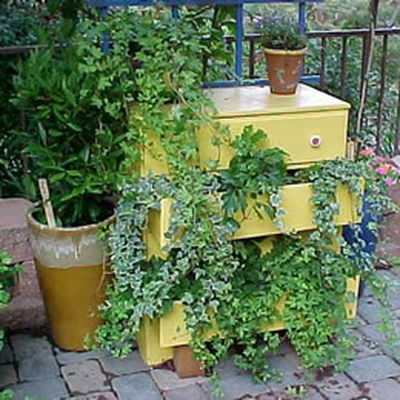
Transforming an old file cabinet into a planter utilizes all the drawers, since each drawer has holes in the bottom for drainage. Each drawer should be filled with soil or planting mix and, to prevent it from tipping over, Savio suggests anchoring the cabinet by using a lighter mix in the top drawer than the bottom drawer.
By pulling each drawer out like a staircase, you ensure that the top drawer does not block sunlight to the bottom drawers. Each drawer can be filled with the plant of your choice.
“It’s a great container because each drawer is more than a foot deep,” says Savio. “You want to choose plants that are going to be smaller when they put out their color. Pansies, roses, etc. The whole point is to have a spectacular view close in.”
Some containers can even roll right off your car.
Christopher Nyerges of Los Angeles, co-founder of the School of Self-Reliance and author of “How to Survive Anywhere: A Guide for Urban, Suburban, Rural, And Wilderness Environments” (Stackpole, 2006), has recycled old tires into potato planters. He starts by stacking four of them and filling the inside of the tires with a couple shovels full of compost, regular soil and straw. Then he takes potatoes from the kitchen that are too old to eat and plants a piece of the potato with the sprout (or eye) going out. He plants about three eyes per stack of tires.
“It’s all above ground and it’s very easy to do,” Nyerges says. “The way you harvest it is you just pull off the top two tires. You might get 10 to 20 potatoes per stack of tires.”
Bob Matthews, originator of the online community, the Gardener’s Network, has even heard of an unusual urban rooftop container.
“There was a lady who lived in a high rise apartment in downtown Los Angeles,” Matthews recalls. “Her kids had outgrown her kiddy swimming pool, which was on the roof above their apartment. She filled it with soil, planted pumpkins and let the vines trail across the skylight, providing shade. She got five or six pumpkins out of it. She was so excited.”
Perhaps best of all, using old and odd containers for planting gives going green a whole new meaning.
Says Savio: “You just have to literally think outside the container so that it can contain a whole new life as a new item in the garden.”