
Economic downturn forces automakers to put on brakes
Companies scaling back at auto shows
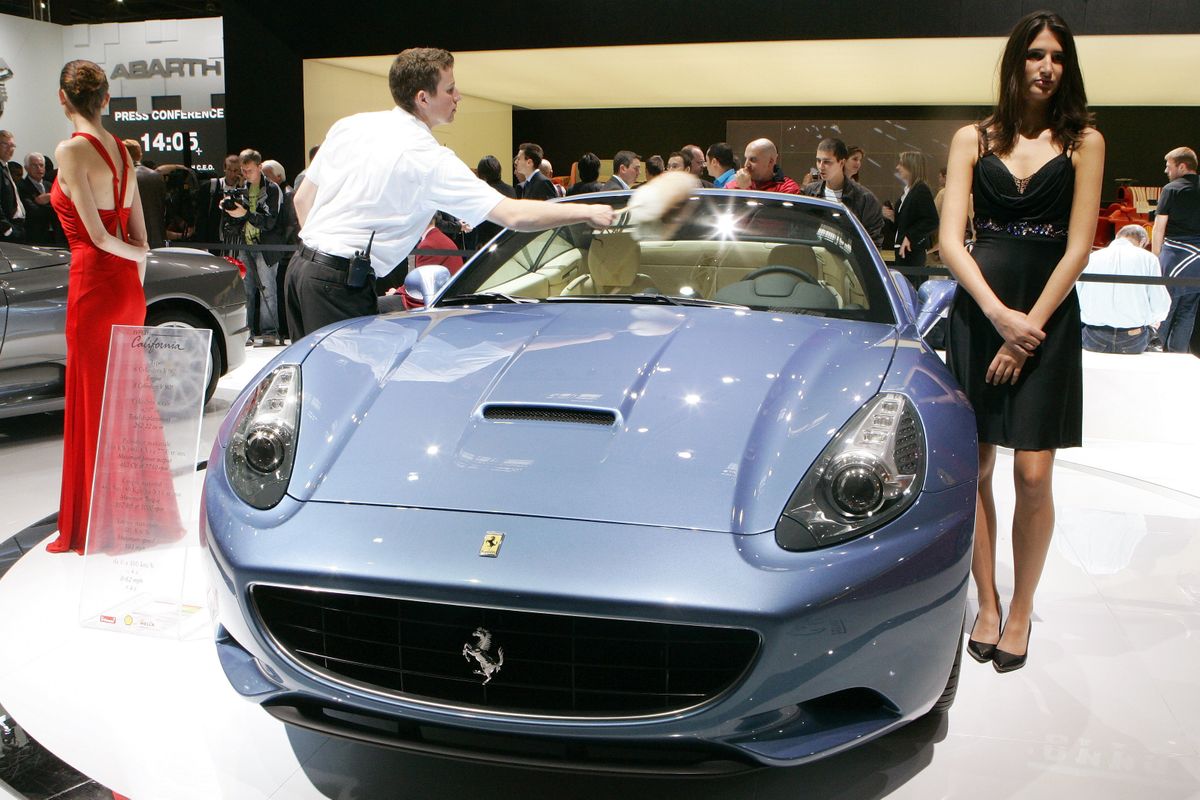
Facing their worst sales in decades, carmakers are cutting spending on auto shows, the industry’s traditional customer-courtship event.
General Motors Corp. has scrapped plans to debut its new Buick LaCrosse and the Cadillac CTS Coupe at the Los Angeles Auto Show next week and said Tuesday that it was canceling its only news conference planned for the event. Chrysler, meanwhile, said it would make local dealers pay for the company’s exhibition stand at the show and would reveal no new products.
Ferrari, Rolls Royce, Land Rover and Suzuki Motor Corp., meanwhile, are withdrawing entirely from the nation’s premier auto show, held in Detroit in January.
Those and other auto show cutbacks come as GM, Chrysler and Ford Motor Co. lobby for billions of dollars in federal aid, GM and Ford lost a combined $30 billion in the first nine months of the year, and GM said last week that it could run out of cash in the first half of 2009. Privately held Chrysler does not release financial results but is widely believed to be in dire financial straits.
Through October, overall U.S. auto sales are down nearly 15 percent compared with last year, and just one major automaker, Subaru Motor Co., has sold more cars here this year than last.
The car shows in Los Angeles, Detroit, Chicago and New York are traditionally the largest and most important. Drawing media to their new model and concept car introductions, they build buzz and then throw open their doors to potential buyers.
“Clearly, we’re affected,” said Andy Fuzesi, general manager and co-owner of the L.A. Auto Show, which has nearly 20 percent fewer exhibitors at this year’s show than last year’s, when nearly 100 companies paid to show their wares and more than 1 million people attended. “Everybody is clearly reassessing where they spend their money.”
Of course, not all automakers are pulling back. Ford is introducing six vehicles at the L.A. show, including two new hybrids, and is throwing a huge party for the debut of its 2010 Mustang redesign. “We have no plans to cut back on our show activity,” Ford spokesman Jay Ward said.
The nation’s second-largest automaker is planning to debut as many as five other vehicles at the Detroit show, according to a source at the company who spoke on condition of anonymity because he was not authorized to discuss such details.
For Suzuki, which sold 100,000 cars in the U.S. last year, spending money on the Detroit show no longer made sense. Suzuki’s sales here are down 12 percent this year, and with no new models or concept cars to introduce, the company decided to give up on the North American International Auto Show.
Instead, the company is hosting a small dinner for media. Subaru is avoiding the expense in transporting dozens of vehicles across the country and also saving the costs of renting floor space, sets and lighting, and employing a large staff at the booth. The savings, said spokesman Jeff Holland, were worth more than the chance to get a few thousand Michiganders in its four models.
“It’s a purely economic decision,” said Holland, adding that “this is no reflection on the people of Detroit or on the city.”
In August, GM also canceled GM Style, its huge kick-off media party at the Detroit show; a Chrysler spokesman Tuesday said the company was weighing whether to cut back on its legendary Detroit Firehouse party.
Some car companies aren’t pulling out of shows but are spreading the sauce as thinly as possible. Volkswagen this week canceled its news conference at the L.A. show — it had planned to debut a roadster concept car — and rescheduled for Detroit.
Chrysler, with a severely curtailed new-product schedule and sales that are down 25 percent through October, long ago decided not to hold a news conference in Los Angeles even though it has three new electric concept vehicles to show off — exactly the kind of fare that California audiences salivate over.
To reduce costs, the automaker is unloading the costs of running a display onto its network of Southern California dealers. A Chrysler spokesman called the move normal, but it raised eyebrows in the rest of the industry.
“Corporate usually shoulders a big part of the expense,” said Barry Toepke, a public relations executive at automotive company RWB who formerly ran PR for the L.A. show.
Of all carmakers, GM appears to be in the most difficult financial position. In July, it announced a $10 billion cost-reduction program and last week said it would cut costs by another $5 billion. On Monday, a Deutsche Bank analyst set a $0 12-month price target for GM stock, which promptly hit a 59-year low. It fell another 13 percent Tuesday, closing at $2.92, its lowest level since 1943.
The difficult times have led to across-the-board budget cuts, said GM spokesman Scott Fosgard, who oversees auto shows for the company.
GM scaled back in L.A. because it wanted to avoid the prospect that the vehicle would get overlooked in a rush of questions about the company’s health, said Fosgard. But it was also about the cost, he said.
“It’s saving money, maybe 10 percent to 20 percent of my annual budget,” Fosgard said.