
Eye in the woods
Hunter uses stealth camera to bag a big buck
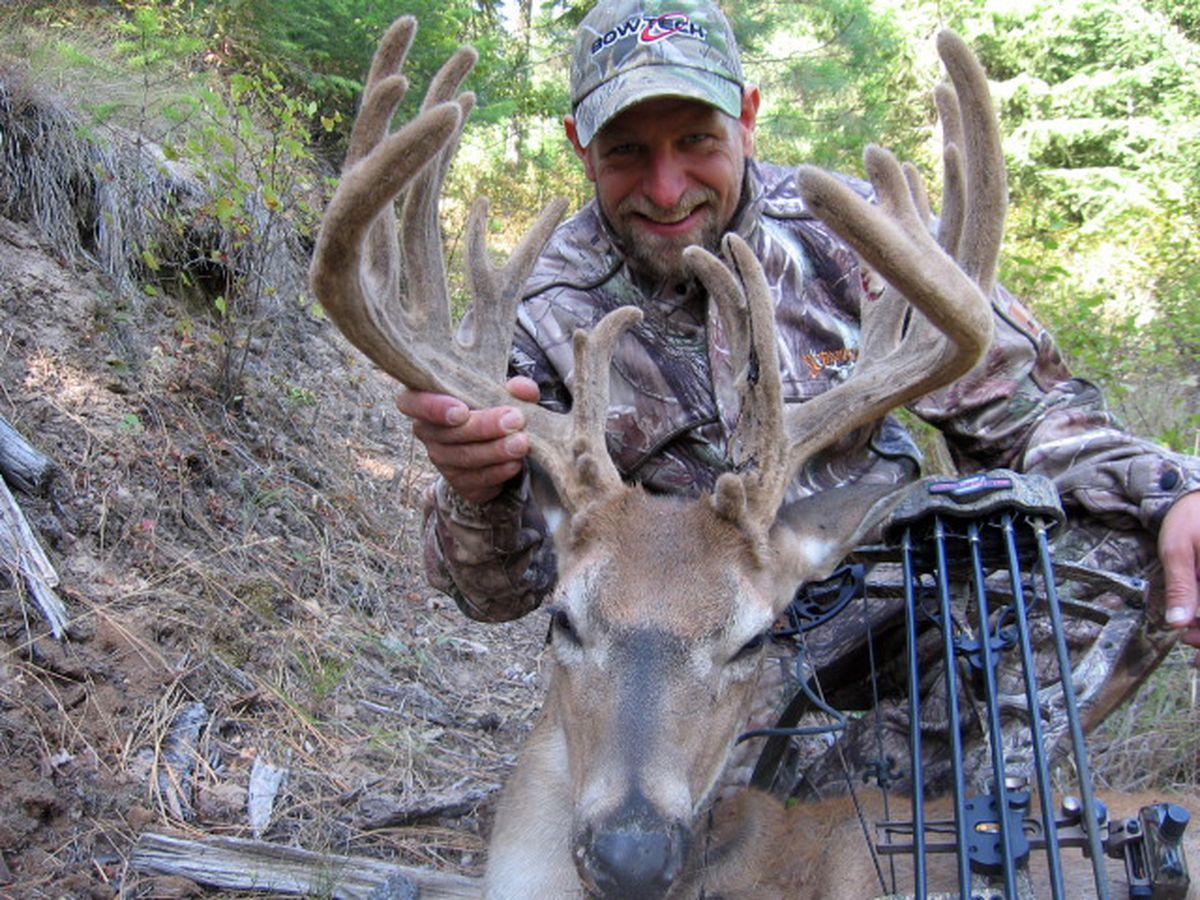
A picture is worth a thousand tracks, rubs, scrapes and scats. At least it was to Cheney bowhunter Thom Long. After taking up archery in the late 90s, Long switched to muzzleloader to take advantage of late deer seasons near his home. This year, he got back into archery hunting – in a big way.
He upgraded to a new compound bow as well as investing in a couple of $40 outdoor digital “game cameras” that are triggered by motion.
With his 10-year-old son looking forward to his first deer hunting seasons, Long started preparing for the hunts in July. He planned to hunt the early archery season and devote his attention to the boy during rifle season.
He got permission from landowners to hunt on their property and put up tree stands, but first they allowed him to start scouting the area and put up the camera.
For years, the landowner has maintained stock water troughs scattered about his property surrounded by grain fields and alfalfa. Long could see by the game trails that the deer hang out in the shade of trees and brush all day in the summer then move to the fields or water in the evening.
“We came back four days later to check the cameras, and I was really excited to see the number and quality of the bucks,” Long said. “I told the landowner about the photos and e-mailed them to him.”
They checked the area and the cameras every five days or so, and learned that a very big buck – sporting an 8-by-9- point rack in velvet – came on the trail past one camera virtually every day, although at different times.
The photos gave the hunters a good idea of where to put up the tree stands, and what they would be shooting for.
The landowners were deer hunters, but they told Long to take that big buck if he got him in his sights, Long said.
On Sept. 1, Long was in his stand by 5 a.m. waiting for the official shooting hours to start the season.
“A little forked-horn buck came by first,” he said. “Then I heard some noise out in front of me and saw (the big buck) coming in through the thick trees. He came right under my stand at 10 yards.
“I drew back and let him have it at about 6:15 on opening day. There was no doubt that this was the buck I had seen on the cameras.”
While most hunters continue to use the traditional scouting methods that include tracking and scouting with binoculars, an increasing number of hunters are using these remote cameras. Hundreds of camera models are on the market and the technology is advancing in a blur.
Thom said he used a very inexpensive model he bought at Wal-Mart.
“They don’t have all the bells and whistles like “time” and “date stamp” but as you can tell, they worked very well for me,” he said.
The selection of remote digital cameras at Cabela’s ranges from $80 to $350, with high-resolution models and cameras that shoot with infrared technology to deliver night photos without a flash.
“A lot of these cameras are used for security purposes, not for hunting,” said salesman Mark Hanson. “You don’t really need to pay for a lot of megapixels for game-watching.”
Accessories include solar panels to keep the batteries charged and card viewers so you can read the camera’s SD card in the field without packing along a pocket digital camera or laptop computer.
More expensive cameras usually have a delay of one second or less between the time the infrared sensor detects movement and the picture is made. Less expensive cameras can take several seconds to trigger, resulting in more pictures of animals’ bottoms.
Some of the more expensive cameras note not just the date and time on the image, but also the barometric pressure, allowing the hunter to relate deer movement to weather patterns.
Digital models store the pictures on a data card. The number of pictures depends on the card’s size, but a 256-megabyte card in a four-megapixel camera at the highest resolution holds more than 500 images.
A series of photographs can document the antler development of different bucks from spring through fall.
High-tech camera systems will snap a digital photo, send an e-mail message to your cell phone or computer that the camera shutter has been tripped, and then deliver the photo via wireless connection.
“No matter what kind of camera you get for following game, you want a locking security box so bears don’t tear it up,” Hanson said. “