
Ike leaves coffin cleanup job
Families, authorities search for caskets unearthed by storm
IN THE MARSH OF CAMERON PARISH, La. – Joe Johnson craned his neck from the airboat as it circled a patch of brown marsh grass. The runaway coffin was not where it was supposed to be.
Johnson pulled up to a pile of rocks and hopped out. After a few minutes of scouring along the tall, reedlike grass, he flagged down two fishermen.
“Can you possibly take me along the shoreline?” Johnson asked. “I’m looking for a casket.”
Beyond the usual, dismal rebuilding, Hurricane Ike left another grim task when it struck last month: Its 13-foot storm surge washed an estimated 200 caskets out of their graves, ripping through most of Cameron Parish’s 47 cemeteries and others in southwest Louisiana and coastal Texas. Some coffins floated miles into the marsh.
At Hollywood Cemetery in Orange, Texas, Ike unearthed about 100 caskets. Dozens more were disgorged in hard-hit Galveston.
Officials in coastal areas have long struggled with interring the dead, as caskets buried in low-lying areas are susceptible to being belched up by floodwaters. Some areas – most notably New Orleans – house the dead in above-ground crypts to keep them from drifting away in storms.
For many of the dead forced up by Ike, it wasn’t their first disturbance. About 80 percent of the caskets in southwest Louisiana displaced by Ike were rousted by Hurricane Rita just three years earlier, said Zeb Johnson, the Calcasieu Parish deputy coroner who’s headed casket recovery efforts for Rita and Ike.
Of the caskets ejected by Rita in September 2005, 335 were found and reburied, he said. Eighteen were never found.
“Our mother came out for Rita, and now she came out for Ike,” said Debra Dyson, a commercial fisher whose house in Cameron was destroyed by Ike.
Dyson said coffins holding her brother-in-law and cousin also were heaved out by Rita. Ike was worse – the storm thrust out caskets of her mother, brother-in-law, cousin, niece, three uncles and two aunts.
“It’s hard to lose your home, but the first stop you make is that cemetery just to make sure they’re still there, and it’s heartbreaking when they’re not,” said Marilyn Dyson Elizondo, Dyson’s sister who lives in Dayton, Texas.
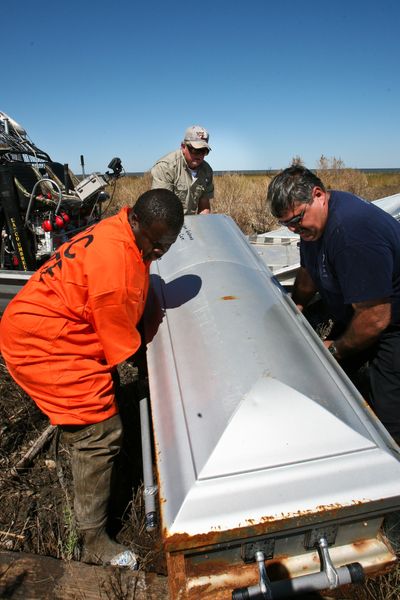
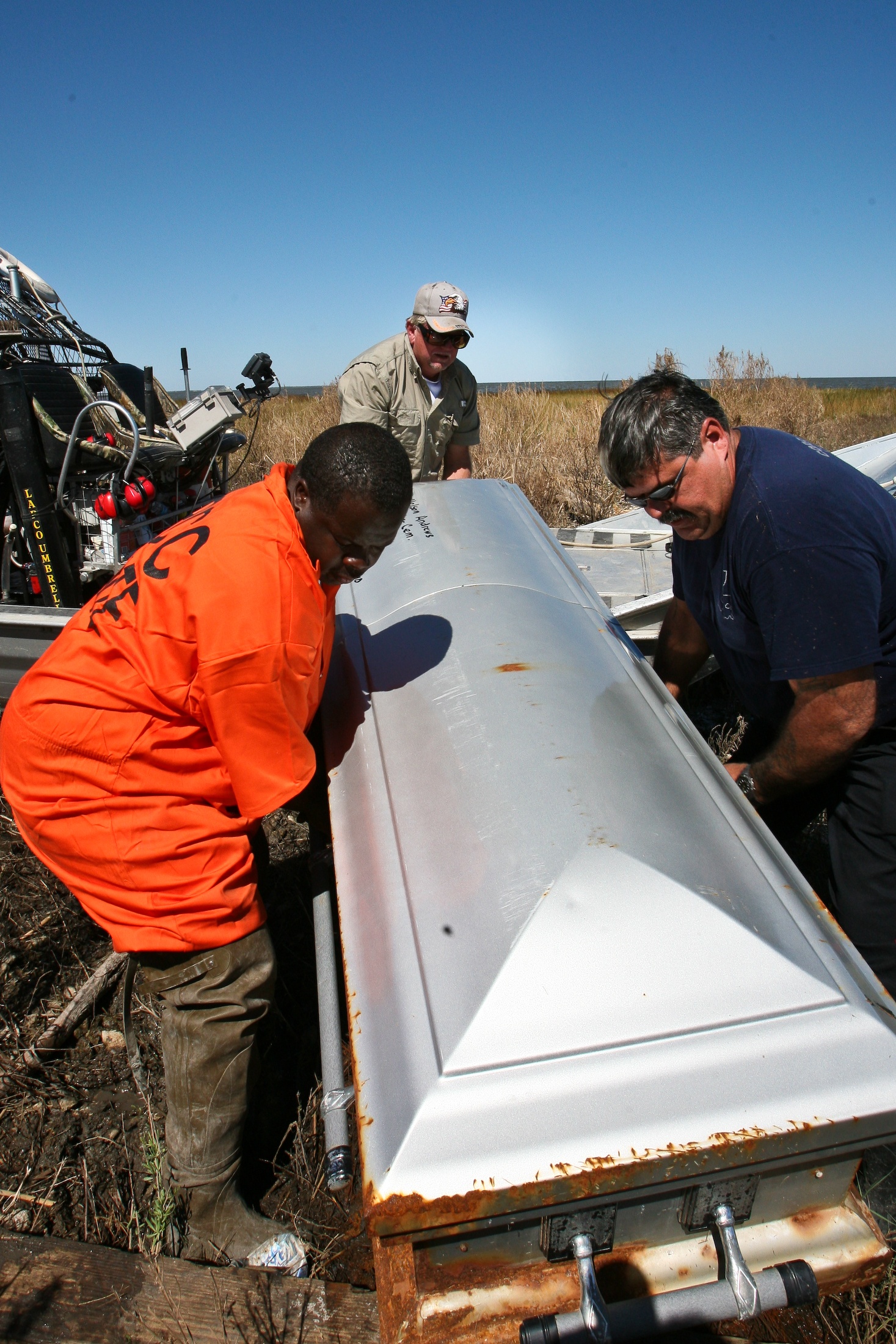
Zeb Johnson helms a team of two employees, volunteer boat pilots and state prisoners to search hundreds of miles of marsh with loaned equipment and haul coffins back to shore. The work is backbreaking, with caskets weighed down by mud in swampy areas teeming with alligators and snakes and the stench of rotting marsh grass.
“It’s a job that has to be done,” said Joe Johnson, a funeral director and embalmer from Lake Charles who is not related to the deputy coroner.
The identification work in many instances is easier this time around. Bodies found after Rita were tagged with special markers, as were the silver metal coffins in which they were reburied. The coffins include a scroll with the deceased’s name, where they were buried and other information.
A few families are considering reburials on higher ground. Cameron Parish’s government has proposed requiring deeper burials.
Elizondo, whose family awaits word on the missing Dyson caskets, said her brother was buried in January in a deeper vault than those that housed her missing relatives. Ike didn’t disturb her brother, so Elizondo wants to rebury her mother the same way, though it is more expensive.
“It’s worth it. That way we have the peace of mind that mom won’t be gone again,” Elizondo said. “We’ve even offered to do the backhoe ourselves. We just don’t want her coming back up again.”