
More builders looking into Green techniques
Going green is going mainstream. That’s the near-future forecast for the Inland Northwest’s construction industry, according to local specialists and sustainable building experts – well, at least that’s their optimistic outlook on the area’s building potential.
Addressing the need for conserving natural resources, green building has been adopted in and adapted to environments from coast to coast, while the Inland Empire has until recently fallen behind in those eco-friendly standards. Not anymore.
From a 2004 law mandating all state-funded new construction projects to meet or exceed a Silver rating on the U.S. Green Building Council’s Leadership in Energy and Environmental Design (LEED) Green Building Rating System, to local groups dedicated to raising the public’s awareness on sustainable practices, there’s a conservation undercurrent seeping into the social order. Fueled in part by soaring energy prices and almost every American feeling an economic pinch, consumer demand for greener homes has never been higher.
In the burgeoning world of sustainable construction, there are varying sets of standards from both local and national associations, all of which uphold the idea of preserving the environment through eco-friendly practices and employing a long-term approach to neighborhoods. With more and more go-green options cluttering the table, there is more of a need to simplify that crush of consumer and developer information.
Fortunately for us – and the environment – there is a community of like-minded individuals dedicated to the undertaking.
In Eastern Washington, the Spokane Home Builders Association has introduced the two-year-old Built Green program, a streamlined set of residential-construction standards. “The process was created in direct response to market demand,” says Paul Warfield, the community affairs director for SHBA.
Culling together eight months of research from local sustainability specialists, developers and environmental experts such as with Avista Utilities and the Washington Department of Ecology, the program is a Spokane-specific adaptation of the state’s Built Green master plan, which was developed by Puget Sound area builders and consultants.
Homeowners and residential developers can use the standards as a roadmap to reach any shade of green under its five-star rating system, with the added assurance that there is no “greenwashing,” or trying to appear as environmentally aware.
“It’s a partnership between different groups all working together for a common goal of standard practices for green building…It’s specifically tailored for our community,” Warfield explains. “The goal is to let any builders, remodeler or developer incorporate as much green into their business model for any aspect of their business model. We would rather have 40 percent of the market built at a two- to three-star range than 1 percent at the five-star level,’ which would be a zero-carbon producing building.
From a real estate perspective, the homes are an up and coming commodity with sky-high possibilities. Even the National Association of Realtors is getting involved by offering a new sustainable certification course for brokers and agents at their upcoming convention.
“It’s being embraced by the Realtor community,” says Rob Higgins, executive vice president of the Spokane Association of Realtors. “It’s all a response to the consumers embracing the sustainable home idea. I see all this gaining in popularity, there’s no doubt about it, and I envision it becoming more common in the future.”
Even though the home builders association has yet to hold a Built Green public unveiling, it has gained momentum simply through word-of-mouth marketing. So far this year, more than 20 builders have signed on and about 40 homes have been certified, and the goal is to have at least 10 percent of new construction projects in the area adhering to the program in 2009 and 30 percent in 2010.
The “stewardship program,” as Warfield calls it, is sort of a smorgasbord of sustainable housing practices, procedures and techniques that address managing the construction site, energy conservation and efficiency, building with sustainable materials and allowing for healthier indoor air, such as by using paints that emit lower levels of toxins.
But costs can be prohibitive, especially when up-front is compared to right-now.
However, Warfield and sustainable specialists point out, these practices don’t have to affect your bank account any more than less-than-green choices. New materials and technologies have greatly reduced prices.
“We’re destroying the myth that green has to cost more,” he says. Also, Warfield adds, simple steps such as replacing old lights with compact fluorescent bulbs can cut down on monthly bills.
North Idaho, however, still lacks a specific sustainable outline. While the LEED program has been used on commercial buildings, residential developers have largely looked elsewhere for examples.
“I think its important that there’s a program that all contractors are familiar with,” says Gary Young, a landscape architect who founded e2 Planning and Design in Post Falls, which offers site-to-building planning services and has an environmentally-conscious residential development, called Greenridge, in the works in the Cougar Gulch area southwest of Coeur d’Alene.
A former project manager for the Post Falls, Young had a hand in the design of the new City Hall, which incorporated several sustainable systems. Now, he’s working on drafting his own conservation benchmarks for internal and external construction projects.
“A true green building looks at the whole lifestyle. It’s a holistic approach, you kind of look at the cradle-to-the-grave aspect of building,” he says, adding that he believes consumer demand will ultimately drive the need for a standardized guidebook. Until then (though the North Idaho Building Contractors Association might adapt a similar Built Green program for the area), Young says there needs to be greater understanding of what is, and what isn’t, sustainable living.
“It’s an educational process of people looking beyond first-costs,” he says, adding that although it may be three- to five-percent more money at first, your looking at half the energy expenditure afterward. “I think the energy situation is going to force people to look at building green.”
Conservation advocates in the area agree.
“The higher shades of green I think are fantastic and are really catching on, like energy efficiency and less water consumption,” says Juliet Sinisterra, the services director for Community Minded Enterprises, a non-profit organization that facilitates and enhances community well being, including sustainable living.
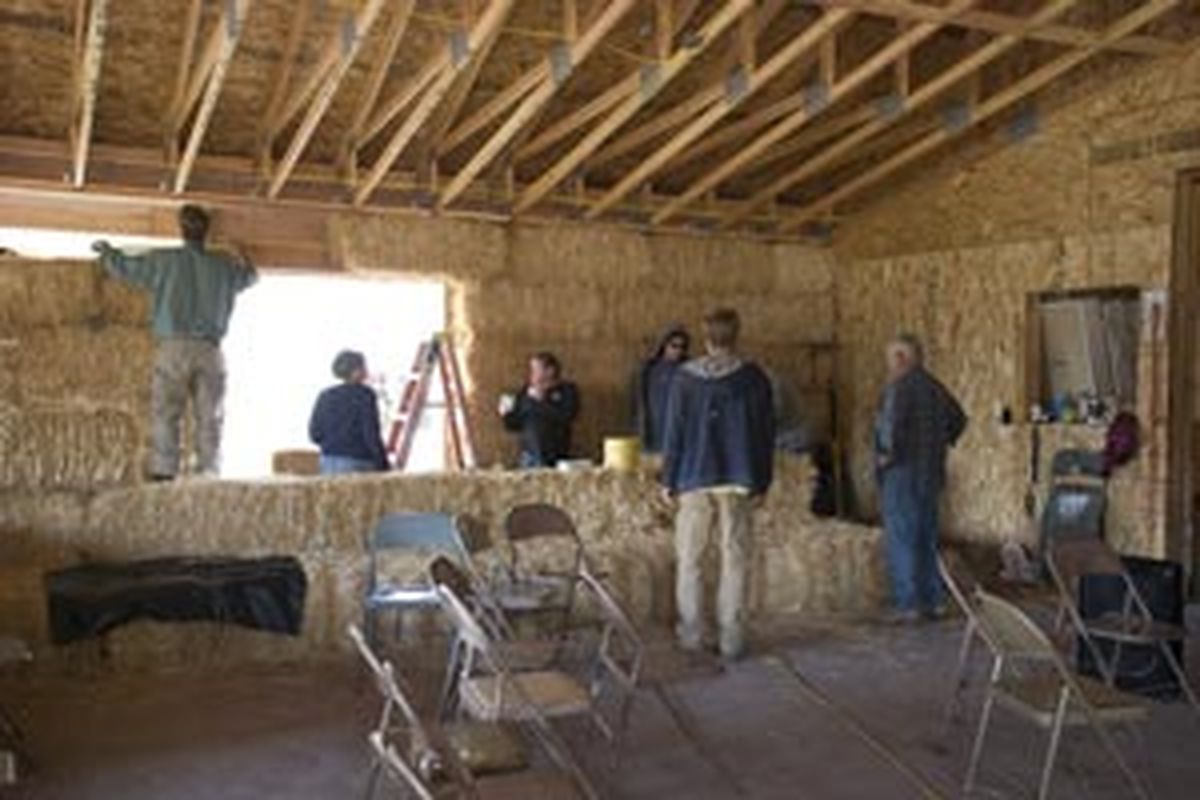
But are those midrange qualifications enough? On the flip side, can it ever be too green? Future generations might not think so, Sinisterra says, which is why she and other groups such as the Cascadia Region Green Building Council’s Living Building Challenge advocate a net-zero blueprint, or a carbon free, closed-loop household. That means a home featuring, among other things, a solar oven, extreme insulation and composting toilets. Those and other stewardship groups even work together to offer building demonstrations around the area several times a year to highlight the techniques used in zero emission households, including straw bail construction.
That’s the ultimate energy efficiency goal, Sinisterra argues, and it will be a necessary step in offsetting looming energy needs. “I think if you look at it in the long term, in the next 20 years or by 2030, we need to be building completely carbon neutral buildings – zero emissions – and that’s a huge jump,” she says. “The ideal is to have a closed-loop house, where all the energy you use goes back into the house. If we could get to that point it would be tremendous, and I don’t think that would be too green.”