
With moon launch, India joins space race
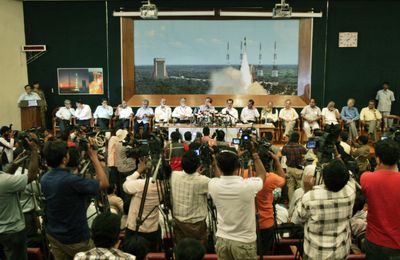

CHENNAI, India – India began its first lunar mission on Wednesday, a moment of national pride that confirmed the country’s place as an emerging power in the new Asian space race.
Through heavy morning clouds, the unmanned Chandrayaan-1 – which means “moon craft” in ancient Sanskrit – was launched from the Sriharikota space center on an island in southern India, about 60 miles from Chennai.
“This is a historic moment for India,” Indian Space Research Organization chairman G. Madhavan Nair told crowds of clapping onlookers and reporters. “It’s a remarkable moment to try to unravel the mysteries of the moon.”
So far, only the United States, Russia, the European Space Agency, Japan and China have sent missions to the moon. China became the first Asian country to put its own astronauts into space in 2003, and last month achieved its first spacewalk. As a rival of China’s, India wants to join the superpowers that have dominated space for more than 40 years and hopes to put two Indians into space by 2015.
“It’s truly a moment of pride for every Indian, a real step forward for India,” said S. Satish, a spokesman for the Indian Space Research Organization, in a recent interview. “Every common man in India will be able to benefit from the knowledge and pride we gain.”
The two-year mission is aimed at laying the groundwork for further Indian space expeditions. The probe launched Wednesday will not land on the moon but will orbit it. The mission will create a three-dimensional map of the lunar surface, looking for traces of water, uranium and minerals.
The United States, which in 1969 became the first nation to send men to the moon, is providing two key mapping instruments for India’s mission. One is the Moon Mineralogy Mapper which will obtain images of the mineral composition of the moon from orbit. The second will look for ice deposits, especially at the poles.