
CV senior shares lessons in French
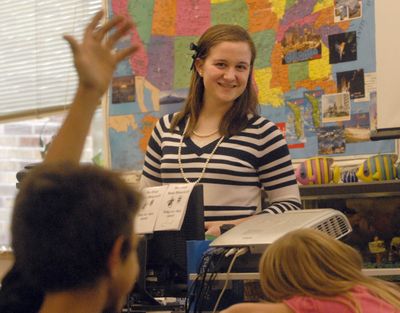

The students in Lori Finley’s fourth-grade class at Trent Elementary School love Thursday afternoons. Not because it’s one day closer to the weekend, but because that’s the day Finley’s daughter, Christy, arrives and gives them a French lesson.
The students clamored for Christy Finley’s attention on a recent Thursday, peppering her with questions on how to say certain words or phrases. “How do you say ‘no’ in French?” one student asked.
Since the school year began, students have been learning color names and how to count and say the alphabet in French. Students begged to sing the alphabet song, complete with stomps.
Christy Finley reviewed the numbers, holding up her fingers as the students chanted. “Tres bien,” she said. “You guys rock.” She pronounced each day of the week slowly and repeatedly for her new lesson. “Lundi, loon-dee,” she said, giving the word for Monday.
A senior at Central Valley High School, Christy Finley is a third-year French student. She can trace her love to the language back to her time at Sunrise Elementary.
“When I was in fourth grade, some girls from CV came to my class and taught me beginning French,” she said.
That memory inspired her to do the same thing. This year she is getting credit for her efforts through a teaching academy class. “Last year it was something I did on my own time,” she said. “It’s mostly for my own fun.”
Finley doesn’t stop at teaching simple words and phrases. Last year’s fourth-graders performed “Cinderella” and “The Emperor’s New Clothes” completely in French. “Everyone had a speaking part,” she said. “I just want to give them an appreciation for another language.”
Lori Finley’s students look forward to her daughter’s visits, and young minds are quick to grasp another language, she said.
“They’re more like a sponge,” she said.
Nina Culver
Forensic firearms expert to give presentation
When Chet and Diane Park flew out of London’s Heathrow Airport five years ago, they had a lot on their minds. He was contemplating taking a temporary job in England; she was wondering what that would be like, and what to do with her successful pond-scaping business in the meantime.
And what were they to do with the family farm they live on, just north of Rathdrum?
As the plane gained altitude, Diane Park looked out the window and saw the long, narrow boats that floated on the canals below.
“She looked at me and said, ‘If you take that job, we’re living on one of those boats,’ “ Chet Park said. “I just kind of shrugged it off.”
About a year later it became reality.
On Tuesday, Chet Park will give a presentation at the Lake City Senior Center about the work he did as a forensic firearms expert in England from 2003 to 2007. He helped establish a private forensic laboratory to assist domestic, international and military law enforcement agencies in investigating firearms-related incidents.
“Moving over there, we didn’t know what to expect,” Diane Park said, sitting in a small meeting room at the Rathdrum Library. “We brought a tent-trailer and a canoe. We lived in the camper for six or eight weeks while we got everything figured out.”
The staffing at Forensic Alliance sounded like the beginning of a good joke, Chet Park said, because it consisted of one Irish, one Scotsman and one American.
“It was a great group,” he said.
Diane Park was hired as an evidence submission officer.
“They are big on DNA, so we had to wear scrubs,” she said. “I’d say their attitude toward work is a little more laid back than ours. They work a 37 1/2-hour work week, and they come and go exactly on time. We were the ones who opened and closed.”
Chet Park already had extensive experience with forensic firearms investigations, among other jobs working for the Idaho State Patrol crime lab in Coeur d’Alene.
The biggest adjustment for him was that laws and regulations pertaining to firearms are completely different in England.
“I would say they have arguably some of the most stringent gun control laws in the world,” he said. “And most police officers are not armed, unless they belong to a specific firearms unit.”
One case Park worked on was that of the first British soldier killed in Iraq. He was killed by friendly fire during the controversy over equipping British soldiers with body armor.
“We worked closely with the military police on that case, trying to establish exactly what had happened,” Park said.
These real cases are the focus of Park’s presentation next week.
Surrounded by canals – the Parks lived just north of Leeds – Diane Park didn’t forget about the boat she’d seen from the air.
“We took a helmsman’s course so we’d know how to sail it,” Diane Park said. “We’d been there for about nine months when we bought the boat.”
“You can go pretty much anywhere in England on the canals,” Chet Park said. “It’s just a great way to travel.”
Pia Hallenberg Christensen
Gravesite memorial commemorates Mann
A lot of words were used to describe Pfc. Joe E. Mann at a recent ceremony honoring him: “selfless,” “patriot,” “inspiration,” “courage” and “sacrifice.”
But one word resonated with the crowd at Spokane’s Greenwood Memorial Terrace: “hero.”
Mann served in World War II with the 101st Airborne Screaming Eagles. In September 1944, near Best, Holland, after getting shot in both shoulders, he pleaded to return to the battlefield to stand watch. That night he threw his body on a grenade to save six of his fellow soldiers.
Since then, the Reardan native’s name has graced a ballroom in South Carolina, a theater at Fort Campbell, Ky., a street at Fort Lewis and the armory on Market Street in Hillyard. A memorial stands in his honor in Best.
Now Mann has a memorial over his grave at Greenwood. It tells the story of what he gave for his country.
The new memorial is on the upper terrace of Greenwood, and Mann’s story is told in detail. It will be part of a walking tour of historic monuments in three Spokane cemeteries that tell of events and people who have made a difference.
Lisa Leinberger