
The Attainable, Sustainable Centerpiece
How to craft a centerpiece that won’t wilt
Imagine a wedding tabletop sans drooping roses or peonies; instead, there are artfully arranged stacks of a bookish couples’ favorite novels interspersed with rustic lanterns. Or perhaps a couple who hails from Arizona but is getting married in Minnesota has opted to decorate their tables with a stream of potted cacti and polished river rocks.
Whether the goal is to be more environmentally conscious, save money or simply create something different that feels more personal, nowadays it’s becoming more and more common for couples to use non-traditional centerpieces, or at least cut down on the cut flowers, and incorporate more non-traditional items, says Karen Bussen, a Manhattan wedding expert and author of the “Simple Stunning Weddings” series of books.
“Lots of couples I talk to are really not interested in the big puffy floral designs of the past,” says Bussen. “They’re looking for something that’s simple and elegant in a clever, appealing presentation.”
Weddings are all about individual style and personal, meaningful details right now, agrees Laura Cassidy, style editor for Seattle Metropolitan and editor-in-chief of Seattle Metropolitan Bride & Groom. “A non-traditional centerpiece, such as an artful arrangement of fresh local fruit or a collection of homemade candles, is another opportunity to wow guests with an expression of what it is that sets this wedding and couple apart,” says Cassidy.
As an added perk, many of these unconventional centerpieces do double-duty getting “recycled” as favors. Bussen helped design an at-home wedding for which they set a 60 foot table with nothing but vintage candelabra and silver bowls of apples from the farm next door. At the end of the night, servers put the apples in bushel baskets and handed them to guests as they boarded buses to return to their hotels.
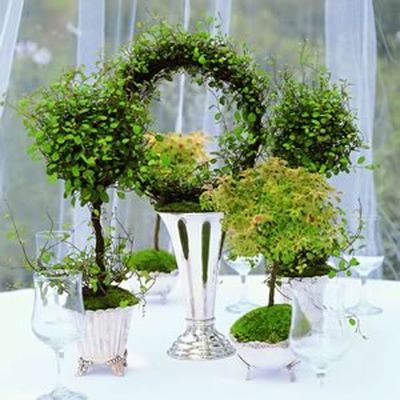
Another centerpiece-to-favor favorite is living plants. Culinary couples can buy simple low, wide terra cotta pots (eight to 12 inches in diameter) and pot them with four or five different fresh herbs, such as rosemary, thyme, sage, basil and parsley. “Not only will these food-friendly fragrances make your party smell divine, the lucky guests who take them home will have a kitchen garden to cut from all season,” says Bussen.
She also notes that, with their leaves and a pretty pot, potted plants can make a bigger statement than the equivalent dollar value in pricey cut blooms. Try potting tall azalea topiaries in old silver trophy cups or compote bowls and top the soil with moss. Place them on pedestals for your ceremony or use them as centerpieces, says Bussen. They may be taller than traditional centerpieces, but their narrow trunks make talking across the table very easy. If you prefer a more architectural look, she suggests buying four-inch diameter daffodil plants and potting them in glass cylinders so that you can see the earth and roots. Line them up down the length of a rectangular table or group them together on a round table, surrounded by glowing votive candles. And again, tell each guest to take one home when they leave for the night.
“How great to think of friends and family growing a living thing in your honor,” says Cassidy.
But if air travel makes gifting botanicals difficult, consider getting fired up. Cassidy knows a bride that had a candle-making party with her mom and sisters for an entire weekend before the wedding and then clustered them together for the centerpieces. They were lightly-used, but still made for lovely and heart-felt favors. Bussen also recommends using glass cake stands, old silver trays or bamboo or lacquer platters as a stage for glowing votive candleholders in vibrant colors. Surround them with a scattering of rose petals, orchid blooms or river stones.
“The variation can create texture and a more interesting visual landscape across the whole room,” she says.
But even if you have your heart set on the traditional cut-flower route, don’t feel like you have to throw your conscience out with your wilted blooms.
“There’s nothing sadder than gorgeous cut flowers sitting in a garbage can, but on the flip side, there are few experiences that can rival that of giving a handful of the same to some unsuspecting recipient,” says Cassidy. At one wedding she attended, an announcement was made that the most senior woman at each table was to be given first pick of the flowers on the table. Arrangements can be sent home with guests, or donated to local charitable organizations or businesses.
In New York City, the Flower Power Foundation (www.flowerpowernyc.org) will pick up flowers, rearrange them and deliver them to nursing homes and hospitals. “However, don’t assume you can drop off flowers anywhere anonymously, as sometimes hospitals, for example, won’t accept them for reasons of safety or policy,” warns Bussen.
Whether it’s a parade of wacky antique toys, towering tiers of petit fours or organic, locally grown flowers, today’s trend is truly making one’s wedding one’s own.
“No one goes to a wedding because they’re hoping to see a dozen red roses peppered with baby’s breath in a plain glass cylinder,” says Cassidy. “They go to witness a union, and to become closer to the couple in doing so.”