
Links bring magic for Tom Watson at British Open
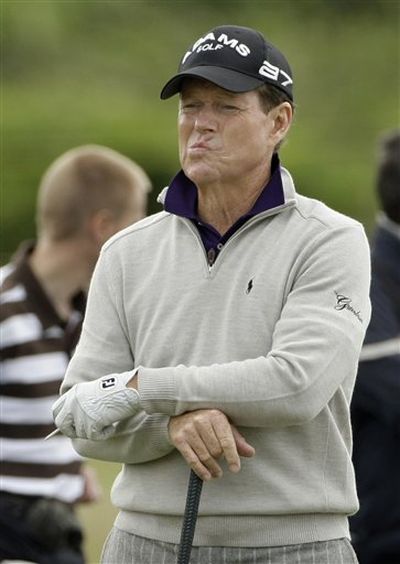
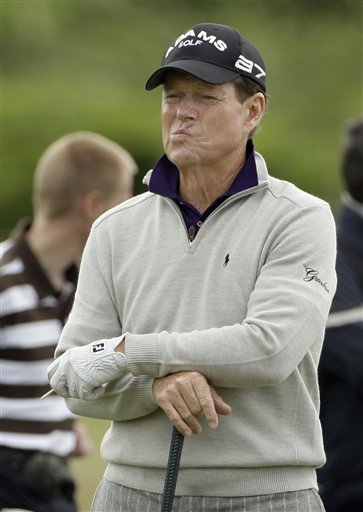
Charlotte, N.C. — Tom Watson is old enough that despite having won five British Opens, his exemption into golf’s grandest championship will expire after next year when the event returns to St. Andrews.
That’s when Watson, who will turn 60 in two months, is expected to pose for the traditional farewell photo astride the Swilcan Bridge on the 18th hole and wave goodbye to the event that defined his greatness.
Then again, he could return to St. Andrews next July as the defending champion if he can string together three more golden days like Thursday, when he shot 65 to stand one off the lead after the first round of the British Open.
That is the beauty and charm of golf, particularly links golf played primarily in Scotland, England and Ireland, where wisdom and patience might be more valuable than strength and fearlessness.
Links golf, classically framed by blue-gray skies and salt-scented air, is played on patches of sandy soil that literally links the mainland to the ocean. The terrain is typically bumpy and windblown, the golf holes shaped more by nature than by man, challenging golfers to deal with quirky bounces, changing conditions and their own dangerous temptation to attempt to overpower the course.
Watson can’t win the Masters or the U.S. Open anymore_they demand more power than his game can now generate_but he could win this weekend at Turnberry, where he famously beat Jack Nicklaus in the Duel in the Sun 32 years ago.
There’s not another sport where something like that is possible.
Bjorn Borg, 53, can’t play Wimbledon anymore. Michael Jordan, 46, isn’t Air Jordan anymore. At age 39, Brett Favre is spending his summer throwing passes to high school kids in Mississippi, to learn if he still has enough in him to play football.
Yes, 50-year old Mark Martin is still winning NASCAR races, but he’s helped by his machine.
No matter how much better the equipment is than it was 32 years ago, Watson is doing this with his talent, his mind and an inspiration that seems forever young when he’s walking through the windswept dunes.
The essence of Watson’s Hall of Fame career was created at the British Open between 1975 and 1983 where he won five of his eight major championships and came to be adopted by the galleries, who admired the way he embraced their game.
At first, Watson didn’t like links golf and the way it forced him to rely on bouncing the ball along the ground rather than attacking hole locations through the air. He won his first two British Opens despite himself and, during the 1979 Open at Royal Lytham, he surrendered, accepting he had to play golf differently on the great links than he did at home in Kansas City or most other places. In doing so, Watson fell in love with the Scottish game.
Sports is about hope. It’s about the possibility that today or this week or this season, it will be your time or your team’s time.
In most sports, the window of time closes quickly. Tennis players are done before they’re 30, baseball players (without the help of pharmaceuticals) are usually finished by 40.
The age limit on golf is different. A year ago, 53-year-old Greg Norman led the British Open entering the final round in a spellbinding performance that sent a flutter that reached beyond the sports world.
When Ben Hogan was 54, walking on legs that ached with every step, he shot 30 on the back nine of Augusta National during a third-round 66 that reminded everyone of his brilliance. That day, Hogan birdied the 10th, 11th, 12th and 13th holes.
In 1986, 46-year-old Jack Nicklaus shot 65 on Sunday to win his sixth Masters and 12 years later was in contention again on another Augusta Sunday.
Just three months ago, Kenny Perry, 48, was a swing away from winning the Masters.
Six years ago, Watson led after the first round of the U.S Open at Olympia Fields with his long-time caddie, Bruce Edwards, dying from ALS, carrying his bag. It was as sweet a day as the grueling U.S. Open has produced.
Watson, nine months removed from hip replacement surgery, thrust himself into another British Open story Thursday morning before most Americans had finished their first cup of coffee.
He shot 65 in calm conditions playing golf the way the Scots believe it should be played_bouncing the ball into greens and holing a handful of medium-range putts that turn solid days into special ones.
Watson’s score was not a total shock, given his history overseas. His name was mentioned as a legitimate long shot pick in pre-tournament chatter and his three Senior British Open victories since 2003 are evidence that his game hasn’t gone entirely gray.
He still averages 287 yards off the tee, one yard longer than the average driving distance on the PGA Tour, but Watson doesn’t play often. He’s made only five Champions Tour starts this year, finishing inside the top 10 once.
With his quick stride and simple swing, Watson became one of the game’s defining figures over the past 30 years. Only five players_Nicklaus, Woods, Walter Hagen, Gary Player and Hogan_won more majors than Watson.
More than any other player, Watson stood up to and beat Nicklaus in major championships, most notably at Turnberry in 1977 and with his famous U.S. Open chip-in at Pebble Beach five years later.
In his prime, Watson putted as if the hole were 3 feet wide, ramming the ball into the cup. Over the years, his nerves betrayed him on the short ones, as it seems to happen when the years add up.
But Thursday, in his gray argyle sweater and gap-toothed smile, playing the course as it was meant to be played, 59-year-old Tom Watson looked young enough.