
Talon agent
Orchardist employs falcons to keep pesky birds from munching on his thriving bluberry crop
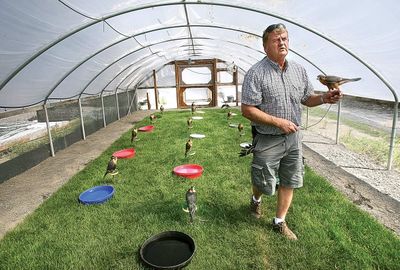
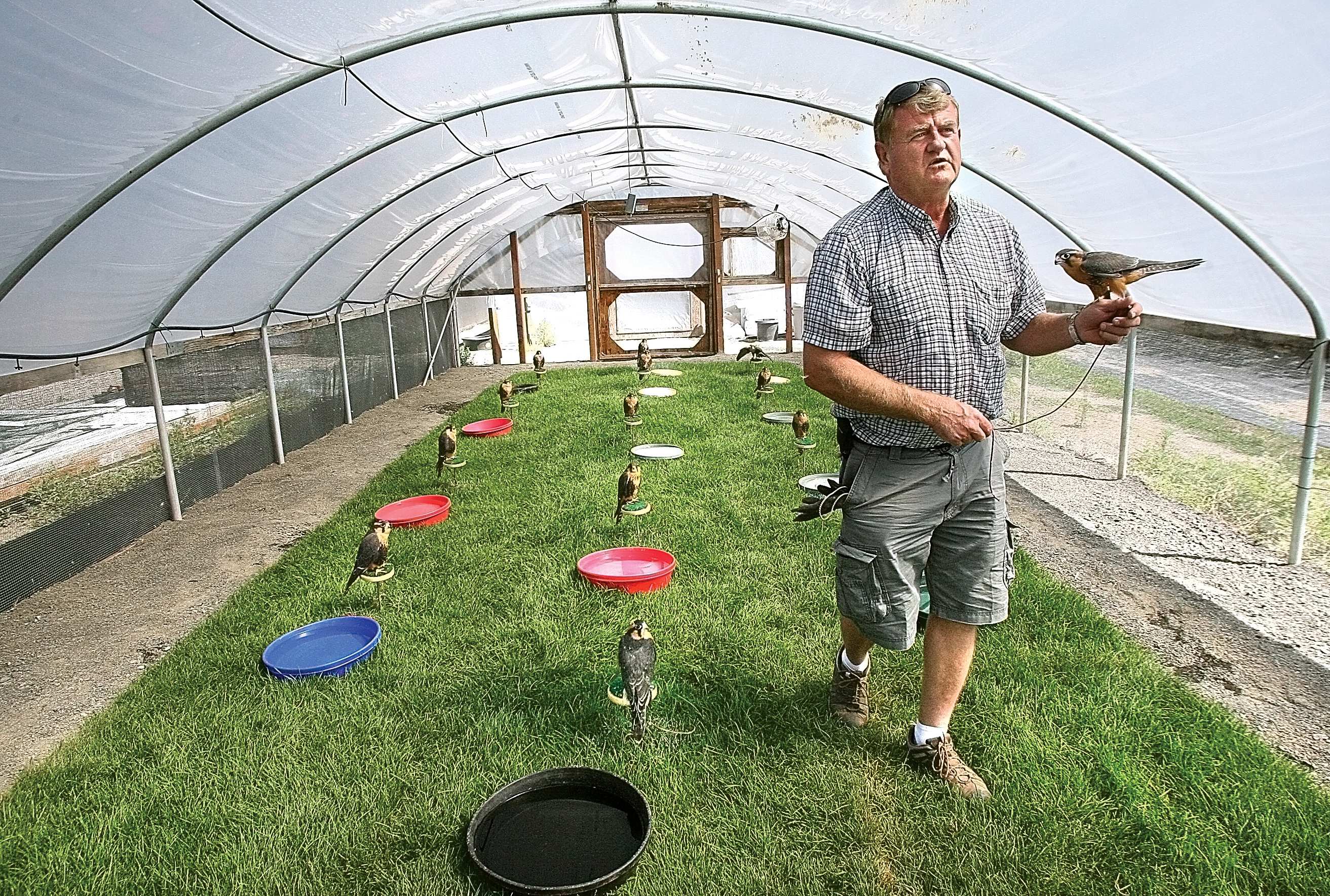
BURBANK, Wash. – The several dozen falcons keeping watch over Jim Lott’s Burbank blueberry fields are an evolving manifestation of his self-described penchant for “overdoing things.”
“Once it starts, it almost takes on a life of its own,” said the owner of Applegate Orchards. “It’s a pretty big business.”
Within the last year Lott has acquired and bred about 70 Aplomado falcons that he uses in a bird abatement program.
And not only have Lott’s blueberries flourished – for the first time this year people are invited to the orchard to pick their own berries – but the falcon patrol has been so successful that Lott has hired nearly a dozen falconers to manage the birds and now contracts them to patrol other farmers’ fields.
“Our goal is to scare (pest) birds,” Lott said.
He also has a team breeding falcons and quail for their food supply.
The program seems to be working well, as Lott said almost no berries are lost to avian thievery.
Lott said when he first planted blueberries seven years ago, many called him crazy for trying to grow the fruit in such a hot climate.
But Eastern Washington’s blueberry crop has since exploded and the berries now grow on about 2,500 acres in the drier part of the state, said Alan Schreiber, director of the Washington Blueberry Commission.
Blueberry acreage doubled east of the Cascades in the past two years as the fruit has become more popular, he added. “Blueberries have a well-deserved reputation for being very nutritious and healthy,” Schreiber said.
And Eastern Washington, despite initial concerns about too much heat, turned out to have ideal conditions for blueberries, he added.
“A lot of diseases and insects are very specific to blueberries,” Schreiber said. “Because we don’t have native species here or anything like them here, we don’t have the pests.”
And Lott’s falcon patrol provides a perfect tool to make sure his valuable crop gets to market.
On a recent Tuesday, seven falconers patrolled Lott’s 250 acres of berries with three falcons each.
By late morning, starlings, robins and finches mostly knew to stay out of the area to protect themselves, said Polo Gallegos, 21, of Pasco, one of Lott’s newest falconers.
Gallegos was working with Reggie, who had a bell on his ankle for easier tracking.
Effective bird abatement requires the falconers to walk through the fields as a falcon flies overhead. If pest birds aren’t around, the falcons are given an occasional treat to keep them motivated, Gallegos said.
One bird can cover about 40 acres, Lott said. And working the birds is somewhat of an art.
The falcon must be kept at just the right hunger level to fly – too hungry and it will attack and eat the pest birds, too full and it isn’t motivated to engage in a chase. Falconers are able to monitor the birds’ hunger by weighing them.
Gallegos used to work irrigation for Lott but took an interest in the falcons and recently passed the test to get his handling permit, which is issued by the state in partnership with the federal government.
Working with a bird he’s trained is very satisfying, Gallegos said, adding that he enjoys the chases.
“It’s like, ‘I can’t believe I just trained this bird,’ ” he said.