
UW grad piloting Hubble mission
Seattle native making first trip to space
SEATTLE – Greg Johnson wasn’t one of those kids who always wanted to be an astronaut.
He remembers when he was 3 or 4 years old, watching a jet take off from Seattle-Tacoma International Airport, and thinking, “Wow! That looks like a fun job.” He jokes it was the start of his later life plan: “to go from fun job to fun job.”
But Monday, the Seattle native and University of Washington graduate will undertake the ultimate flying assignment: piloting the final shuttle mission to service the Hubble Space Telescope.
His parents, who live in Mukilteo, and former colleagues say Johnson’s calm demeanor and nearly 35 years’ experience flying some of the world’s fastest planes have prepared him well for his 11-day mission in space.
What 54-year-old Johnson doesn’t say, but what friends fill in, is that he was a math and science standout at West Seattle High School, where he graduated in 1972, and in aerospace engineering at UW. Within four years of joining NASA in 1990, he was named chief of maintenance and engineering, responsible for NASA’s fleet of 44 jets and cargo planes.
“Greg was always a great pilot, but he always wanted to do it right. He always wanted to understand the physical and technical aspects of flying,” said Dave Waggoner, director of Paine Field in Everett and commanding officer of Johnson’s flight squadron at Naval Air Station Whidbey Island in the early 1980s.
Johnson attended UW at his father’s prompting, on the condition he could first attend flight school at Big Bend Community College in Moses Lake. His father, Raleigh Johnson, still remembers the excitement in his son’s voice when he phoned home after his first flight.
After flying seaplanes and landing on glaciers, Johnson joined the Navy, flying fighter jets on two deployments to the Pacific and Middle East and completing more than 500 aircraft-carrier landings.
“He was a coach and mentor for the other pilots. He was the final authority on whether the approach was good enough to get on safely. You can only do that when you have the experience of flying and the confidence of other pilots,” Waggoner said.
Johnson applied for the astronaut program three times before he was accepted in 1998 at age 44. He graduated at the top of his class. The Hubble mission will be his first trip into space.
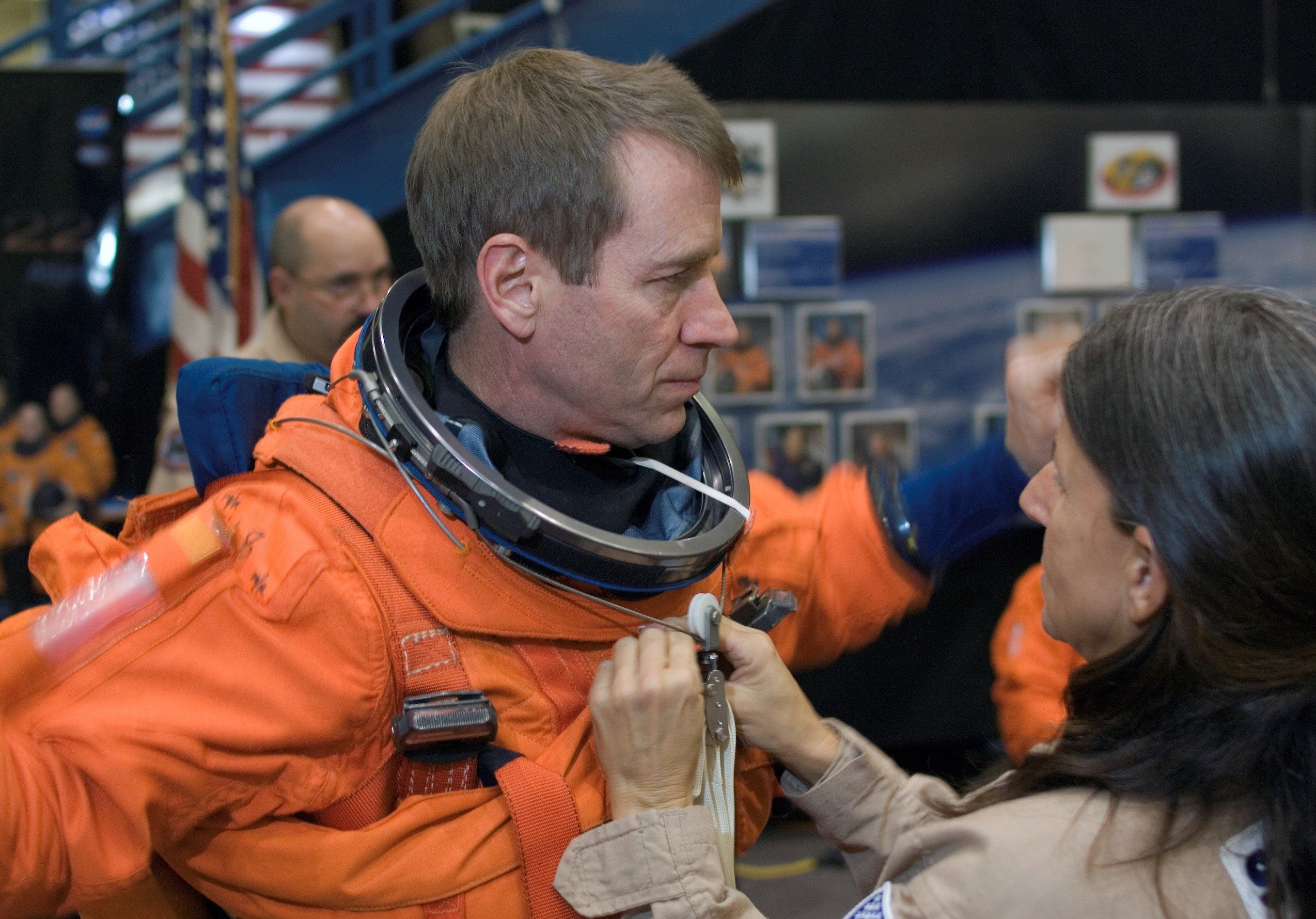
Johnson describes his role on the mission as a “jack of all trades.” He’ll pilot Atlantis and position it to capture the space telescope in the shuttle’s cargo bay, help the astronauts get into and out of their spacesuits, and he’ll film the mission with an IMAX camera for National Geographic.
If the mission is successful, the telescope will be 10 times more powerful and will continue to send images of remote galaxies and of the birth of stars through at least 2014. The data Hubble records could help answer questions about the origins of the universe and the nature of dark energy, the little-understood force that seems to be driving the cosmos apart.
For Johnson, the gain in scientific knowledge outweighs the risks.
“The Hubble’s discoveries over the years have been phenomenal,” Johnson said. “We expect it to continue to make discoveries.”