
Sea lions, salmon slow to show at dam
PORTLAND – From fin to fur, activity at Bonneville Dam is down sharply this spring.
It has been three weeks since Oregon and Washington fisheries managers have caught a salmon-eating California sea lion in traps at the dam, and so far this year the run of adult spring chinook at the dam is roughly half of usual.
A fraction of the sea lions that usually go to the dam to snack on the chinook have shown up.
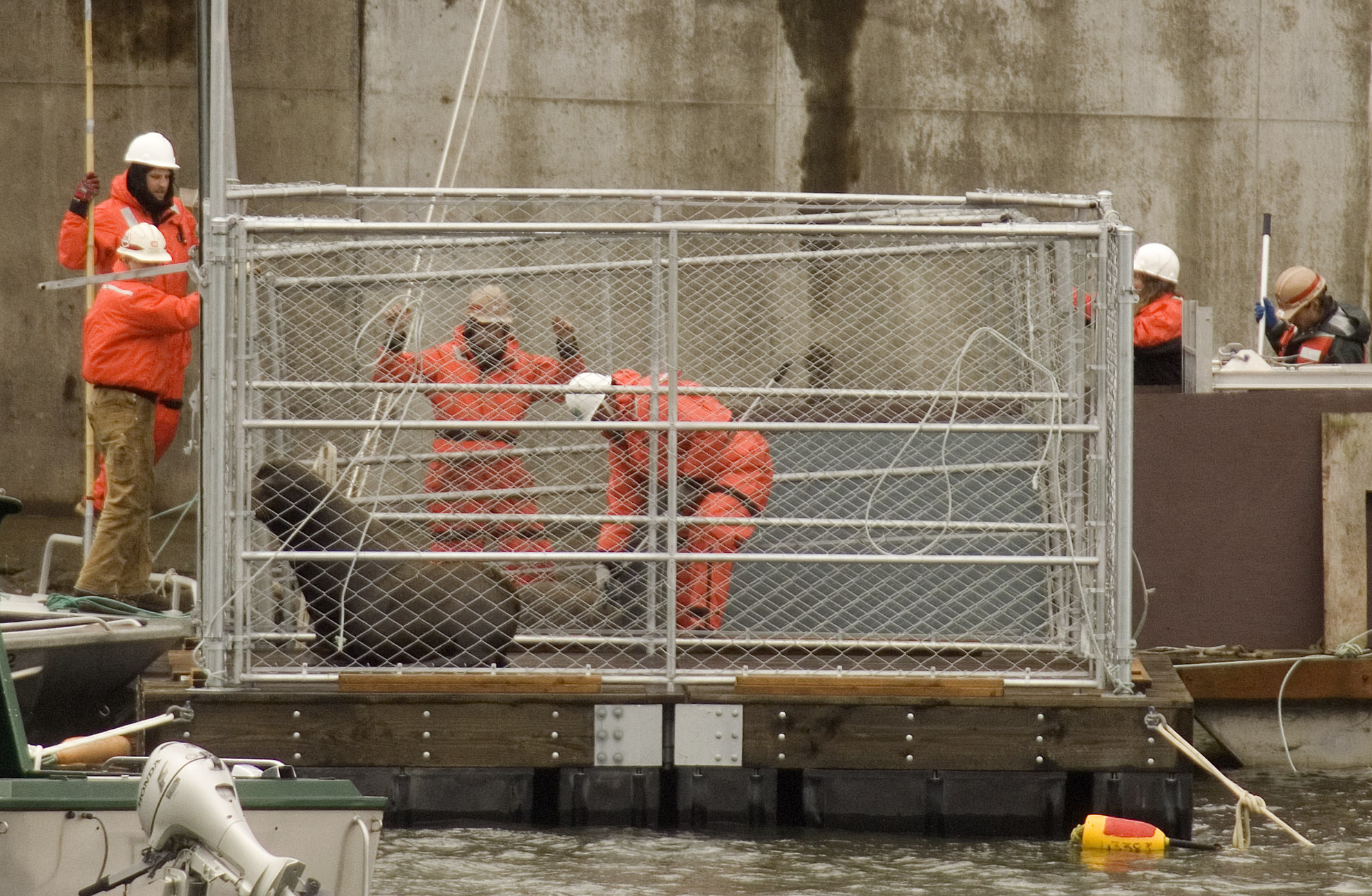
Brian Gorman, spokesman for the National Marine Fisheries Service in Seattle, said that since trapping began in early March only 11 sea lions marked for removal have been caught.
Four went to zoos, and seven were killed, all suffering from a precancerous genital condition. Zoos, Gorman said, want only healthy animals.
All the sea lions were on a government “hit list” of about 75 sea lions identified by brands and other markings as repeat eaters of protected salmon at the dam.
The states can remove up to 85 of the California sea lions a year for five years to reduce pressure on the salmon runs.
California sea lions are protected under the 1972 Marine Mammals Protection Act, which has an amendment allowing states to remove sea lions identified as salmon predators if the states request permission to do so.
Oregon and Washington, with support from Idaho, did so in 2006.
This year’s predicted adult spring chinook run was in the 300,000 range, based on counts of last year’s passage of jack, or young salmon, who head upriver a year early.
“The jacks are a fairly good indicator over time of what next year’s run will be like, but not year-to-year,” Gorman said Friday.
“In the past several years the runs have been later than usual. This year (the count of ) jacks is way up.”
As of Thursday, 56,598 adult chinooks had been counted at Bonneville. The 10-year average for that date is 120,490.
The jack salmon count on Thursday was 12,118 against a 10-year average of just 3,741.
Gorman said the 300,000 estimate still could be accurate, but that there may be a midseason adjustment in run estimates and catch limits.
The spring run is considered finicky about water conditions.
In recent years the run has been as low as 42,000 in 1999 and as high as 438,000 in 2001.
Observers at the dam are seeing about 20 California sea lions and another 20 Steller sea lions, Robert Stansell, a biologist with the U.S. Army Corps of Engineers, told the Vancouver Columbian, which first reported that sea lions hadn’t been showing up recently in the traps at the dam. Gorman said there is no solid explanation for the sea lion reduction.
Nearly 100 sea lions were estimated to have been at the dam last year.