
Returning native lands to their native state
Cd’A Tribe moves ahead with plans to rehab wetlands, help trout
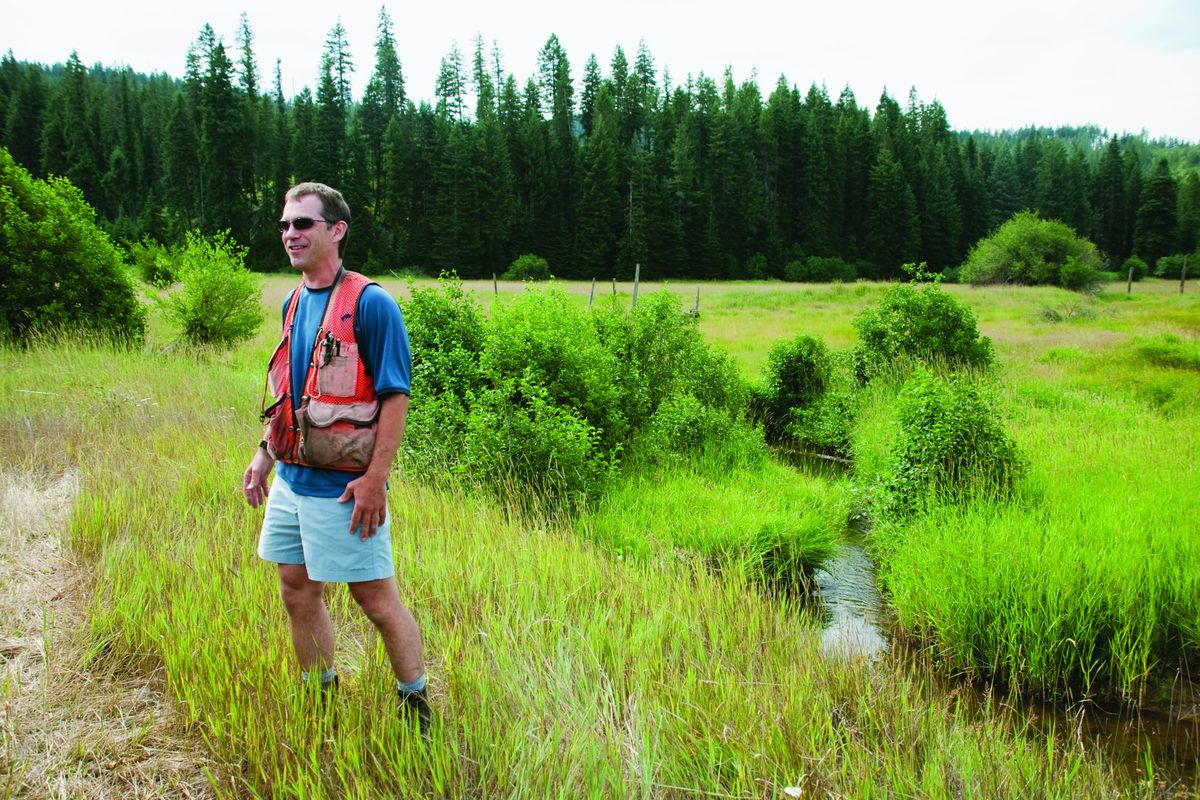
The Coeur d’Alene Tribe is returning its native lands to their native state.
As an intended result, more fish are living in the streams that wind through the reservation, and more birds are staying longer in its wetlands.
Unexpectedly, more beavers are making their homes there, and tribal scientists are breaking ground in the area of stream restoration.
The tribe has two initiatives under way, one of which has the ultimate goal of creating or restoring wetlands for North Idaho’s bird population. The other involves rebuilding streams to help cutthroat trout.
Cutthroat policies
In the early 1990s, the Coeur d’Alene Tribe took on what has proven to be its longest ecological effort to date: restore the cutthroat trout population.
Angelo Vitale, project supervisor who is overseeing cutthroat-habitat restoration, says the effort helps populations grow in four watersheds—Benewah Creek, Lake Creek, Alder Creek and Evans Creek.
Biologist Jon Firehammer says cutthroat trout have been monitored for about 15 years, and data suggests populations have grown since the mid-1990s. Specifically, he says, the number of juvenile fish counted each spring—biologists have fish traps set up at key points in the creeks and count and release the fish back into the stream daily—has grown in the past five years.
The increase in numbers has occurred in both resident cutthroat— which live in the streams—and what are called adfluvial trout, which are born in the streams and spend juvenile years there, then swim down to Lake Coeur d’Alene to live and grow as young adults, then return upstream to spawn. The migration is analogous to that of Pacific salmon and relatively unusual in cutthroat.
“There aren’t too many populations who use the lake to grow well,” Firehammer says.
One reason for the increases in fish populations is a moratorium on stream fishing in effect for several years.
What the tribe’s scientists believe will have a longer lasting effect on the cutthroat’s ability to thrive is a stream restoration effort, which Vitale says is essential due to how streams have changed over time.
When land in the valleys was developed for farming and the surrounding mountainsides began to be logged, Vitale says streams changed from slowly meandering waterways with deep pockets and rich vegetation on their banks to straighter, more shallow creeks through which water ran more quickly.
In some cases, he says, routes were altered intentionally, with streams re-engineered to maximize the amount of farmable land. In other cases, less vegetation surrounded the streams, and consequently, snow would melt more rapidly, and water would enter the streams faster, removing some of the meandering paths.
The most extensive current restoration involves digging out a stream’s original path and damming the current route so water flows as it did originally.
Much of the work has involved working within the existing stream to create deep pockets and slow the water’s flow. Along some stretches, the tribe has added rock to create ripples.
One big part of the project has involved buying logs and placing them in the water to simulate logs felled by beavers. In addition, some valley bottoms have been reforested with cottonwoods and aspens.
While mimicking the effects for beavers, something unexpected has happened, Firehammer says: the beaver population on the reservation has increased. More beaver dams are being built along streams, a positive for the cutthroat population because dams naturally create deep pools.
Many of the techniques employed by the tribe are largely experimental and could be benchmarks for future stream restoration.
“There are models for stream engineering, but stream restoration is really new,” Firehammer says.
While the numbers of cutthroat are growing, the population still is in a recovery phase. Ultimately, Firehammer says, the tribe hopes to see numbers grow to where tribal members can begin harvesting from streams again.
For the birds
The tribe receives hundreds of thousands of dollars annually from Bonneville Power Administration to help restore wetlands that dried up when hydropower dams were built in the 1900s.
With that money, the tribe buys former wetlands on the reservation and restores them to wetland and riparian habitat, says Cameron Heusser, wildlife program manager for the Coeur d’Alenes.
So far, the Coeur d’Alenes have bought 3,600 acres of land with BPA money. While the tribe owns the land, BPA holds a conservation easement on that property that states the property will be maintained in perpetuity as wild habitat.
The 3,600 acres represent more than 1 percent of the total acreage on the reservation. The bulk of the former wetlands is being bought from non-Indians, who own roughly 80 percent of the land on the reservation.
To restore wetland habitat, the tribe takes a number of steps once it purchases land, Heusser says. Often, that involves adding the ability to manipulate water levels.
In the Goose Haven area on the east side of Lake Coeur d’Alene, the tribe has installed a water-control system. That land floods each spring, but the water would drain off the land quickly. Now, the land is engineered to retain floodwaters longer.
In the Hangman Creek area, the tribe has realigned some stream channels and replanted hardwood trees along stream banks to restore waters to a more natural flow—one more inviting to wildlife. It’s paying off, Heusser says.
“The birds were already there, but they didn’t stay long,” he says. “Now, we’ve got them there nesting.”
The Coeur d’Alene Tribe hasn’t bought any land this year and doesn’t plan to do so. The tribe bought about 600 acres of land in 2008 and has focused efforts this year on improving and maintaining that property.
Land acquisition efforts could ramp up again soon, though. In addition to the annual BPA funds, the tribe has another large chunk of money coming from Avista for conservation efforts. The tribe and Avista agreed to a $150 million settlement in late 2008 that compensates the Coeur d’Alenes for past use of tribal lands and other factors. Heusser says a portion of that money will be used to address wetland loss, but that’s still in the planning stages.
“The tribe has an aggressive land-acquisition plan,” Heusser says.