
Scythe, shock, and stook
East Valley garden yields food, sense of community
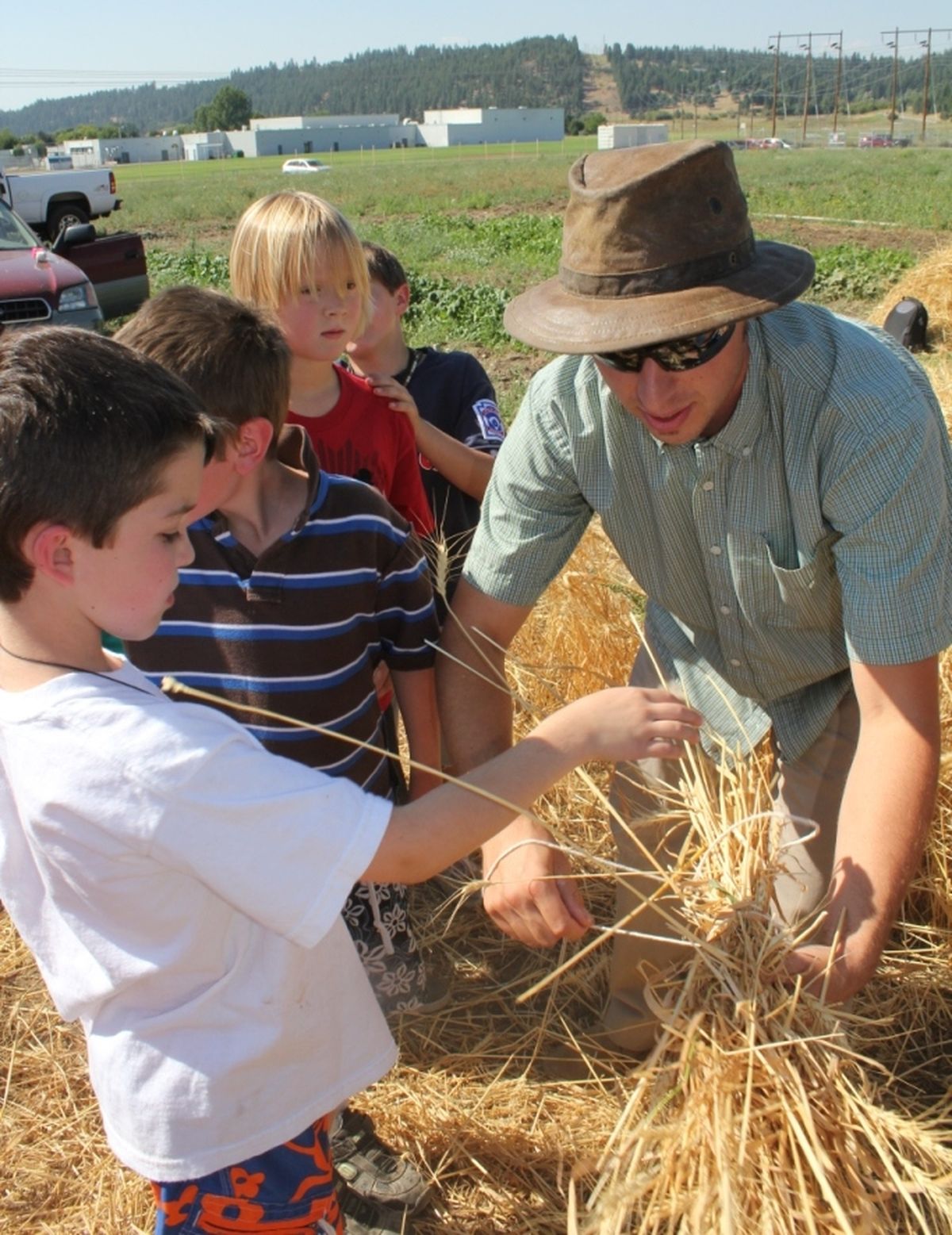
On a recent August afternoon, a group of second and third-grade students prepared to harvest a plot of golden wheat in East Valley School District’s new community garden.
The students attend John Conley’s class at the Continuous Curriculum School and were accompanied by their parents, siblings, and members of the community.
“I thought it would be a neat experience for my class to learn where food comes from and how we can use that knowledge to help hungry kids in other countries,” Conley says. “We decided to do the wheat cutting after school so community members and other staff members could participate along with the kids.”
Conley’s father, Dan, held a cradle-scythe in his hand as he explained the method used to harvest wheat during ancient times, a method the group would be using.
The teacher and several other adults, including an 80-year-old longtime farmer, took turns cutting small sections of the wheat with the scythe. The children then collected the wheat from the ground and helped form it into bunches, called shocks, and tied them. Next, the shocks were “shooked” into piles. Later, the class plans to use the wheat to make biscuits.
This 1,100-square-foot plot yielded enough wheat to feed a family of four for a year, the elder Conley says. The activity teaches the children delayed-gratification, he says.
The exercise had the desired effect on the children. “The students were amazed at how simple it was to harvest the patch of wheat. A few of my students were proudly showing off their scratches and how sweaty they were as a result of their hard work.
The parents seemed very excited about the project,” John Conley says. “For students, the garden is an opportunity to learn by doing. It takes responsibilty and respect for the earth to have a successful garden. We talk about these character traits in class all of the time but the garden turns it into a real world application and real life practice.”
Second grader Jack Wilber says the experience was fun. “You get to work outside and you get to work with your friends. We’re going to try and help people on the other side of the earth who don’t have no food like us.”
Parent Matthew Pedersen believes the experience of harvesting was a good learning experience for his daughter, Sarah. “I think it’s a great idea for them to see where their food comes from (instead of) just from a box and into their mouths.” Pedersen, who took a turn cutting the wheat, now is thinking about adding the crop to the family garden.
Student Addison Meyer picked out a few small seeds and popped them in her mouth. “How do they taste?” she was asked. “Yummy.”
The community garden is part of the district’s Farm to School program, which was launched a little over a year ago. The program is the next phase of East Valley’s health initiative, which works to promote healthy eating habits and consumption of locally-grown products. The garden is located between the high school, at 15711 E. Wellesley, and East Valley Middle School.
This summer, 10 pounds of lettuce were harvested and used by the school district’s kitchens to feed students, says Lynette Romney, who helped organize the creation of the community garden. The garden is yielding beans, broccoli, squash, cucumbers, parsnips, and bok choy. In addition, several hundred pounds of tomatoes could be harvested, weather permitting.
In September, the district plans to harvest 11,000 pounds of potatoes. About two thirds of the crop will be donated to the Second Harvest Food Bank, while the remainder will be used by the school’s kitchens, she says.
“The garden is producing and feeding people who are hungry,” she says. “We’ve taken every avenue we can think of to make kids productive and learn.”
In the future, the district plans to increase the size of the area it plants from two acres to four. “Our vision is getting bigger.”
Romney says the garden also is yielding a sense of community.
“The garden has been a great tool to bring our community members together. I have seen folks chatting at the garden as they water and tend their beds and field crops. People have stopped to talk through the fence as they walk or drive by. … Another young woman saw me out in my cast/boot this spring moving irrigation lines and said I was a great role model to her. Please know that I am not bragging, but that I feel a tremendous amount of humility and responsibility for the example and vehicle for good that this garden is.”
One Saturday, a group of more than 20 air force personnel in the Fairchild Air Force Base Airmen Leadership School spent time working in the garden and learning about the school district’s program.
“Every time we have a class, we do a community service project. It’s a worthy cause,” says Tech. Sgt. Mike Wright. “Everybody wants their kids to eat healthy.”
For the airmen, it “broadens their horizons and cultivates an awareness of the community.” While the base’s mission might be to “put planes in the air,” it is committed to enriching the community that surrounds it, he says. “It’s humbling work.”
Michelle Lucero, a student in the leadership class, enjoys gardening. “I think it’s a really good thing they’re doing here … growing their own food and donating it, teaching kids skills.”
She appreciates the experience because it allows her to give back to the community. “On an Air Force base you’re kind of cut off from the community.” It’s good for people to see members of military in the community wearing their civilian clothes.
“Most of us are college age. We’re just like anybody else,” she says.
At the end of the garden’s first growing season, Romney has high expectations. “I see each school having their own raised bed. I see clubs growing crops in fallow fields throughout the district to sell and pay for expenses,” she says. “Kids need to have an understanding of what goes on in food production. Their understanding at a young age of this process will help them in other areas of their lives. …This garden is just the beginning.”
Says Conley, “By creating the garden, the district has created a positive, community oriented, environment. Our superintendent and other administration staff have done an exceptional job of giving people a place to grow their own food and make our East Valley community better connected to the earth and one another.”
Individual plots at the East Valley School District community garden are available for free. To reserve a plot in the East Valley community garden or for more information, call Lynette Romney at (509) 230-9436.