
Experts pan new spotted owl plan
Administration approach no improvement, they say
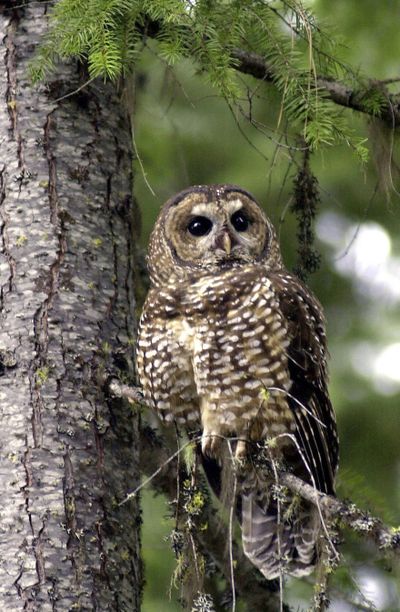

GRANTS PASS, Ore. – The Obama administration’s plan for saving spotted owls isn’t much better than the one proposed by his predecessor, experts on the threatened bird said.
Wildlife scientists said both administrations put too much blame on wildfire as a major threat to the survival of spotted owls and did not do enough to protect old-growth forest habitat from logging.
The scientists were hired by the U.S. Fish and Wildlife Service to review the Obama plan and included some who were involved in a lawsuit challenging the Bush plan.
“The main point is, ‘It’s the habitat, dummy,’ ” said Dominick DellaSala, chief scientist for the Geos Institute in Ashland, who served on the team drafting the 2008 owl recovery plan for the Bush administration. “The Fish and Wildlife Service just doesn’t get it.”
The institute is a plaintiff in a lawsuit challenging the Bush administration plan.
Reviewers also complained the U.S. Fish and Wildlife Service did not use the best available science – required by the Endangered Species Act – to create the draft plan.
The northern spotted owl was declared a threatened species in 1990. The owl’s need for old-growth forests has long put it at the center of legal and political battles over logging in the Northwest. Lawsuits from conservation groups led to a reduction of more than 80 percent in logging on federal lands in 1994, causing economic pain in many logging towns.
Reviewers for the Wildlife Society said the Obama administration plan justified the need for logging to reduce fire risk when there was plentiful evidence to the contrary.
Studies show that prey may actually increase for owls in burned-over forests, and the rate of severe forest fires would have to increase five to eight times to pose a serious threat to the amount of habitat, they wrote. Meanwhile, there is minimal research to show that thinning forests does not drive out spotted owls.
They acknowledged that the latest draft was better than the Bush plan but complained the draft plan was incomplete.
It lacked a design for habitat reserves, making it impossible to determine if enough habitat would be protected for existing owls, as well as expected increases as the species recovers, they said.