
Beef Revolution – One Acre at a Time
Solar Dollars are in Grassland Management
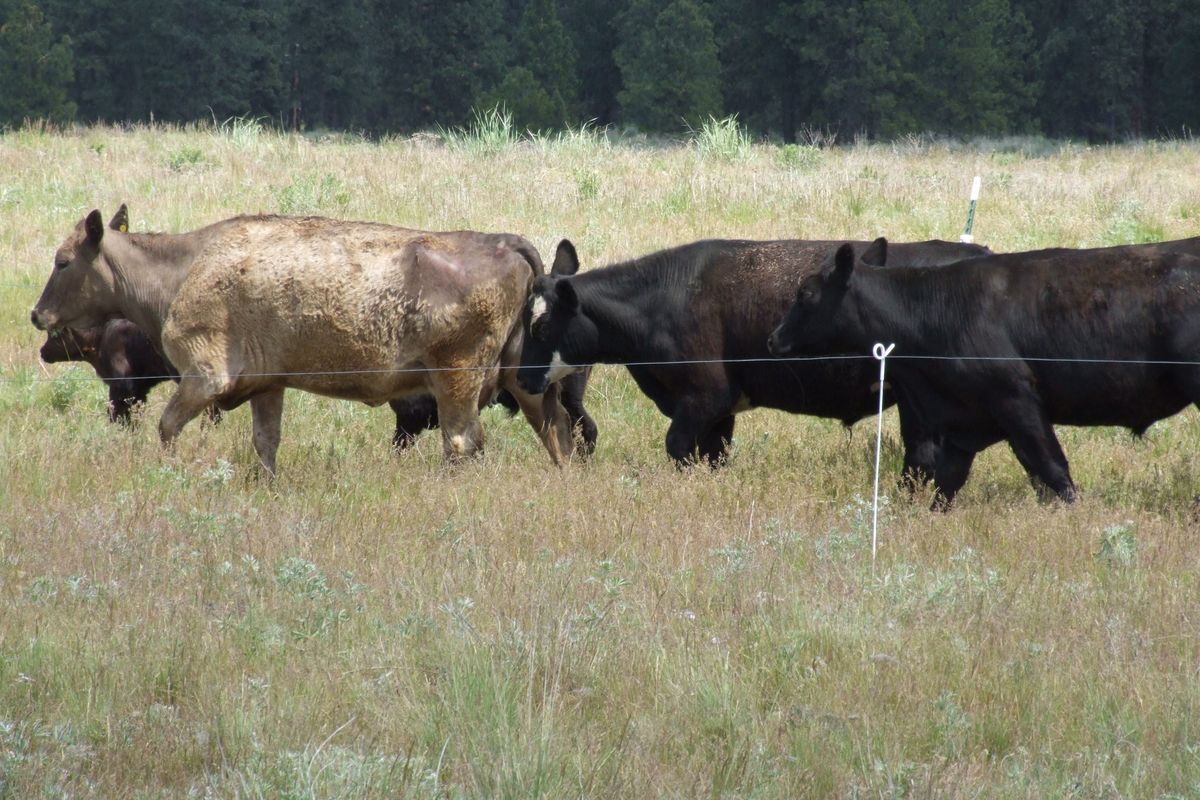
For some cows, yearlings and calves, grazing on natural grass can be an electrifying experience – as in 6,000 to 8,000 volts of incentives.
Imagine huge marked-off pie pieces, high voltage lines radiating out to a hub, directing cattle to the prairie grasses; then picture a strategic watering trough and salt licks so the cows self-herd themselves. Then visualize a new-fangled cowboy marching around, multiple times a day, to make sure those grasses don’t “get all bit up to hell.”
It’s part of a magical thing called managed holistic grazing, which started millennia before ranching took hold anywhere. It’s was seen in buffalo grasslands in the Dakotas, or Zimbabwe, where grass eaters like wildebeests, zebras and antelopes only got so much time to nibble before big predators came in.
Around here, past generations of deer and elk could never do much damage to prairies because there were always enough bear, cougar and wolves around to scare them to other plots.
For Maurice Robinette, high-intensity grazing practices and a longer, more intentional “rest” period for the land are the elements to how he ranches 100 pairs of cattle and calves. He’s a fourth-generation cattle rancher, but his Lazy R ranch near Cheney is an experiment in ecosystems management tied to innovations started by former Rhodesian rancher Allan Savory who has helped to play out forms of high-density, rotational, and managed intensive grazing, or as Maurice calls it, planned grazing.
“Essentially, it’s a process of putting the right number of animals at the right place at the right time of the year for the right length of time,” Robinette shared with 32 ranchers, farmers, and experts tied to small farming, part of a Washington Tilth Producers and Washington State University Small Farms Program 2010 Farm Walk.
Ten farm walks are scheduled from April to November, developed by WSU’s Marcy Ostrom and Tilth’s Carey Hunter (Pine Stump Farm).
“We try to match the nutritional requirements of the animal to the forage availability of the land,” Robinette explained. “Here, we place a heavy emphasis on biodiversity and try to preserve wildlife habitat through practices.”
It sounds complicated, almost dreamy in a green sort of way, but it’s still cattle and calves and all about butchering and bringing grass-fed “product” to meat eaters’ tables. Robinette and other practitioners of holistic management and planned grazing are moving high numbers of grass foragers – 100 cows and calves per acre in some instances – frequently.
They use high-voltage monofilament wires to keep animals in proscribed paddocks while monitoring exactly how much plant matter they eat. “My cows travel well and have learned to herd themselves into trucks so I can move them from paddock to paddock with very little stress on them or me.”
This is the height of sustainable meat producing, not oxymoronic to ranchers who find growing hay or importing it to feed cows antithetical to energy efficiency. Compared to unsustainable Confined (sometimes called Concentrated) Animal Feeding Operations and bizarre steroid, antibiotic, fungicide input for one cattle finishing operation where cattle eat corn, soy, manure and rendered animal kill, this style of ranching is a dream come true.
“Bringing in hay is importing nutrients instead of exporting nutrients. That’s not the goal in good management, “said Don Nelson, WSU beef specialist, who sees the power of on-site solar power and photosynthesis as the keys to sustainable beef.
On the Lazy R, Robinette is working five chunks of land totaling 1,000 acres. One section is adjacent to three other plots subject to three different farming/land practices – one field is Timothy hay cut annually. Another is basically left as is, similar to a conservation easement. The third type is conventional grazing.
With the fourth type of land use – holistic, planned, intensive grazing – it’s easy to see a diversity of plants and flowers, plus richer, thicker, taller grasses. Birds, moths, butterflies and ants abound.
While cattle are his “tool” for ecosystems management, Robinette is out of the hay business in terms of growing and harvesting.
“It’s not easy shifting from a conventional mode to a new paradigm,” Robinette said, jokingly characterizing himself as a “recovering conventional rancher.”
Even after 14 years of moving cows from paddock to paddock, attending a two-year Washington Agriculture and Forest Program leadership course, and working with some of WSU’s land, soil and ag specialists looking at carbon sequestration as a ranching process, Robinette still has an uphill battle convincing conventional ranchers that holistic and planned management works.
So many ranchers worldwide overgraze, depend on hay, and finish off cows with corn and soy. Land stewardship is key to holistic management, however. Grasslands throughout Washington are damaged from overgrazing whereby the soil dries out, biodiversity shrinks and invasive and uneatable plants like yarrow come in.
Much of the grasslands taken out of farming or ranching through a federal supplemented incentive, Conservation Reserves Program, are full of grey or wolf grass and have less abundance in variety and numbers. Robinette has learned through innovators like Savory, Dick Divens and others, and by experiencing it himself, that if the grass is eaten down to a certain volume, not only are the rhizome-based roots full of life-sustaining carbohydrates, but shafts and blades above ground allow for robust and dynamic photosynthesis.
The plant then produces more biomass.
Nelson pointed out that this formula has little to do with the plant’s height: 50 percent of the typical grass species’ volume is distributed in the last one-fourth or one-third of the plant’s lower above-ground portion.
This is where another key ingredient to high-density grazing systems comes in – monitoring the ecosystem. Robinette employs what’s called a Land EKG to set up a baseline on his land to determine plant fecundity and variety, wildlife and how the orchestrating of sun, water, mineral and cow changes over time.
Robinette has a master’s in rural sociology, and can easily discuss issues tied to environmentalism, global warming, peak oil, health care, food issues, and sustainability. He and his wife share two daughters, one of whom is finishing a sustainable agriculture degree from Western Washington University. She graduates soon and wants to help with the direct marketing of the Lazy R beef, available at Main Market.
We look over the green-looking prairie, where Robinette notices the high density of yarrow, and sees the shape of the season now unfolding by the number of cow pies per step. Lupines dot the prairie, but Robinette knows there are 300 varieties, one of which is poisonous to cattle.
Choices are many for today’s ranchers – graze the land easy, hard, intensely; rest it; burn it; or apply Round-up. Robinette is putting his cows and money on the power of rest and recovery for grasses that have evolved over eons to take heat, cold, drought, fire and the hooves and teeth of foragers.
He’s always noticing weeds and grasses, how much alfalfa is in one paddock, how much canary or quack grasses are in another. He knows you pay the price of letting cows come in too early to get a second graze. He’s noticing yarrow coming in like gangbusters on one section.
“I’m always thinking. Essential oil from the yarrow plant is $200 an ounce. Who knows, I might go into the yarrow business. What do they say, ‘if you have lemons, why not make lemonade’?”
For more information about holistic grazing or Lazy R Ranch, visit lazyrbeef.com or email maurice@lazyrbeef.com.