
Visual appeal
Designer asked to paint mural promoting community garden
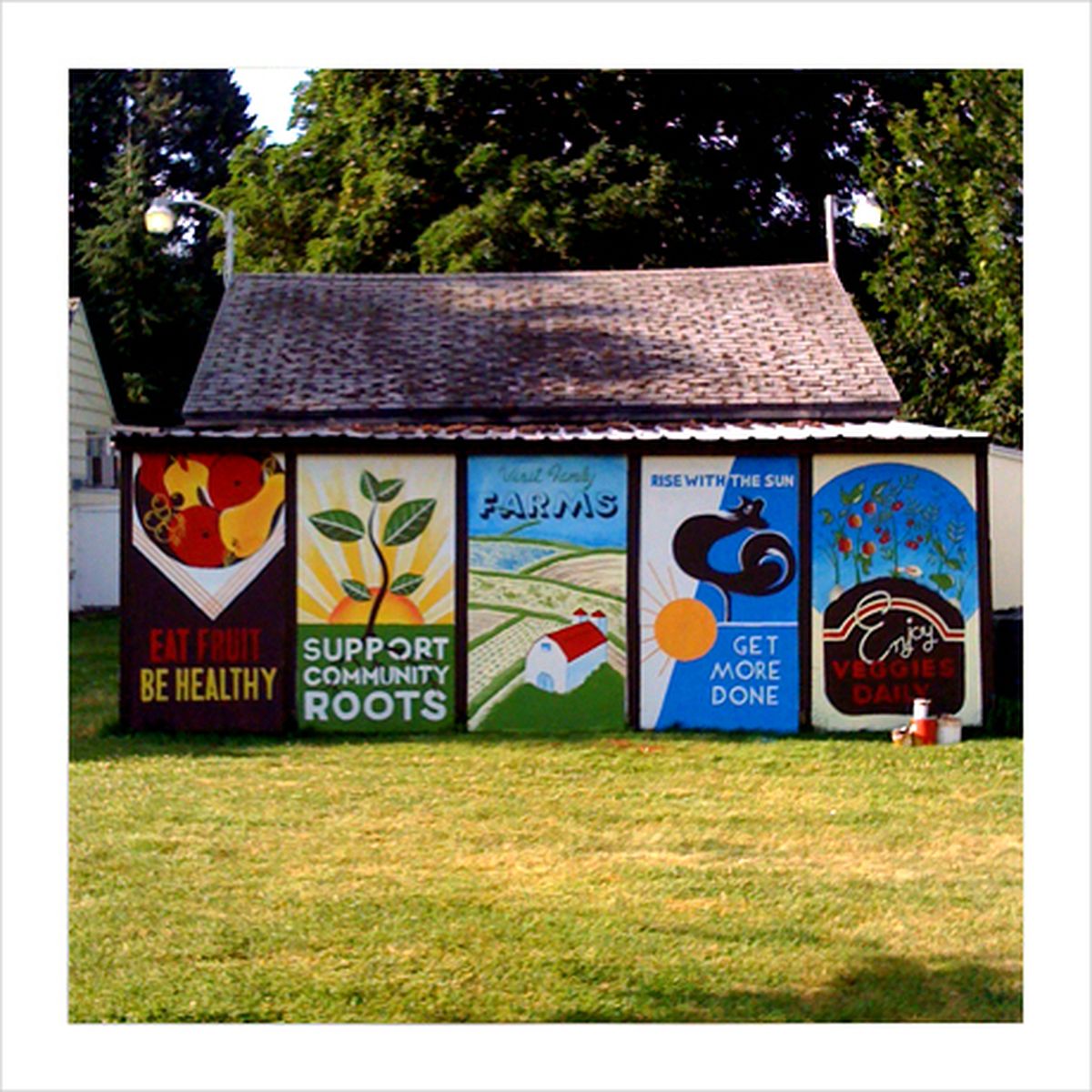
Artists sometimes humbly say that their paintings of nature pale in comparison to the real thing. But there’s a small farm in North Idaho that doesn’t have to choose between fine art and earthly beauty.
Community Roots, which is a program sponsored by Kootenai Environmental Alliance, runs a community-supported agriculture (CSA) program on a 1.5-acre piece of land in Dalton Gardens.
The farm spans the properties of two neighbors and friends—Gayla Mosley and Linda and Scott Stranger—who donated the use of their land to Community Roots’ mission.
As if a bountiful field of vegetables and herbs isn’t gorgeous enough, a painting of vibrant sunflowers flanks the side of a barn that sits on Strangers’ property. It was created by their daughter, Annie, when Annie was a student at Coeur d’Alene High School in the mid-1990s.
Annie lives in New York City now, working as a freelance designer. While visiting home in August, the Community Roots organizers approached Annie with an idea: would she consider painting another image, this time on the side of a shed on Mosley’s land?
Like the organizers behind Community Roots, Annie is passionate about growing and eating sustainable food. She co-authors a blog with a chef called Chew on This, which is about the “health and environmental benefits of eating locally.”
Together, they created an illustrated wheel that, when turned, reveals the best times of year to buy locally-grown produce in New York and offers tips on preparing and storing vegetables, fruits and herbs. Their food wheels have been featured in Martha Stewart Living magazine.
So when Korrine Kreilkamp, Community Roots’ founder, approached Annie with the shed-painting idea, the immediate response was, “Heck, yeah! Sign me up. I’d love to,” Annie said in a telephone interview.
In her line of work, she said it’s rare to be able to contribute to something about which you’re personally passionate.
“I’m not a chef. I’m not a biologist. I’m not a teacher,” she said. “All of the ways I saw people contributing (made her assume) I didn’t have the skill set to be a contributor. It’s rare to have an opportunity to do something that’s impactful and meaningful.”
Annie presented Mosley and Kreilkamp with two different concepts. One would show the progression of a pumpkin, from seed to harvest. The other idea, which was ultimately chosen, was to treat the side of the shed as five separate panels, and to paint an image on each inspired by the artwork funded by the Works Progress Administration in the 1930s and 1940s.
Like the Depression-era posters, each of Annie’s images touts a message about health and contributing to the greater good:
Eat fruit, be healthy.
Support Community Roots.
Visit family farms.
Rise with the sun; get more done.
Enjoy veggies daily.
The project took five days to complete, and as a thank you for her work, Community Roots sent Annie “the most amazing selection of garlic.” She said being out in the North Idaho sunshine was a welcome benefit, too.
“I got the first tan I’ve had in 10 years, although only the back part of me got tan,” she said.
Kreilkamp, the Community Roots founder, said her group is thrilled with the finished product.
The program is wrapping up its first CSA season, but the Community Roots effort began in 2007.
It started as an organization that helped backyard gardeners and farmers deliver their surplus crops to food-assistance programs. As part of that, Kreilkamp organizes volunteers to pick fruit trees that otherwise would go unharvested.
In 2009, Community Roots started a community garden with 52 plots in downtown Coeur d’Alene called Shared Harvest. That spot also acts as a central distribution point to bring extra produce to people in need. The food is delivered via bicycle to reduce the program’s carbon footprint.
Kreilkamp saw the need for a larger agricultural component, and met Caleb Goss, who’d been working for eight years as a farmer for Killarney Farm, a certified organic operation in Cataldo, Idaho.
Goss was interested in starting something new, so he and Kreilkamp teamed up. They were eyeing Dalton Gardens because the town is zoned so that lots are a minimum of 1 acre in size. In other words, there was a lot of fertile land just being mowed, Kreilkamp said.
They met Mosley first, while harvesting fruit from her property for donation to the Community Roots program, and then the Strangers became interested in donating the use of their land after hearing the idea to put a small farm on their neighbor’s property.
Roots CSA, as it is called, started with 30 shareholders this year, half of whom pay the $200 to receive a box of fresh produce every other week between July and October. The other half of the shareholders pay $100, a discount granted based on their income level.
The CSA includes a newsletter with each box, educating shareholders on what produce is inside, how to store it and how to prepare it.
“We talk about what’s going on with the land, the soil, what the issues are that week, and then there’s a page of recipes, tips and ideas,” Kreilkamp said. “As the organizer, you don’t realize how much people value that until you don’t do it one week.”
The produce isn’t certified organic, but it’s organically grown.
“Caleb doesn’t know how to farm any other way,” Kreilkamp said.
Shareholders are encouraged to help harvest crops during busy times of the season. They also benefit from the program by simply visiting the farm to retrieve their produce, Kreilkamp said.
“Each time you pick up that box, you get to talk with the farmer, you get to look at the land and touch it,” she said. “You’re building a relationship with the land.”
Community Roots has begun involving neighboring schools in the program in an effort to educate children about nutrition and give them a better understanding of foods’ origins.
Students from Canfield Middle School, for example, made flags to hang on the farm’s surrounding fence to help keep away deer.
And, of course, to further beautify a space already filled with art—manmade and natural.
For more details visit www.kealliance.org. Annie Stranger’s blog can be found at www.chewonthis.org/site.