
Cyclists help create community in Columbia City
How diversity, economic struggle, and pedaling empower youth in Seattle neighborhood
What the heck do the theories of John Dewey and Jean Piaget have to do with grinding pedals and shifting through a well-lubricated derailleur?
Or how does the following Confucian philosophy tied to experiential learning figure into a South Seattle neighborhood where more than 40 different languages are spoken?
“Tell me and I will forget. Show me and I may not remember. Let me try and I’ll understand.”
For young and old in Columbia City, Wash., hands-on biking means giving back to the community – working on donated bikes, learning how to work as a group, and taking that learning into their own hands.
“We’re not trying to keep youth from doing bad things. We’re turning people onto good habits,” said Jake Beattie, Bike Works executive director, a business in the southern reach of the shadow cast from Beacon Hill.
Beattie is serious about turning tables on education, advocating that youth, ages 9-17, own the experiences of bike trips and bike maintenance by planning and organizing activities themselves. Too often, adults dictate what’s fun and worthy to young people, and that comes crashing down.
Since 1996, Bike Works has provided bikes, classes and youth outreach for this diverse neighborhood of pho venders, comida corrida restaurants, bars, pea gardens, funky shops, check cashing joints and older homes, imbued with murals and glued together with an eclectic collection of African-Americans, Hispanics and immigrants from Etruria to El Salvador, Hanoi to Cairo.
Columbia City is a little gem of neighborhood-scale inside a greater city that’s way too expensive, too metro-sexual, way too car-centric, and too big on itself “green wise.”
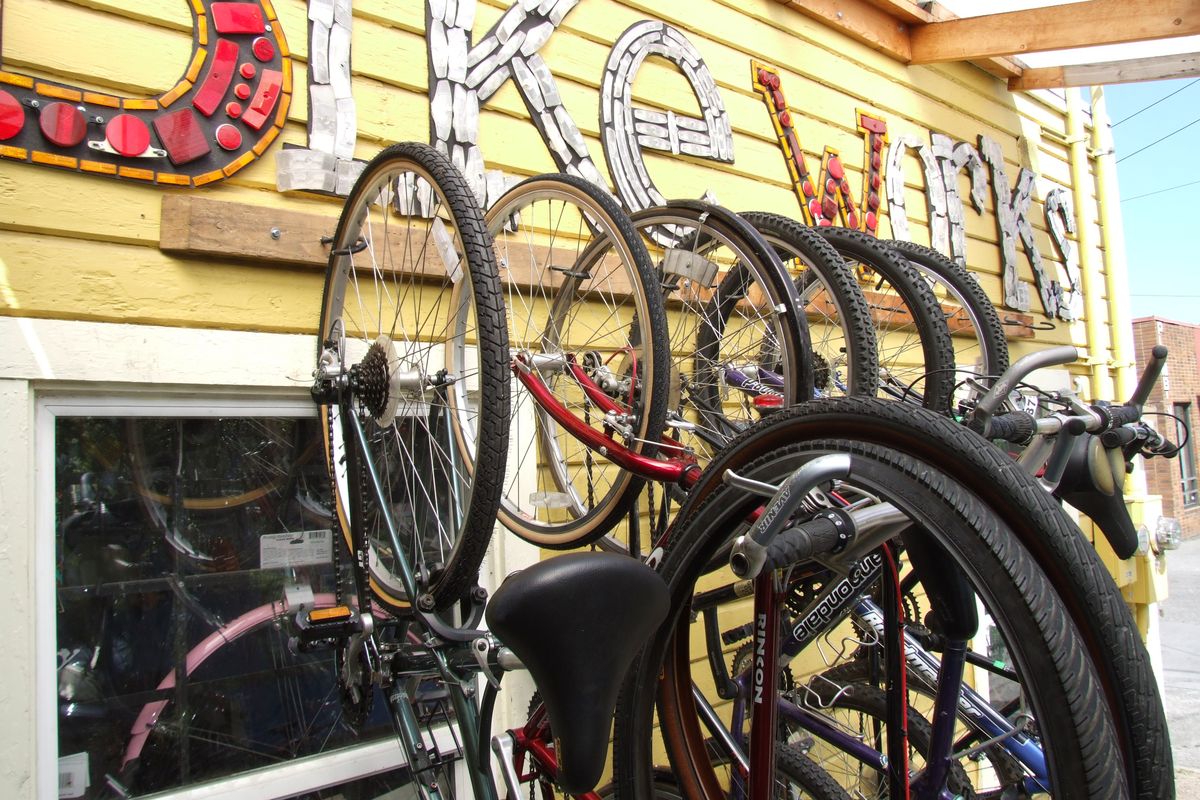
The bright yellow bike shop functions as a social enterprise – it’s the only bike business in the area, and as such the staff and volunteers sell low-cost used bikes, parts and repairs.
Bike Works also provides youth programs including one where a bike can be earned after throwing in 18 hours of community service working on bikes and with customers.
Beattie says more than 1,000 hours a year under this program are put into Bike Works’ projects. A total of 3,700 hours are managed by over 350 volunteers. Additionally, the popular annual bicycle swap has grown exponentially: the 2010 swap saw 300 families coming in for bikes.
“I love bikes,” said Donaldo Villarreal, a 33-year-old from North Dakota who has been working with bicycles for more than nine years, three with Bike Works, two as a Seattle bike messenger, and four in Tucson with the BICAS (Bicycle Inter-Community Action & Salvage, a non-profit similar to Bike Works with community education programs and a recycling center for bicycles).
“It’s so empowering for someone to be on a bike, learning how to ride and at least learning how to fix a flat,” Villarreal said showing me around the warehouse where he works on many of the hundreds of bikes representing manufacturing years all the way back to 1970, and all shapes, sizes, and colors and range of mechanical conditions.
Both Villarreal and Beattie emphasized how more people in this neighborhood and other Seattle boroughs are turning to human-powered transportation.
“Right after the economic crash, all sorts of businesses were closing up in this neighborhood, “ Villarreal said. “Bike Works’ business went up.”
Cars repossessed, auto insurance prices spiking, even the rise in a bus ticket (now $2 for each Seattle trip) were catalysts for some to try cycling for work, errands, trips to the store. Other motivators include wanting to get back into shape or concerns for personal and environmental health.
Bike Works’ other youth programs include multiple day “bike and camp” tours; a two-week Olympic Peninsula loop trip; and a 400-mile Oregon-California trek. Beattie says his organization works with the Seattle Girls School, as they use a four-day San Juan Islands bike tour as a graduation trip. Beacon Hill Elementary partners with Bike Works on programs to get youth to explore neighborhoods on their bicycles “without parents worrying about them.”
Adult classes are held in the old cobbler’s store that now is Bike Works, including courses on general repair, wheel making and winterizing bicycles.
Beattie, Villarreal and others with Bike Works repeat the power of mentorship and bringing youth to appreciate their community, the built community and the bicycle one. Sometimes it’s a matter of getting out of the bubble of the car and seeing a city anew, from a 21-gear inter-urban bike.
Columbia City 15 years ago was in perpetual decay, and Beattie emphasized a bit of a spark to Bike Works’ genesis, in the form of a city grant which allowed youth and others to draw murals on all the plywood shuttering up the defunct businesses. That little act of beautification had a deep effect on the individuals, as well as gelling the community’s collective consciousness.
Now, the area is vibrant, with a strong business district and some gentrification. Beattie sees this trend as the story of Seattle the past two decades.
“Neighborhoods near the core are revitalizing … but also gentrifying,” he said.
Fremont was once affordable for artists and bohemians, but now they are priced out. Wallingford was a working-class neighborhood with a dump and gasification plant; now it’s overpriced homes. The same with Ballard, where Beattie grew up.
The sustainability aspect of what Bike Works provides isn’t just clean transportation that doubles as exercise. It puts a huge dent in removing bikes from the waste stream. Various studies say 15 million bikes a year in the U.S. end up dump-bound.
Bike Works’ building is owned by Craig Lorch, president of Total Reclaim, an electronics (e-waste) recycler that has seen 18 million pounds come through his center in one year. Lorch is on the board of
Bike Works and spearheads a program called Bikes to Communities Abroad.For the past decade, Bike Works and dozens of volunteers have shipped 4,000 bikes and tons of parts to Ghana, West Africa, under the vision of Lorch and others (including Moscow, Idaho’s Village Bicycle Project.)
FareStart, a restaurant training program for Seattle’s homeless, partners with Bike Works – graduates of FareStart receive a free bike from Bike Works.
In the end, though, Bike Works resembles a mom and pop bike shop. The staff down-sells customers, and Beattie said they try and remove cultural barriers to bike riding, to get people comfortable and at east at the shop.
The basic concept of getting people outside, on a bike, is important to community building.
Beattie’s own motivation to join Bike Works in November 2009 came after years working on tugboats and commercial freighters and then later on tall ships and with Outward Bound-type programs – these enriched and sometimes intense experiential hands-on classroom models.
The learning for these participants comes from crucible moments, when we’re thrown into experiences forcing us to create connections to ourselves, Beattie said. Those connections aren’t couched in sophisticated urban planners’ or sociologists’ constructs, but rather in the simple act of making a city smaller by getting on a bicycle.
“We need those connections,” Beattie concluded. “Too often we exist in a world of bubbles.”
These can be Seattle-style series of bubbles — from the condo bubble to the car bubble to the office bubble back to the car bubble back to the condo bubble.
“Getting outside is important to community building.” No fancy talk about this or that theory from this or that Ph.D. One community bike shop at a time is the formula all cities should adopt.