
World embraces fabric gift wrap
Spokane company partners with Indonesia supplier
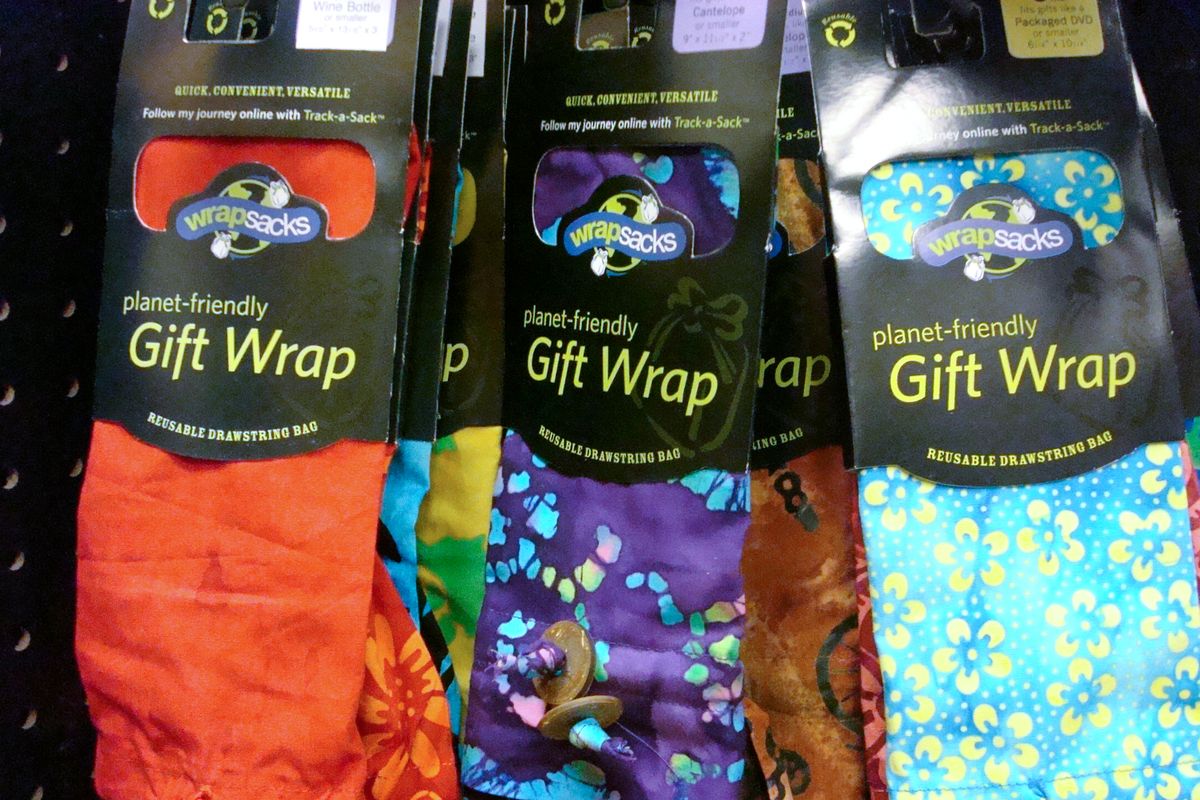
The sight of torn gift-wrap spilling out of crammed trash bins on Dec. 26, 2001, was enough to quash Kathryn Hapke-Miner’s holiday spirit and to prompt her to find an alternative.
The environmentally conscious mother of two decided that reusable gift bags were a more responsible choice for the planet and could transform “re-gifting” from a social taboo into a fun and admirable pursuit.
Consumers agreed, and the Spokane family now sells colorful fabric gift bags plus lunch sacks, totes, and greeting cards all over the world through its company Wrapsacks.
While contemplating the perfect size and design, Kathryn became interested in the ancient batik method of dyeing fabric, where melted wax creates patterns as dye reacts to sunlight. The method has strong cultural significance in Indonesia, as evidenced by UNESCO’s 2009 designation of Indonesian batik as a Masterpiece of Oral and Intangible Heritage of Humanity.
Kathryn decided that batik could give her bags the colorful, unique patterns she was looking for, and she travelled to Solo, Indonesia, a city thriving with small, family-run batik factories that still practice the art form without the aid of machines. Kathryn met a small group of willing artisans, and since then, she and her husband Michael have visited the artisan community nearly every year to connect with the people who dye and sew their bags.
“In theory we could do everything by email,” she says, “but we choose to visit.”
The business-owner believes strongly in the value of direct communication. “Technology has made face-to-face interaction a rarity,” she says, “People often don’t even hear a voice anymore, and that’s unfortunate. I want the people we work with to know there is a face behind the company.”
It is this commitment to human interaction, combined with her devotion to environmental stewardship, that prompted Kathryn to create Track-A-Sack, an online registry that makes re-gifting no only acceptable, but fun – senders can name their bag and track its journey.
“I was worried that people would hoard the bags, rather than re-gift them,” she said, which would entirely defeat their purpose as a greener alternative to disposable gift wrap.
“So often people get a gift bag and save it because they don’t want to accidentally give it back to the same person and be seen as thrifty or cheap. But when you’re able to name the bag, give it a goal and watch it travel around the world, that puts a positive spin on re-use. Now, the fun of watching the bag travel is part of the gift, as opposed to something you just throw away.”
To date, 29,922 “wrapsters” have registered gift sacks on the web site by giving their sack a name and a goal, such as “travel 10,000 miles” or “travel to Europe and back.”
The top “wrapster” has sent 135 bags travelling around the globe. She lives in Bonduel, Wisc., and is nicknamed “tdlee.”
For each registered bag, the site shows the recipients and their locations, the gifts and the occasions, and the total miles the bag has travelled. So far, participants have recorded 36,610 giftings on Track-a-Sack.
A quick click reveals that a mother in Oregon received a “magic goddess wand” from her daughter on Thanksgiving, and a mousetrap travelled 31 miles to celebrate a birthday in Michigan.
The most generous city by Wrapsack’s standards is Portland, Ore., where 969 gifts have passed through. Spokanites, by comparison, have participated in 367 gift exchanges.
For Kathryn, these numbers mean significant reductions in paper waste and proof that re-gifting is slowly losing its stigma and may even become popular. “Because we are such a busy society,” she explains, “I think that we just go for what’s easiest and what we know. My goal is for more people know about this option, to understand its purpose, and to really see the need to be more conscious.”
The business-owner’s broader goal is for people to start using re-usable alternatives for everything. “Wrapping paper is just one small part of what we should be doing,” she says.
That “small part” she is referring to is the disposable paper gift wrap industry that generates annual sales of $5.1 billion.
Wrapsacks can be purchased online at www.wrapsacks.com or at Huckleberry’s Natural Market on Spokane’s lower South Hill. The bags come in 6 sizes.