
Army stands down
Military vows no action against civilians; groups will meet today to discuss goals
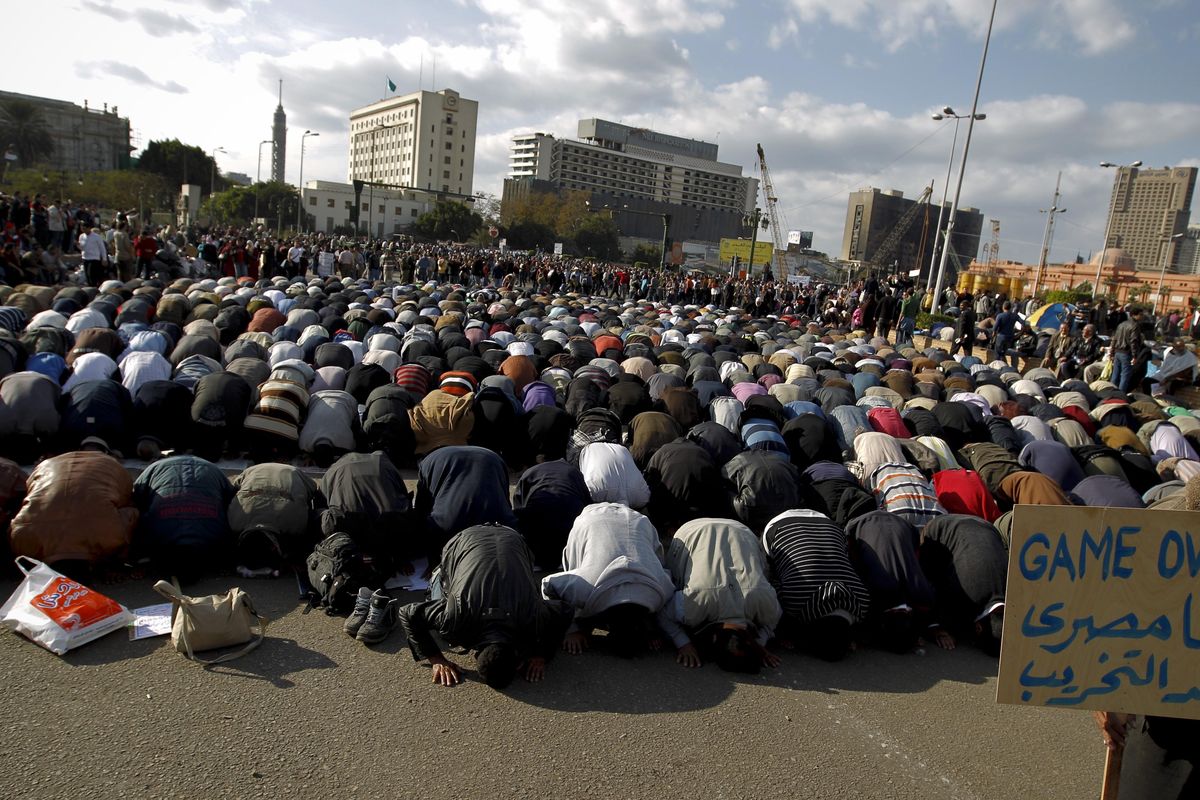
CAIRO, Egypt – Egypt’s military pledged not to fire on protesters in a sign that army support for President Hosni Mubarak may be unraveling on the eve of a major escalation – a push for a million people to take to the streets today to demand his ouster.
More than 10,000 people beat drums, played music and chanted slogans in Tahrir Square, which has become the epicenter of a week of protests demanding an end to Mubarak’s three decades in power.
With organizers calling for a “march of a million people,” the vibe in the sprawling plaza – whose name in Arabic means “Liberation” – was of an intensifying feeling that the uprising was nearing a decisive point.
“He only needs a push!” was one of the most frequent chants, and a leaflet circulated by some protesters said it was time for the military to choose between Mubarak and the people.
Firings fail to mollify
The latest gesture by Mubarak aimed at defusing the crisis fell flat. His top ally, the United States, roundly rejected his announcement of a new government Monday that dropped his highly unpopular interior minister, who heads police forces and has been widely denounced by the protesters.
The crowds in the streets were equally unimpressed.
“It’s almost the same government, as if we are not here, as if we are sheep,” sneered one protester, Khaled Bassyouny, a 30-year-old Internet entrepreneur. He said it was time to escalate the marches. “It has to burn. It has to become ugly. We have to take it to the presidential palace.”
Another concession came late Monday, when Vice President Omar Suleiman – appointed by Mubarak only two days earlier – went on state TV to announce the offer of a dialogue with “political forces” for constitutional and legislative reforms.
Suleiman did not say what the changes would entail or which groups the government would speak with. Opposition forces have long demanded the lifting of restrictions on who is eligible to run for president to allow a real challenge to the ruling party, as well as measures to ensure elections are fair. A presidential election is scheduled for September.
U.S. calls for action
In Washington, White House spokesman Robert Gibbs dismissed the naming of the new government, saying the situation in Egypt calls for action, not appointments.
Publicly, the Obama administration has declined to discuss the subject of Mubarak’s future. However, administration officials said Monday that Washington prefers Mubarak not contest the upcoming vote. They spoke on condition of anonymity because of the sensitivity of diplomacy.
The State Department said that a retired senior diplomat – former ambassador to Egypt Frank Wisner – was now on the ground in Cairo and will meet Egyptian officials to urge them to embrace broad economic and political changes that can pave the way for free and fair elections.
Peaceful expression guaranteed
The army statement, aired on state TV, said the powerful military recognizes “the legitimacy of the people’s demands” – the strongest sign yet that it is willing to let the protests continue and even grow as long as they remain peaceful, even if that leads to the fall of Mubarak.
For days, army tanks and troops have surrounded Tahrir Square, keeping the protests confined but doing nothing to stop people from joining.
Military spokesman Ismail Etman said the military “has not and will not use force against the public” and underlined that “the freedom of peaceful expression is guaranteed for everyone.”
He added the caveats, however, that protesters should not commit “any act that destabilizes security of the country” or damage property.
Efforts at organizing
A major question throughout the unrest has been whether protests that began as a decentralized eruption of anger largely by grass-roots activists can coalesce into a unified political leadership to press demands and keep up momentum.
There were signs Monday of an attempt to do so, as around 30 representatives from various opposition groups met to work out a joint stance.
The gathering issued the call for today’s escalated protests but did not reach a final agreement on a list of demands. They were to meet again today to try to do so and decide whether to make reform advocate Mohamed ElBaradei spokesman for the protesters, said a spokesman of one of the groups.
Unity is far from certain among the array of movements involved in the protests, with sometimes conflicting agendas – including students, online activists, grass-roots organizers, old-school opposition politicians and the fundamentalist Muslim Brotherhood, along with everyday citizens caught up in the exhilaration.
The various protesters have little in common beyond the demand that Mubarak go. Perhaps the most significant tensions among them is between young secular activists and the Muslim Brotherhood, which wants to form an Islamist state in the Arab world’s largest nation. The more secular are deeply suspicious the Brotherhood aims to co-opt what they contend is a spontaneous, popular movement. American officials have suggested they have similar fears.