
Pura Vida promotes straw bale homes
Custom home builder seeks more sustainable practices in industry
When Gavin Tenold started in the construction industry in his early 20s, his sole focus was finding a job where he could make good money but not cut into precious skiing time. Little did he know these priorities would shift.
Now as the owner of Pura Vida, a custom home building company, and a dad to a 2 ½ year old and with another on the way, Tenold doesn’t get the time on the slopes like he used to. But he has found a new passion: straw-bale construction.
As he learned more about building, Tenold realized he didn’t care for the waste associated with the entire industry. He had grown up as a proponent of conservation and environmentalism, and knew better ways could be found.
“I started researching how alternatives could be incorporated into the building process and that’s when I stumbled upon straw-bale building,” said Tenold.
An extremely environmentally-friendly building method, straw bale construction produces beautiful homes that are super-insulated, inexpensive, and durable. As education has become more prevalent on their benefits, the misconception that they’re rudimentary and unsafe is slowly being dispelled. During last year’s 2010 Green and Solar Home Tour, in which the Tenold’s first straw-bale home was featured, the response was encouraging.
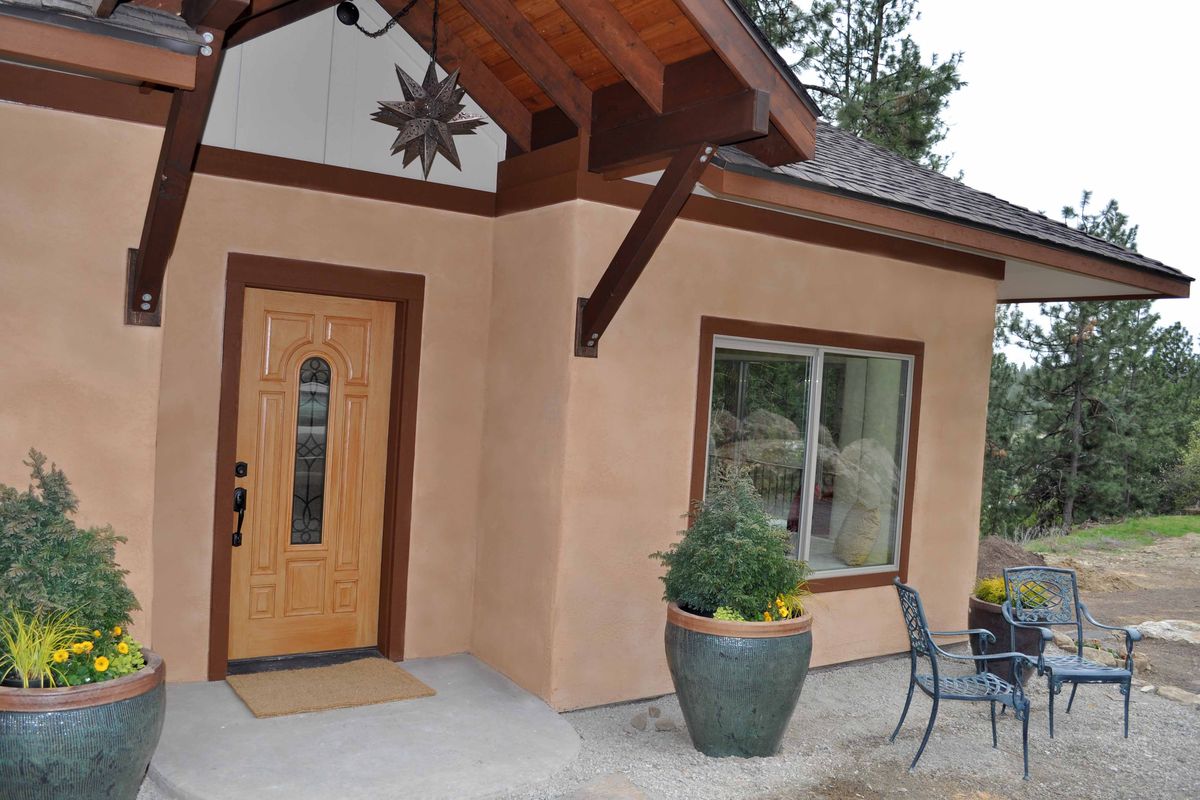
“I think people have this image in their mind of “one of those straw bale houses” not fitting in with the rest of the neighborhood, but really have no idea what to expect” said Gavin’s wife Anne Tenold, Pure Vida’s vice president and marketing director. “When they see homes we’ve built and realize they not only look similar to conventional homes, but mirror natural surroundings, they’re pleasantly surprised.”
Another pleasant surprise to the owners of this 2,700 sq. ft., three-bedroom, four-bath home last year was the heating bil, which averaged less than $34/month.
“In all of our research, straw bales are unsurpassed in terms of energy efficiency,” Gavin Tenold said. “The No. 1 benefit of a straw bale wall system is how this thermal mass maintains a constant interior temperature.”
Straw bale homes date back to the 1890s, when Nebraska residents started using straw in construction of their homes as timber became scarce. Many of these early homes are still standing, completely intact, even amidst the state’s wide temperature swings and blizzard-force winds.
Straw-bale homes are safe if properly constructed and maintained. Loose straw is actually used in fire-fighter training as it burns so slowly. When tightly packed as in straw bales, it’s actually highly flame- and pest-resistant.
Although there are two main types of straw-bale construction—load-bearing and post-and-beam—most professional builders, including Tenold, use the post-and-beam method for its greater structural support.
This method consists of vertical posts and horizontal beams which support the roof. The walls are then constructed by stacking straw-bales with mortar in between and rebar through the center which then attaches to the beams. Walls are finished on the exterior with stucco and the interior with lime plaster.
In addition to the great building properties of straw, the Tenolds love that they can help local farmers by purchasing the typically unwanted by-product of grain production and divert it from the waste stream.
This is part of the Pura Vida ethic. The term means to live the “pure life”—a Spanish term Gavin learned while teaching in Honduras after college, and embodies not only the Tenold’s building philosophy of sustainable homes that nurture the environment and the people they sustain, but a philosophy of gently interacting with the earth.
Growing up in Spokane, Gavin and Anne both had parents who invited them to participate in outdoors activities like backpacking, skiing and spending time at the lake. They both attended Ferris High School and both were nominated their senior year as “Most Likely to Save the Planet.” However they never met except for a brief encounter when he, the school photographer, came to take her picture for the honor.
Upon graduation they both moved to Oregon for college —Gavin attended Linfield College and Anne attended Portland State University. At their 10-year reunion they officially met and realized how much they had in common.
Now, with a young family, the Tenolds are working to bring their dreams of a healthier environment and a healthier community to fruition. They both are members of The Lands Council, volunteer for ReBuilding Together Spokane—the local affiliate of the nation’s largest nonprofit organization dedicated to preserving home ownership and revitalizing communities—and participate in the Spokane River Clean-up each year. Anne is a member of the YMCA member retention task force.
In the future, they would like to sustainably build on urban infill lots (building and developing concept that uses existing urban lots for projects) that foster healthy living and preserve the natural spaces as much as possible for future generations.
“Both of us were lucky enough to grow up with parents that made spending time outdoors a priority,” said Anne. “We had the opportunity to use our imaginations outside of the “built environment” and be instilled with the realization that our “playgrounds” need to be protected.”
Currently Pura Vida Homes is building a custom home in Electric City, Wash., and just finished installing 6,000 straw bales in the $4 million, 18-unit multifamily sustainable housing project in Plummer, Idaho, for the Coeur d’ Alene Tribal Housing Authority. In addition, the company will break ground on two more custom-built homes this spring and summer.
For more info, visit www.puravidahomesspokane.com.