Arrow-right Camera
The Spokesman-Review Newspaper
Spokane, Washington  Est. May 19, 1883

Wal-Mart poor example to praise as great Green business

Spokane CLEEN forum missed not addressing larger issues
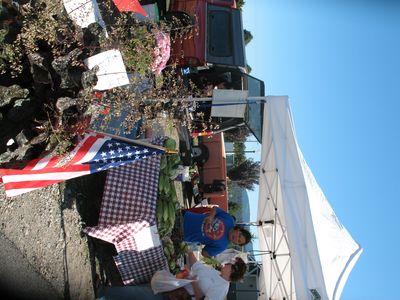
Communities interested in improving and possibly embracing sustainability can benefit more from smaller-scale operations like farmers' markets, such as the weekly one in Liberty Lake, as opposed to larger stores like Wal-Mart.  (Down to Earth NW file photo)
Paul K. Haeder Down to Earth NW Correspondent
This is the continuation of commentary by writer/columnist Paul Haeder regarding a recent “State of the Green Economy” program sponsored by CLEEN, a program of Greater Spokane Incorporated. Part 1 is Here is the disconnect at these so-called forums, dubbed like this one “State of (fill in the city’s or state’s name here) green economy”: 39 percent of high school students in Spokane public schools drop out before graduation. What sort of impacts will be this little doozy’s fallout? Lack of community participation, community malaise, exploited under classes, and ruined futures. Priority Spokane is trying to tackle this issue, and anyone worth his or her green creed needs to put education at the top of the laundry list on how to grow sustainability. Poor, struggling, disenfranchised and politically-economically-legally abused people will not – repeat – will not be on some dream green bandwagon. Unfortunately, from the outset of the 90-minute GSI meeting there was the inevitable pomp and circumstance of this sort of meeting where many in attendance seemed like golf buddies. Calbom, a communications’ expert with his own firm, basically gave softball tosses to Sen. Lisa Brown and the other four panelists after holding up that damned Wal-Mart book as the next best thing since Wonder Bread. “Force of Nature: The Unlikely Story of Wal-Mart’s Green Revolution,” by Edward Humes, is making the rounds – at the Green Festival in Seattle, on TV and radio spots, in New York Times articles, and even on Down to Earth blog posts (here.) Without being too pessimistic (real), the idea of a green Wal-Mart as a way to introduce this “update” on the green economy movement in Spokane is more than an affront to true sustainability adherents and activists. This city, like hundreds of others, needs affordable housing, single payer health care, fully funded K-12 education, community and state colleges that are affordable to the majority of people making America “work.” Wal-Mart, with its class action lawsuit representing 1.5 million female workers, is no paragon of sustainable jobs. Here’s the rub with Wal-Mart: South Florida-based jewelry manufacturer Aurafin under the guise of “responsible sourcing” teamed up with Wal-Mart. Its so-called responsibly sourced jewelry, under a product line named Love, Earth, is made under practices that hurt the environment and with unfavorable work conditions for metal workers. See the great expose in the New Times of Miami here In a nutshell, Love, Earth is produced for Wal-Mart by workers who make half of what it takes to live with basic necessities in Bolivia. Then there’s the study from the University of California Berkeley that concluded that Wal-Mart could set a minimum wage of $12 an hour for its store workers without hiking prices much. The fact is, poor and low-income employees who pull in less than $9 an hour would benefit big time, according to Berkeley’s Center for Labor Research and Education. “Meanwhile, the average Wal-Mart shopper (who spends $1,187 per year at the chain) would see the annual Wal-Mart bill rise only $12.49.” Finally, with the bitter taste of Wal-Mart in some of our mouths at the outset, a reminder of the corporate dominance in our lives came out when the U.S. Supreme Court recently dismissed the largest class action lawsuit in history filed by 1.5 million current and former female employees of Wal-Mart. Writing for the minority in only part of the court’s ruling, Justice Ruth Bader Ginsburg scribed that the “plaintiffs’ evidence, including class members’ tales of their own experiences, suggests that gender bias suffused Wal-Mart’s company culture.” Wal-Mart is anti-union, anti-community and is a monopoly, and with that triple low blow, no state of the green economy makes any sense. The three monkeys prevailed at the Spokane event. The axiom of ‘See no evil, hear no evil, and speak no evil’ applied to these giant corporations like Wal-Mart strips the concept of sustainability from any “green” meeting. Maybe GSI and company need a better reading list, like Liza Featherstone’s “Selling Women Short: The Landmark Battle for Worker’s Rights at Wal-Mart.”
For more information, www.cleennw.org and www.greenspokane.org.