
Mars rover launches to look for carbon
Conditions for life at heart of mission
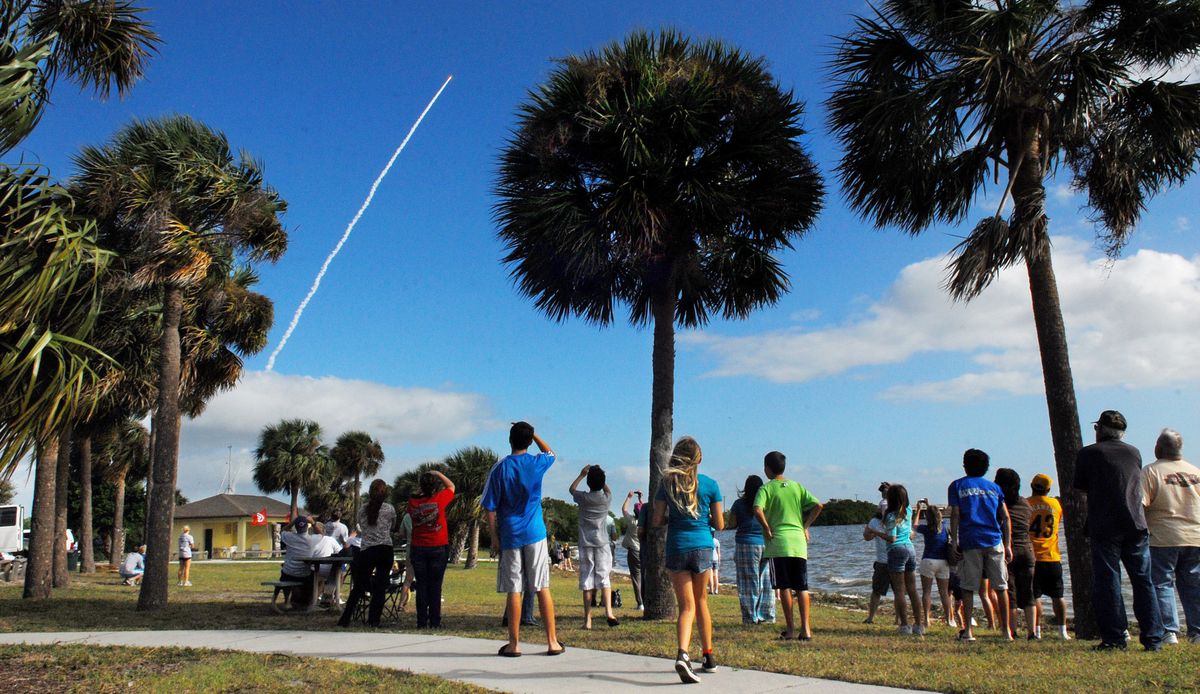
CAPE CANAVERAL, Fla. – With the roar of an Atlas V engine, NASA began its boldest venture yet to another planet, sending its Mars Science Laboratory on an eight-month journey that is expected to provide Earth with new and more detailed information about whether the red planet is – or ever has been – hospitable to life.
After being postponed one day to replace a faulty battery, the launch went off flawlessly at 10:02 a.m. EST Saturday, the rocket rising on a column of white smoke into a blue sky mottled with puffy cumulous clouds.
The rocket’s payload was the rover Curiosity, the largest and most sophisticated in a series of robotic vehicles that NASA has landed on Mars. Built at the Jet Propulsion Laboratory, Curiosity is a six-wheeled, 1-ton, car-size vehicle crammed full of sophisticated scientific gadgets.
Its mission, NASA officials stressed, is not to find life on Mars, but to find out whether life could have existed on Mars in the form of microbes, tiny organisms that are abundant on Earth. It also will try to find further evidence to suggest whether astronauts could survive on Mars.
“I like to say it’s extraterrestrial real estate appraisal,” said Pan Conrad, a JPL astrobiologist, at a briefing earlier in the week.
Within hours of takeoff, control of the spaceship was shifting from the Kennedy Space Center to JPL, which will run the mission for its duration, which is expected to be a minimum of two years.
The Mars Science Lab faces a journey of 354 million miles, which it expects to end in spectacular fashion in early August.
Curiosity, after being slowed in its descent by parachutes, will be lowered softly – NASA hopes – using a sky crane modeled after those used by helicopters.
Once on the ground, NASA intends for the rover to spend one Martian year, which is about two Earth years, exploring an area called Gale Crater, which includes a gently sloped, three-mile-high mountain made of sedimentary rock. As with prior missions, there is the likelihood that the rover will keep going after its two-year “warranty” expires.
Scientists hope that as the rover ascends the mountain, the rock will tell the geologic history of the area and, ideally, suggest whether it could have supported life.
“We’re basically reading the history of Mars’ environmental evolution,” said John Grotzinger, the project’s chief scientist. However, he has been at pains to tamp down expectations.
“We’re on the hot seat, and a wise friend of mine once told me, ‘Don’t promise more than you can deliver,’ ” Grotzinger said. “So we’re on a mission to look for organic carbon, there’s no question about it.”
Mars is considered the most likely planet other than Earth to have nurtured life. By “life,” however, scientists stress that they are considering the most primitive forms and don’t expect Curiosity to be met by an ambassador.
At the same time, said Steven Benner, a biochemist who heads the Foundation for Applied Molecular Evolution, “We don’t want to have a lot of preconceptions. We want to consider that if, you know, Tim Allen’s ‘Galaxy Quest’ alien rock creature comes up and bangs us on the head, we don’t want to ignore it. That would be the ‘Aha!’ moment that we would regret having missed. But that’s relatively far down in our what-if scenarios.”