
The right to grow
Brazilian farmworker tells crowds to unite against Big Ag
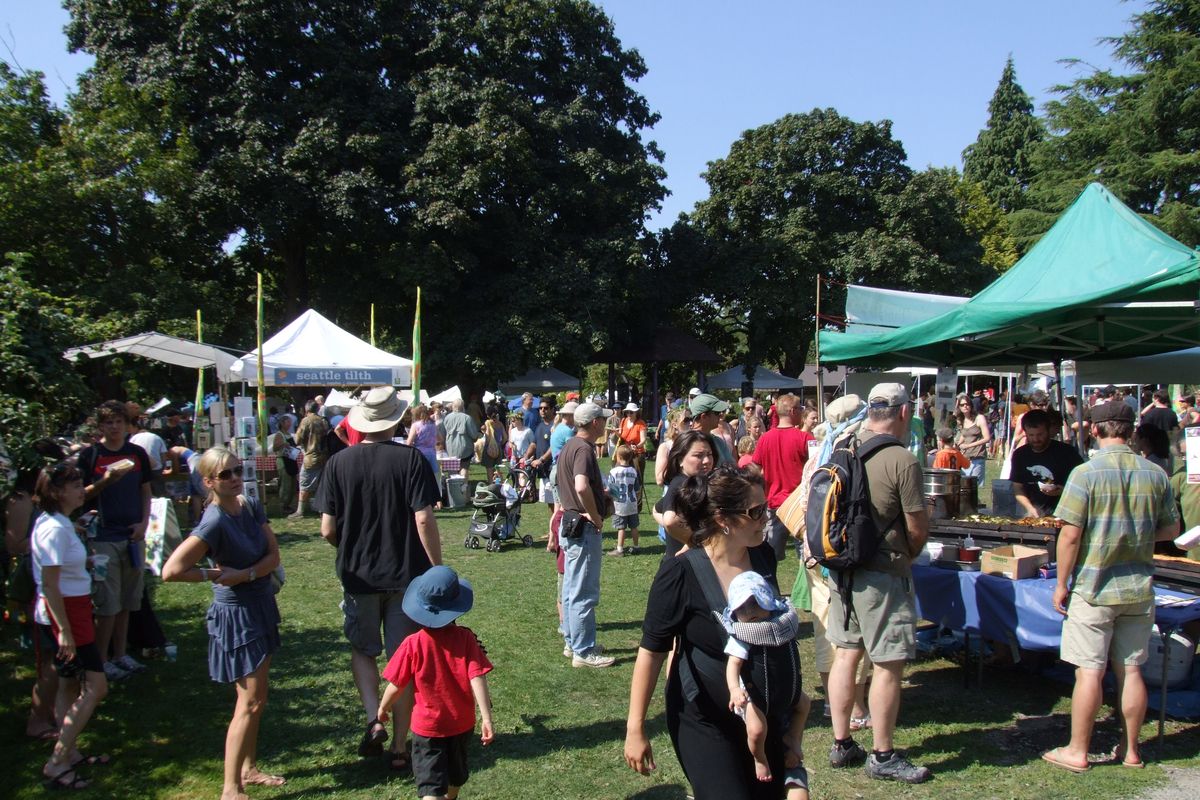
It might not be easy to fathom, but think 2,500 Nicklesvilles in terms of sheer numbers of displaced – landless and homeless — farmers. That was what one farmer from Brazil recently alluded at the Seattle Tilth Harvest Fair.
Yes, the Harvest Fair in early September was phenomenal in its own rural-to-urban way. I counted two chicken coops, 80 vendors, loads of fresh produce, elfin garlands on old and young alike, children chomping on fresh peaches, a few goats, music and an overflow number of enthusiastic folk pushing through the corporate miasma that’s infected almost everything Seattle, especially our food.
Did I mention the 80-degree weather on September 10 nourishing the activities at Meridian Park, behind the Good Shepherd Center in Wallingford? Over 400 people amassed at 2 p.m. checking out urban gardening, community empowerment, talks and music.
Even with all of those green-loving and farmer-based activities, one demure non-English speaker was in the wings, watching the goat talk/demonstration by Lacia Lynne Badley. While the permaculture connection was made by Badley and her three mixed breed goats, Janaina Stronzake was waiting for her interpreter to help her decode from Portuguese and Spanish into English, in order to share her work with the Brazilian Landless Workers Movement, the largest peasant movement in Latin America with over 1.5 million members.
It was clear to the small tent audience that listened to Janaina, articulate, with a second master’s degree almost complete, she is the real thing.
“We were small farmers, my family and I, but we lost our land in the 1970s. In 1984 we joined the landless farm workers movement and occupied land.”
The organization Janaina represents is called, MST, or more formally, Landless Workers Movement. An ancillary of MST is Friends of MST at www.mstbrazil.org. There are other groups grafted from the main trunk of MST — Movement for the Liberation of the Landless (MLST) and the Land, Labor, and Liberty Movement (MTL).
The worldwide landless farmer movement totals 2.5 million fighting for land and social justice.
She illuminated some startling facts about Brazil:
• the rich, 1 percent of the population, owns 46 percent of land
• that land produces less than 30% of food consumed by Brazilians
• 90 percent of public subsidies goes to that 1 percent
Yet, Stronzake made it clear that 70 percent of the food produced for Brazilian consumption comes from small farms, amounting to only 24 percent of the farmland and less than 10 percent of public subsidies.
“Why do we have to occupy lands? Why do we have to fight this system of industrial agri-business?”
She harkened back to 1500, when Portugal “discovered” Brazil, and quickly put into place the “three pillars” of agricultural production, still used by transnational agro-businesses today:
1. slaves
2. monoculture for exportation back to the colonizing country
3. plantations
Janaina pointed out that today, those three pillars are now buttressed by a fourth and equally deadly one – genetically engineered plants, pesticides and more toxins in both the production and harvesting of crops.
Add to that economies of scale killing ag jobs, larger and more frequent land grabs, and millions of traditional farmers pushed off land and into cities looking for work and food.
It’s then a vicious cycle: “When the farmers aren’t eating or are under-resourced, violence ensues … impacting not just Brazil,” she said. Militaries rise, and governments become despotic.
Think of millions of displaced farmers crossing borders because their access to water, soil and seeds has been wrested away by governments in collusion with companies like Bayer, Monsanto, Novartis, Syngenta, Cargill.
The irony is that the impacts from industrial agriculture hit the health of communities, especially women, hard. Then this Brave New World order unfolds — the pharmaceutical company, Novartis, produces drugs that treat the cancers and depression that come from the chemicals and seeds companies like Syngenta concoct.
Janaina committed to the Seattle Tilth Harvest Festival and later that evening with a Community Alliance for Global Justice and Grassroots International event to promote collective power and solutions to this sick agro-chemical model. The farm workers movement in Janaina’s country has occupied land and put offspring into schools and colleges.
While farmers historically have had high levels of illiteracy and education, the movement in Brazil has put investments into educating farmers to navigate the arenas of politics, bio-intensive organic farming and community development and engagement.
“Each city and community can implement another model,” she said. “We can together fight for food sovereignty — the right to access water, soil … to own seeds. But only together can we unite against transnational organizations and countries that support them to get to this old-new model.”