
Trail users participate in maintenance and upkeep, allowing for earlier opening dates.
NACHES, Wash. – For much of May, the trails designated for motorized use within the Naches Ranger District were under surveillance.
Forest Service staffers and volunteers from organized four-wheel-drive and motorcycle clubs were scrutinizing those routes to see if, in light of this year’s relatively dry spring, the Forest Service might be prudent to open them three weeks ahead of schedule – in time for Memorial Day weekend.
One area of particular interest was the Little Naches, always a popular destination over that annual camping-and-trail-fun weekend.
So that’s just where Tacoma Motorcycle Club volunteers focused their attention in the weeks leading up to Memorial Day.
“Just doing the assessments,” said Tacoma Motorcycle member Mike McFadden, “and kind of letting the Forest Service know whether it was time to open it up or keep it closed.”
Volunteers from the Jeeping Nomads, a Yakima four-wheeler club, and others were out in force to check out trail conditions in the Rimrock area.
“We reported back that the mudholes and snow issues were minimal,” recalled Nomads member Ron Rutherford, for years an unofficial liaison between motorized user groups and the Naches Ranger District. “The trails were dry and in pretty good condition, with the understanding that there was some log-clearing that will need to happen.”
So the decision was made: All but a handful of the district’s motorized trails would open in time for Memorial Day weekend.
The one thing officials feared was a last-minute rainstorm.
Which, of course, is just what they got.
“On that Thursday of Memorial weekend, it rained probably an inch in an hour, and then all night and to noon on Friday,” Rutherford said. “We’re thinking, ‘Oh no, the trails are open and all these people will be up there.’”
Jeff Leisy, a Naches District trails and recreation specialist, feared the worst.
“I was thinking,” he said, “we were just going to get creamed.”
Instead, something unusual happened: nothing.
At a time when the trails could be hammered by irresponsible use, everybody was, well, responsible.
“People self-policed themselves really well,” Leisy said. “People did a good job of avoiding really muddy areas. A couple of trails, it looked like they got no use whatsoever when it was really wet. I was really impressed.
“I think one of the main reasons for that is with a lot of the users, there’s peer education happening. It’s basically, ‘Don’t mess things up, because we might have trails closed.’ I think people are starting to learn that if you play nice, your opportunities expand.”
Rutherford said he and other volunteers “went up and walked some trails, and we saw no damage. A lot of people were staying off the trails.”
And the ones who weren’t were monitoring others.
“When we would run into people, we let them know – unless you want the (trail-opening) date pushed back, you’ve got to stay off the muddy areas or tiptoe through them,” McFadden said. “Between the user groups being out there doing education and fixing it when they can, that’s making a difference.
“It’s nice to see everybody participating and taking care of the trail system instead of thinking it’s going to last forever.”
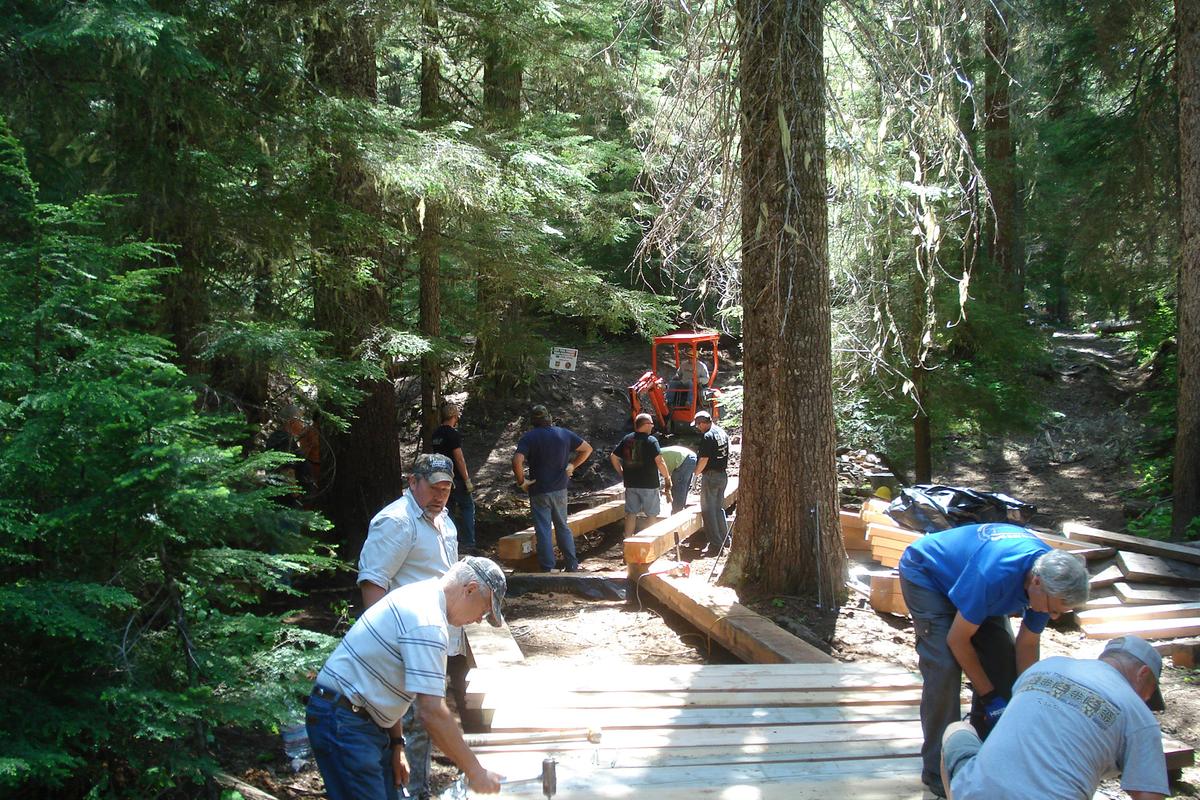
Well, at least one of them – the Naches Trail in the Little Naches – will last a good while longer. The weekend after Memorial Day, motorized-use volunteers turned out in force there for a large and demanding trail overhaul.
The project entailed rebuilding two puncheons (basically, bridges over boggy areas), a 120-footer and a 20-footer, and to shore up a rotting 40-foot bridge over the South Fork Little Naches that is scheduled for a complete replacement within the next three years.
In addition to a $10,000 grant from Polaris and $3,000 from B.F. Goodrich, the bulk of the funds for the materials came through Recreation and Conservation Office (RCO) grants – for which the ranger district must come up with “matching funds” by way of volunteer labor.
And that labor turned out in droves. Volunteers from at least 10 different motorized trail-riding groups – from the Jeeping Nomads, Dust Dodgers, Gleed Boyz and Tacoma Motorcycle to the Yakima Skibenders, a snowmobile club – were there for the weekend effort. Twenty of them were already working by Friday, with 45 volunteers there on Saturday and 30 on Sunday.
“That’s a huge amount of labor – and it took that. It was really labor-intensive,” Leisy said. “We had to tear the old rotten puncheon out and replace it with new.”
In all, volunteers put in 760 volunteer work hours over the three days.
“And people were asking, when and where is the next project?” Rutherford said. “I’m thinking, wow – sore backs, tired hands, and these people are ready to get out there and go again.”
A much smaller volunteer-driven project is slated for the July 25-26 weekend at the Kaner Flats Trail off Highway 410, and the Yakima Skibenders will be hosting a volunteer cleanup at the Ahtanum Sno-Park this weekend.
This upsurge in trail-and-work ethic may be in part a response to the change in leadership at the Naches Ranger District, where Irene Davidson left last summer as Naches District ranger and was replaced by Kelly Lawrence. Certainly, motorized users took notice when Lawrence agreed to open most motorized trails three weeks before July 15, which had become the annual opening date for motorized trails under Davidson.
“There were a lot of volunteers out there,” Rutherford said, “telling people, ‘Look, here’s the situation: We’re making progress with the new ranger, so tread lightly. Respect the trails.’ ”
McFadden said people missing the way things used to be – “where if the snow was gone, people could ride” – are gradually accepting their role in keeping trails open.
“When you tell people, hey, if we start policing ourselves, they’ll start leaving it up to us how we ride, and where and when we ride, and not (dictated by) just a date on the calendar,” McFadden said.
“It used to be you might look the other way when you saw somebody doing something they shouldn’t be doing, but now that you’ve got closures and later dates, you’ve got people educating and enforcing the rules, so we can all use it.”