
Trail workers rescue footsore pets
Lost spaniels on last legs in Bob Marshall when kind crew took them in
After spending almost two weeks in July wandering on their own deep into the Bob Marshall Wilderness, Jim Cain’s two English cocker spaniels seem to have recovered from their re-enactment of “The Incredible Journey.”
“There’s no sign of any lasting problems,” Cain said. “But since they’ve done that they don’t pass up a meal. You put a bowl of food down and they’re on it. And they stick a little closer to home now.”
Abby, 11, is the mother to Molly, who is 6 years old. And their tale of getting lost in the 1 million-acre wilderness and then found touched the group of people involved.
“It’s definitely one of the most unusual things to happen to me in the backcountry,” said Sonny Mazzullo, who works for the Montana Wilderness Association as a Continental Divide Trail field coordinator.
In July, Mazzullo had a crew of staff and volunteers working on a section of the CDT near Bowl Creek. The crew was five days into a nine-day hitch about 11 to 12 miles deep into the wilderness when Abby and Molly came walking down the trail.
“No one thought too much of seeing the two dogs. Everyone figured the owners would be trailing along shortly,” wrote Ted Brewer, MWA’s communications director, in a blog post. “They never showed.”
“After 10 minutes we started fearing the worst, that the dogs had wandered away,” said Mazzullo. “After 20 minutes we figured nobody was coming with them.”
Judging by the cuts on the dogs’ feet and bodies, their thinness, exhaustion, hunger and thirst, the crew figured the dogs had been on the trail for some time.
“They looked haggard,” Mazzullo said.
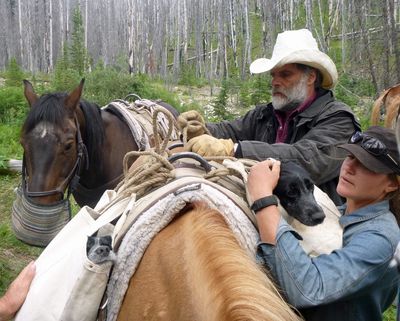
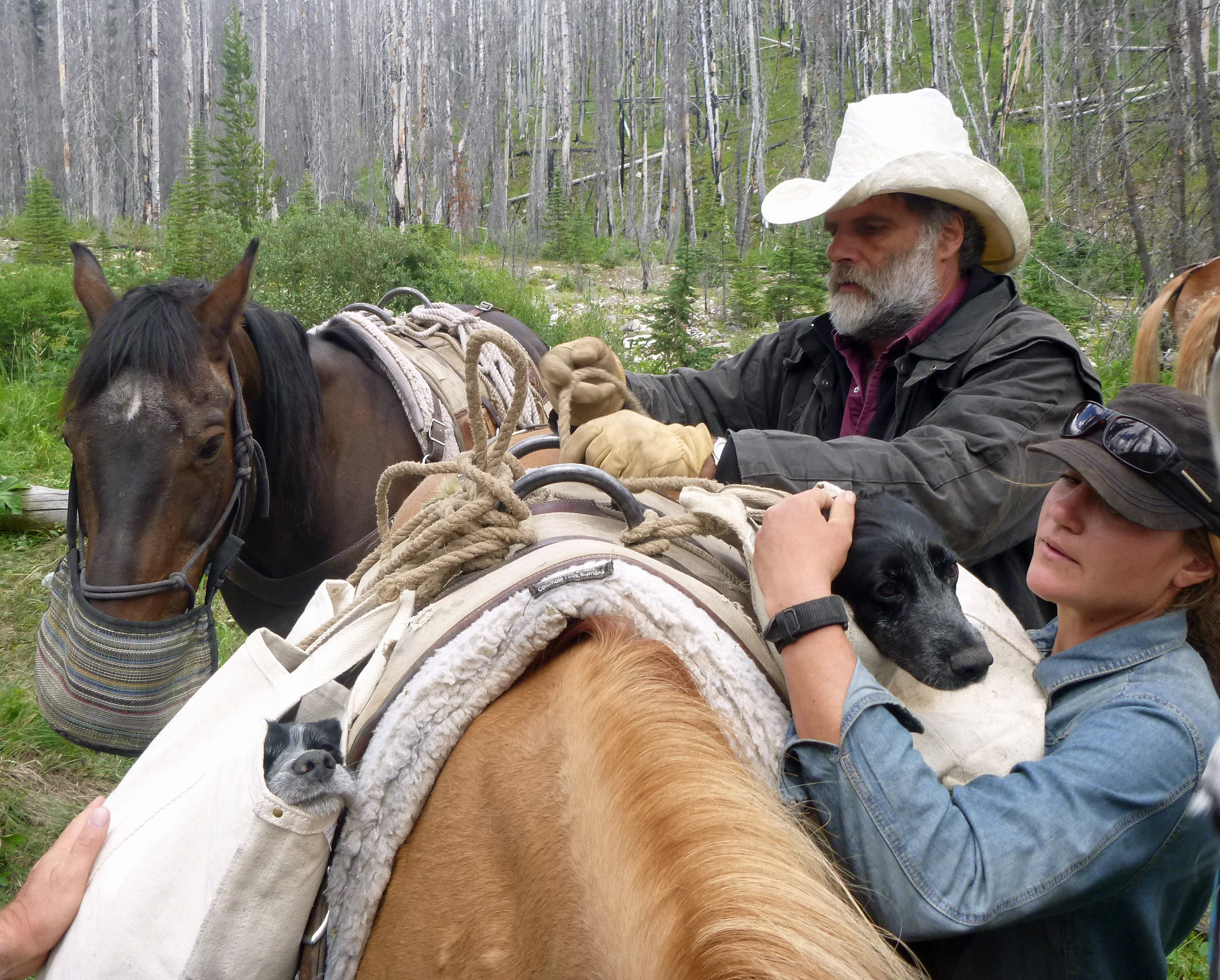
Since the dogs were too exhausted to walk any farther and camp was about 2 miles away from the work site, backcountry horseman and packer Greg Schatz used bags the crew was using to haul gravel to carry the dogs back to camp on his horse, Dusty.
In his 27 years of trekking into the Bob Marshall Wilderness, Schatz has often carried unusual things on his pack horses and mules – everything from bridge timbers to wheelbarrows, fire hose to scaffold – but he said he’s probably never carried anything more unusual than the pair of dogs.
“They were in such tough shape that they couldn’t walk,” he said. “They were finished.”
Then the concern arose that the dogs’ owners may have been injured and that a search and rescue operation might be necessary. Luckily, Molly still had her collar on and a tag that had a phone number.
“Crew co-leader Nick Burkland radioed the Schaefer Meadows Ranger Station and reported finding the dogs,” Brewer wrote. “The ranger called the number on Molly’s dog tag and later reported back that he had reached the dogs’ owners.”
The incredible journey began when Cain had let the dogs out on July 2 to do their morning business while staying at a family cabin on the West Fork of the Teton River, just past the Teton Pass Winter Sports Area northwest of Choteau.
When the pooches didn’t return, Cain said his family contacted everyone they could think of: the county sheriff, Forest Service and the newspaper in Great Falls. They offered a $500 reward and spent the rest of their vacation at the cabin driving up and down the road and checking trails in the area.
“We’re quite the dog people,” Cain said, noting that altogether they have eight canines at their Conrad home. “Those two really love to go outdoors. They’re a field dog. They’re used to running around.”
But after a week of looking and with no leads, he said the chance of ever seeing the dogs again seemed hopeless.
How the dogs ended up crossing the Continental Divide 12 to 13 miles from the cabin is uncertain. Did they chase an animal and lose their way, or maybe follow other hikers or a pack train?
Schatz described the terrain between the cabin and work site as “extremely rocky,” littered with downfall and dense brush.
The dogs would have crossed the Rocky Mountain Front, known to the Blackfeet Tribe as the backbone of the world.
The trail crew went over 7,200-foot high Teton Pass – an elevation gain of about 1,600 feet above Cain’s cabin. Whether the dogs followed that trail or clambered over the Lewis and Clark mountain range somewhere else – places with names like Corrugate Ridge or Washboard Reef – is unknown.
“I was shocked that the dogs, which are not backcountry dogs, had made it as far as they did, and with no dog food,” Schatz said. “They probably had 200 miles on them.”
The area is remote. The trail crew saw only two other backpackers during their stint, with the exception of the Forest Service and horse-packers who were scheduled to come in.
With Cain unable to retrieve the dogs from the wilderness, the trail crew took turns staying with the pups until work was finished. Mazzullo said he carries a two-man tent into the wilderness for his own comfort and in case someone else needs shelter.
“I made room for the ladies,” he joked.
Abby was constantly shaking in the cool temperatures, Mazzullo said.
When the work was done, the crew tested options for packing out the dogs. The older dog’s feet were too sore for the trail.
Carrying the 30-pound dogs in their arms wasn’t practical. Instead, they cut a pair of long logs and tied the gravel bags in the middle to give the dogs a place to ride out. The volunteers would take turns carrying the logs on their shoulders.
“After about 5 miles, I was thinking we might have been able to get by with smaller logs,” Mazzullo said.
Molly stayed in her hammock about 2 miles before she scrambled free. But Abby – the older dog – was happy to make the trip out on the shoulders of the workers.
Cain’s wife, Traci, was waiting at the trailhead to greet the workers, snapping pictures and cuddling the long-lost pooches. She insisted the volunteers take the reward money, which the crew donated to the MWA and its Continental Divide Trail program.
“You could tell right away that the dogs were really happy,” Mazzullo said. “That was a good feeling. We had gotten pretty attached to them.”
Cain still can’t thank the volunteers enough.
“Mom was pretty shell-shocked,” he said of the older dog, Abby. “If they hadn’t met that trail crew she wouldn’t have made it.”
“The thing that’s cool about the story,” Mazzullo said, “is that it’s a reflection of the good hearts that our volunteers have. Our volunteers are terrific.”