
Goats in the city: Grant seeks to support urban farming
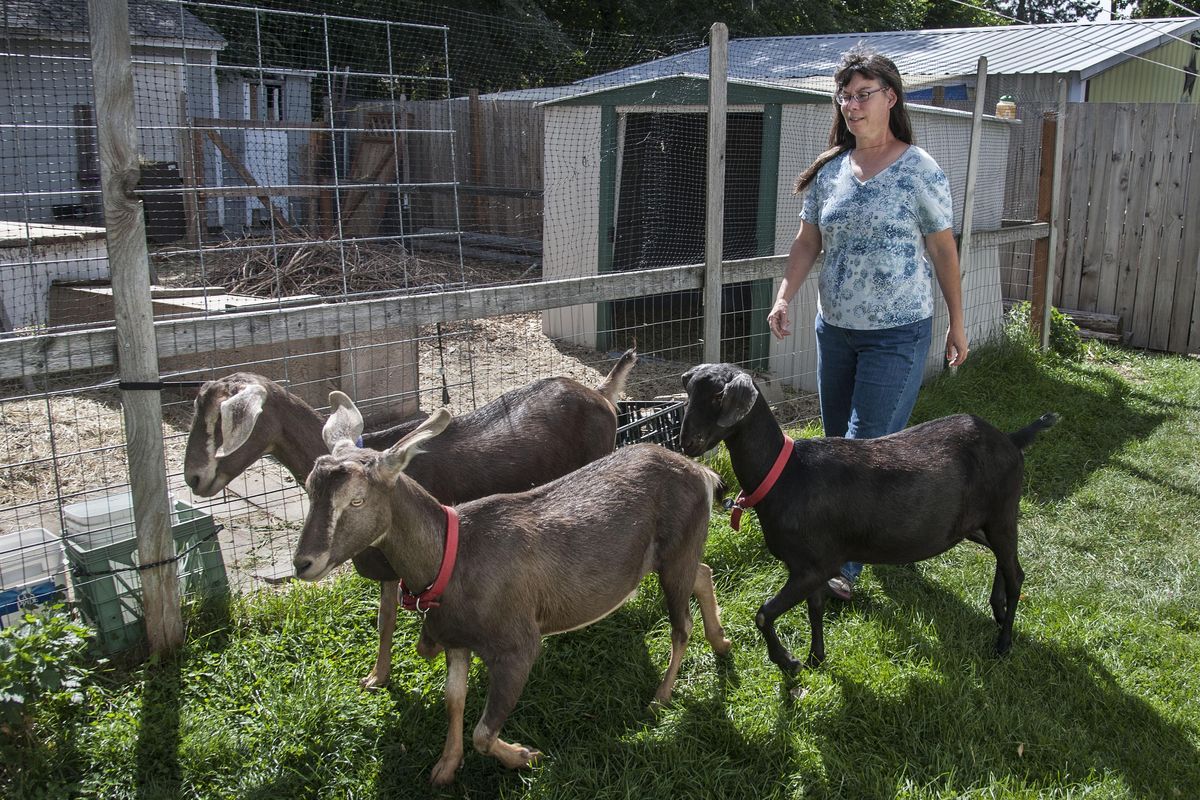
Janice Swagerty is teaching the tricks of raising kids – goat kids, that is.
She is a leader in an urban farm movement that is gaining ground in Spokane thanks in part to a 2014 city ordinance that allows residents to keep small animals.
Now the Spokane Conservation District has received a $47,000 grant to build a network of skilled farmers to help others who want to raise chickens, ducks, rabbits, goats, sheep or small pigs.
“I think it’s time for it to take off,” Swagerty said.
A free urban farm tour is planned for 10 a.m. Saturday beginning at her home.
During a visit to Swagerty’s backyard farm in the 3400 block of West Longfellow Avenue, she talked about how a 10,500-square-foot lot with a small home and garage can be turned to greater food production.
The mainstay of her animal production is a momma goat named Missy who produces milk after giving birth to two kids. The milk is used at the home to make yogurt, cheese and pancakes, as well as help feed the young goats.
The kids eventually may be sold to other urban farmers looking for animals that will thrive in a backyard setting.
Swagerty said setting up the pens and milking area is vital to success because goats will try to breach any enclosure, and the milk area needs to be sanitary. Handling of waste also is critical, as odors and flies can build up, she said.
“You just have to get those pens cleaned out before you have problems,” she said.
Swagerty learned animal husbandry growing up on a farm.
In Spokane, raising goats, sheep or pigs requires training and certification under the 2014 ordinance. WSU Spokane County Extension offers classes. So far, more than 30 people have been certified. Swagerty is one of the class teachers.
The ordinance limits the number and size of animals that an urban farm can have. In Swagerty’s case, she has two chickens and one rabbit in addition to the goats – her limit. The chickens, of course, provide eggs.
Swagerty’s daughter, Katie, 12, helps with the work.
“My daughter and I have an agreement that no animals raised in the backyard will be eaten,” Swagerty said.
Her daughter raised and sold a racing pig that went for $450.
The two kids might fetch $375.
In addition to the animals, the Swagertys raise herbs, vegetables and fruits, even using the front yard for dwarf fruit trees.
Pat Munts, project coordinator of the yearlong grant and also a gardening columnist for The Spokesman-Review, said one of the goals is to build a network of experts on urban farms who can help newer farmers succeed.
A second goal is to reach out to lower income areas to help families learn the tricks of raising food, including traditional backyard cultivation of vegetables and fruits.
The grant came from the National Association of Conservation Districts and runs through July.
Saturday’s tour will go to the Urban Eden Farm, Project Hope’s Riverfront Farm, the West Central Community Garden and Food for All Farm.
Representatives from the Edible Tree Project and Spokane Food Forest will share information, too.
In another event, the city farm project is sponsoring what it calls a community conversation on urban agriculture. It will be from 6 to 8:30 p.m. Oct. 12 at the Robinson Teaching Theatre at Whitworth University.
The conservation district in a news release said that “even small actions on an urban lot can improve environmental quality.”