
Spokane Valley homeowners clash with developer over plans for land
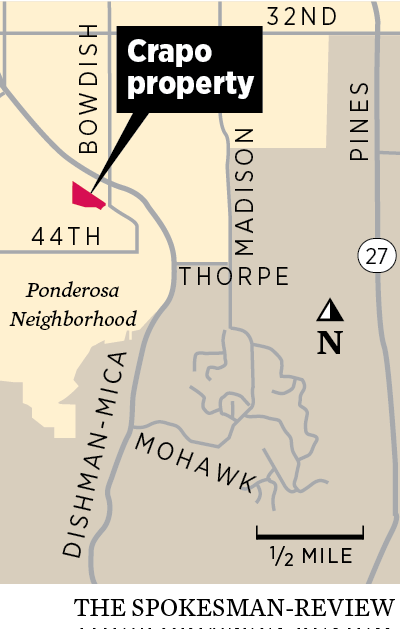

A group of Spokane Valley homeowners has continued its yearslong clash with developer Dennis Crapo, arguing before a hearing examiner on Wednesday that the 29,000 cubic yards of construction debris he plans to haul to the area could put its neighborhood at risk.
The project is located at the intersection of South Bowdish Road and East Sands Road, near Chester Creek in Spokane Valley.
Crapo has asked the city to allow his company, Diamond Rock Construction, to fill in that land with construction materials from other sites in the area and no longer designate the land as a flood plain. He has been working to get the proper permits for more than a year and a half.
The project’s neighbors have appealed Crapo’s application, arguing there are environmental issues with the proposal and said that, when they bought their homes, they were told there wouldn’t be more development behind them.
Ann Carey, one of the nearby homeowners, said in a phone call before the hearing she fears the project may be just one step in a larger plan to develop the property behind their own. And if that doesn’t happen, she fears she could end up living next to a construction-waste site.
“Is it going to be his own personal landfill or is there going to be houses there?” Carey said.
She and fellow neighbor Dave Johnson were among several residents who said their homes were built on top of fill and had settling issues. Carey said she was concerned that, if a future house is built, a future neighbor might experience the same thing.
“We just want it done correctly,” she said. “(And) we’re concerned about the impact to our homes.”
Neighbors, who called into the hearing to participate virtually, also said they were concerned that they didn’t know where the construction materials came from and what types of materials would be hauled into the area. Some said they fear fewer animals they are used to seeing, such as owls and deer, would visit, and that it could make flooding in their yards worse.
When Crapo attempted to obtain a zoning change in 2018 to build a multiuse development in the same area, neighbors also brought up flooding due to the proximity to Chester Creek.
The neighbors have enlisted the assistance of Al Merkel, who has worked with homeowners to oppose other Valley development and zoning changes and who was their primary representative during the hearing.
He said he was concerned by the lack of information about what could be hauled into the neighborhood, saying the application was so vague it could be anything from dirtto concrete to soda cans to nuclear waste from Hanford.
Merkel, who was criticized by the city and Crapo’s attorney for speculating about what could be hauled onto the property, said neighbors had no choice but to make guesses because they weren’t told what the material would be.
“All of this speculation could have been cleared up by simply evaluating the sites where the fill was coming from,” he said.
Aziza Foster, the city’s legal intern, argued that when the city approves an application, it can only do so on the material presented to them, and can’t make decisions based on how the property may be used in the future. She said the city also can’t hold past projects and applications against anyone applying for a permit, or use rumors about their past work in their decision making.
“The appellant wrote in their briefing and by some comments in their arguments that due to some alleged prior bad acts, that the city could be more rigorous in the applicant’s checklist than in review of other checklists,” she said. “In essence, what the appellant is asking the city to do is provide different standards of review based on who is applying. This completely ignores principles of equality and constitutional due process that the city must comply with and enforce.”
Merkel also argued that communication issues between city staff and neighbors led to issues with their appeal and gave them less opportunity to fight the project.
Deputy City Attorney Erik Lamb argued that the neighbors could have hired a land use issues attorney to properly guide them through the process and that city staff had provided accurate information to neighbors’ questions when asked.
“We provided every opportunity for the appellant to challenge and appeal the underlying permit,” he said.
Crapo’s attorney, Taudd Hume, noted that there are other regulations outside of the city’s process to regulate the safety of the site.
He added that Crapo did not have any particular, immediate plans for the property beyond what was in his permit, filling the lot and raising it, and said many of the neighbors’ comments and issues were based on guesses and possibilities, not on what was in the record and proven. He urged the hearing examiner to consider facts and materials that had been presented, not “hypotheticals” that could occur when the project commences.
“It’s not enough to just speculate, and that’s all they have done today,” he said.
Merkel acknowledged the neighbors did not have a lawyer, many funds or details about the project, but said they should be listened to as constituents trying to be involved in the process and follow the rules.
“We’re trying to weed through this process at a clear disadvantage in terms of funds and everything else and protect the neighborhood we have against a city that’s overreaching in development and favoring developers,” Merkel said.
“The overarching statement of the law is this should have happened in the light of day and the way it should have happened – telling us where the fill sites are coming from, telling us where the fill material, giving us the information that would have been required to really evaluate the environmental impacts of this entire project.”
The hearing examiner said he would decide the case in the next few weeks. Hearing examiners’ decisions can be found on the city of Spokane Valley’s website .