‘Our wars have come home’: Veterans for Peace reflect on Vietnam War at remembrance vigil for those killed at My Lai

A group of veterans gathered around the Vietnam Memorial in Riverfront Park Tuesday to remember the 504 Vietnamese civilians who were killed at the My Lai Massacre 53 years before.
The local Spokane Veterans for Peace chapter held the vigil with about 15 people in attendance.
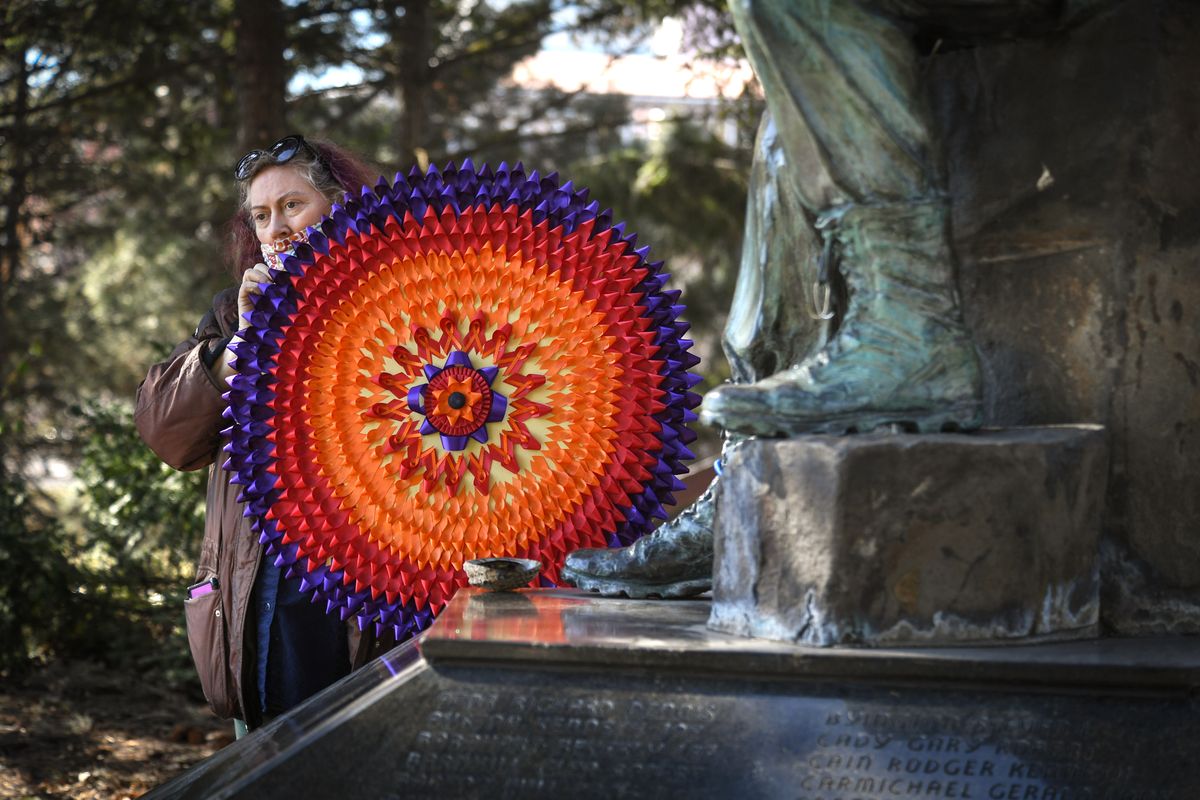
On the feet of the seated soldier that stands in Riverfront Park as a memorial to the Vietnam War, the group placed a wreath with 504 ribbons of different colors representing the men, women, and children who were killed on March 16, 1968. The wreath, made by Valerie Waley, also had indicators for the number of pregnant women who were killed that day.
Soldiers of Charlie Company, 1st Battalion, 20th Infantry Regiment killed the unarmed civilians under orders to kill every living thing in the village. An Army photographer there that day named Ron Haeberle took photos of the massacre that later appeared in Life Magazine, largely changing the perception of the war.
Second Lt. William Calley was the only soldier convicted of any crime after the massacre that remains one of the most infamous moments of the war.
Dave Newton, a veteran who served in Vietnam from 1970-1971 as an infantry officer, made the trek last year to the country where he first saw war.
Only two walls have brought tears to Newton’s eyes, the Vietnam Memorial in Washington, D.C., and the mural of My Lai, he told the group Tuesday.
“Our country lied to us about what really happened,” he said. “We bombed and shelled the village for several days after to erase the evidence.”
Newton recounted his visit and reflected on his time serving during the war. He said he was shocked that soldiers followed orders to kill the villagers, something he said he and the soldiers he knew wouldn’t have done.
He was also frustrated at how much of the history surrounding why the United States went into Vietnam in the first place was “swept underneath the carpet.” He said he believes that the real reasoning behind getting into the war wasn’t what was sold to the public.
“It’s a continual thing with the American people,” he said. “We’ll go fight a war to fight a war.”
Other members of the group spoke, including Rusty Nelson, who read a poem he wrote.
“Because we reject the lessons of Vietnam, of My Lai
Our Wars have come home. Our sins, Our crimes are back
To plague another clueless, flag-draped generation,” the poem read in part.
The group had a moment of silence before ending the vigil. Afterward, they chatted with each other, sharing their experiences and feelings about the war.
Most of the men present had been home from war for decades. Some, like Nelson, have grown increasingly angered over the inhumanity of war, while others, like Newton, see their own personal change that came as a result of witnessing violence up close.
“When I went to Vietnam, I was the biggest hawk in the world. I wanted to get over there and kill commies,” Newton said. “Right now, I’m a dove.”