
The collector: Potato mashers are John Wagner’s jam

John Wagner blames (or credits) The Spokesman-Review for his obsession with potato mashers.
Some years ago he read a Doug Clark column about a guy in Sandpoint who collected the kitchen utensils, noted for their propensity to jam drawers.
“For years I joked that someday I would collect potato mashers,” Wagner recalled. “Then, one day, my brother-in-law asked me if I wanted to go to some garage sales with him. I asked what would interest me, and he said, ‘Potato mashers.’ ”
Called out on his joke, he went along with it and purchased two mashers.
“Then I looked closely at the differences between them. They were interesting,” he said. “That’s when I got addicted to potato mashers. There was no stopping me. If I encountered a different potato masher, I had to have it.”
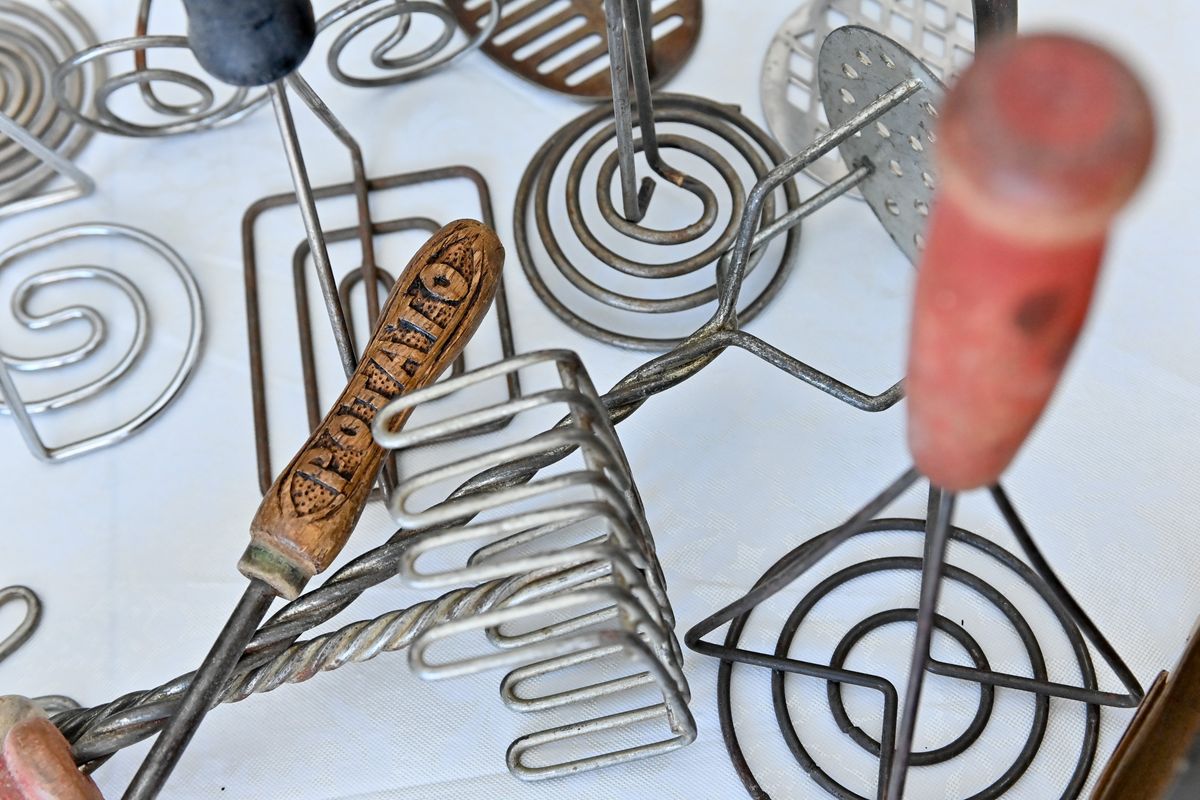
He started collecting in the late 1990s and not counting duplicates, he’s amassed between 600 and 700 hundred of them.
“There’s another reason for the collection. I have a condition called Asperger syndrome, sometimes called high-functioning autism,” Wagner said. “One of the symptoms is an intense and very narrow interest, so a lot of us have collections of odd items.”
Wagner taught philosophy at Gonzaga University for 39 years and displayed his collection on bookshelves in his office.
“Total strangers would wander in, attracted by the collection,” Wagner said. “Potato mashers are great conversation starters.”
He would introduce himself to students by saying, “I’m Dr. Wagner. I’m known for my tremendous intellectual ability, my sense of humor (long pause) and my potato mashers.”
Since he retired two years ago, most of his collection is packed in boxes, but last week in his north side living room, he showed off some of his prized specimens.
His largest masher is made of solid metal and stands 4 feet, 10½ inches tall. Like many of his most unusual items, he found it on eBay. The large potato masher came from a catering company and Wagner snagged it for $15, plus $20 shipping.
“A great advantage to collecting potato mashers is they’re inexpensive,” he said. “If you want something expensive to collect, try egg beaters.”
While handles can be made from all kinds of materials, most masher heads feature large-gauge wire in a rounded zigzag shape or a plate with holes or slits. One of Wagner’s favorites features a vertical metal fin.
“Bernadette (his wife) figured out the fin is so you can mash potatoes in a circular way,” he explained.
Whimsical designs can be both cute and functional. Take “The Duck,” for instance. Made in 1990, it features a duck head handle and webbed feet for mashing. A rocket masher works fine as does a little yellow canary whose feet do the mashing.
Wagner also collects design failures.
One of those is a squatty-looking device with a large black knob for a handle. He surmises whoever made it hadn’t actually mashed potatoes as the knob is too big to easily grasp. Another design fail is the “Monster Mash.” It features a green dinosaur (or alligator) plastic handle, and the splayed-foot masher is too wide to effectively do the job.
The spring-handled mashers also fall into his fail category.
“These are love them or hate them models,” he said. “It takes a lot of effort to use them.”
Wagner had lots of fun with his “electric potato masher.” The gag gift is a standard masher with an attached cord. Which leads to the question, how often has Wagner mashed potatoes?
He shrugged.
“Maybe once or twice.”
Turns out Bernadette is the chief masher in the family.
One of his more unusual finds is a wooden model that looks more like a weapon than a kitchen utensil.
“I call it the Fred Flintstone masher,” Wagner said. “It’s completely made by ax and was advertised as being made in the 1890s.”
His most valuable item is probably one with a Bakelite handle – Bakelite is highly collectible. He also has a cast-iron model from the 1930s that’s truly a work of art. Speaking of art, one of his students created a ceramic potato masher for him in a pottery class.
Then there are double-duty mashers, including some with a bottle opener at one end, and some that can pivot and become potato ricers, and he even owns a masher/whisk combo.
But home cooks find the most recent innovations most impressive – potato mashers with hinges that allow the head to pivot and fold – no more jammed drawers.
“I’m still being surprised,” Wagner said. “Why didn’t someone think of this before?”
Of course, all collectors have their Holy Grail or “the one that got away.” For Wagner, it was one made of tigerwood.
“It was a beautiful work of art,” he said, sighing. “It went for $450 on eBay.”
He’s still adding to his collection, but is pleased with the variety he’s curated.
“The collection reflects the creativity and sheer genius that goes into creating so many different types of such an ordinary-looking thing,” he said.
But choosing his ultimate favorite potato masher proves elusive.
“Which one would I take to the grave with me? None of them,” Wagner said. “I want to leave them behind for others to enjoy.”