
Going Rogue: shedding the frustrations of modern life on a Wild and Scenic River
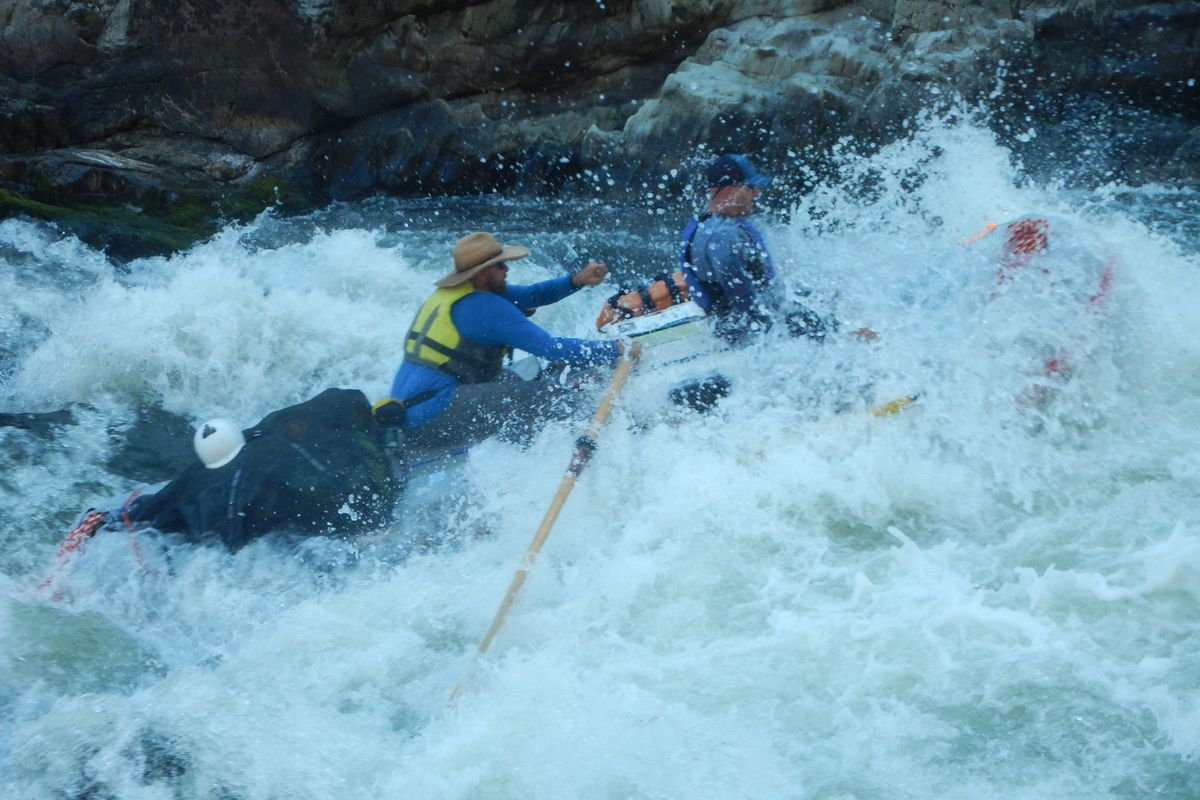
It’s not America’s most famous whitewater stream, but the Rogue River in southwestern Oregon is an ideal place to have fun with your friends and shed the frustrations of modern life for a few days. The rapids aren’t terribly difficult, the scenery is outstanding, and the solitude is profound.
Born near Crater Lake, the Rogue flows west through the heavily forested Klamath mountains on its journey to the sea. It’s a long drive to reach the launch site – more than 600 miles from Spokane – but it’s worth doing. The Rogue is so remarkable that it was one of the inaugural rivers protected under the federal Wild and Scenic Rivers Act of 1968. (See sidebar)
The Old Canoeist was there earlier this month – a little apprehensive at the start, a little beat up in the middle, and pretty pleased with himself by the end. There were 11 others on the trip and, after four days on the water, their bonds of friendship were tighter and deeper than ever.
Red tape formalities
Like many rivers these days, the wilderness section of the Rogue is a controlled-access stream that requires a permit to float; the only way to get a permit is to win one in a competitive lottery. The Old Canoeist got lucky this year as one of his buddies drew a permit with a launch date of Oct. 2. Early October is a great time to go Rogue because the weather is usually warm and dry.
The 35-mile permit section begins at Grave Creek, but overnight camping isn’t allowed there. So the Pullman/Moscow-based group, known collectively as the “Palouse Pirates,” camped near a boat ramp 4 miles upstream at Almeda Park.
There was the usual swirl of excitement on launch day as the Pirates packed their bags and loaded their boats. The fleet consisted of four rafts, four kayaks and one rouge-colored canoe.
Despite its ghastly color, the Old Canoeist had high hopes for that boat, which he lovingly restored last year. The hull was 30 years old, but the boat looked sharp with new ash gunwales, a new seat, and a new lease on life. Trouble was, the Old Canoeist hadn’t paddled it much, so he was still a bit fuzzy on its performance characteristics.
It didn’t take long before it was clear he’d brought the wrong boat.
Rogue River swim team
In fact, the Old Canoeist was dogged by failure before he even reached the permit section at Grave Creek. Edgy and tippy, the canoe failed to avoid a rock in an easy riffle and its skipper was summarily ejected. Fortunately, the river was low and slow, and not terribly cold, so the only damage was a ragged gash in the stern and a disheartening loss of confidence.
Less than 2 miles later, the Old Canoeist suffered another out-of-boat experience in an even easier rapid. At this point, an armada of individual doubts ran together and thickened into a bubbling stew of apprehension. “Am I really up to this?” he wondered.
Shortly after Grave Creek, low morale led the Old Canoeist to make his first sensible decision of the trip. Grave Creek Falls looked too rambunctious for a squirrelly canoe carrying a guy on the verge of Medicare enrollment. Everyone else in his group ran the falls, but the Old Canoeist opted for the heel-and-toe route down the right bank.
Less than half a mile into the permit section, and he already had two swims and a portage under his belt. At this point, his companions were organizing a betting pool on the final tally.
The balm of wild country
Easy rapid followed easy rapid and confidence gradually returned, allowing the Old Canoeist to lift his head and take in the sights. There’s a lot to keep the eye busy in the Rogue River’s riparian area, but the first thing visitors notice are the effects of recent wildfires.
The banks were lined with a mosaic of live and dead trees, notably madrone, some still smoldering with their exfoliating red bark blackened by fire. Live oak, tanoak and Douglas fir also fell prey to the flames. The acrid smell of smoke hung heavy in tight side canyons. Elsewhere, parched hillsides were occasionally raked by dry landslides, in which a single rolling stone blossoms into a nasty little avalanche. One of the kayakers, who earns his living as a postfire erosion scientist, referred to these slides as “dry ravel.”
Famed for its salmon and steelhead runs, the Rogue is home to a wide variety of wildlife ranging from curious deer in the campsites to playful otters in the river. Great blue heron are common, and snowy egrets are occasionally spotted as well.
Let’s think twice about this
The first serious navigational challenge on the permit section is Ranie Falls, where the river plunges over a 12-foot ledge before smashing into a frothy maelstrom below. Daring rafters and kayakers occasionally run Ranie Falls, but none of the Pirates was up for the challenge.
Rather than risk the wrath of the falls, everyone aimed for a skimpy channel blasted down the right bank long ago. The fish ladder, as it’s known, is where boat traffic really backs up.
Six aluminum drift boats were bobbing in the eddy above the fish ladder when the Old Canoeist arrived. Six fishing guides eyed him sullenly, leaving no doubt as to who had the right of way. One by one, the guides stepped ashore, took their bow lines in hand, then walked, pushed and cajoled their boats down the shallow channel.
Some boats got stuck. Some guides needed help. There were some slips and falls. There was some swearing. A lot of aluminum got scraped onto shallow rocks. It wasn’t pretty.
Things were no different for the Pirates when it was their turn. Some boats got stuck. There were some slips and falls. There was some swearing. It was a real goat rodeo.
Room with a view
Because the permit section is so short, the Pirates hove-to after a relatively brief day and camped on a dusty bench with a single human improvement: a little corral formed by a spindly electrified fence. Black bears are a nuisance on the Rogue, so boaters are encouraged to store their coolers, food boxes and cooking equipment inside the enclosures.
Sure enough, the camp was amply stocked with bear scat, but there was no show of rudeness from the ursine community that night.
Ah, nighttime on the Rogue! Out there, visitors are treated to the real night sky, with thousands of stars shimmering overhead. Shooting stars streak across the firmament as weary paddlers drift off to sleep. If you enjoy life’s simple pleasures, a clear night on the Rogue is hard to beat.
The Rogue River Trail hems the river’s right bank, so not all visitors arrive by boat. Early one morning, the Old Canoeist spotted a thru hiker carrying a modest little day pack. A handful of private lodges is scattered along the permit section of the Rogue, so the man undoubtedly was spending his nights in Chablis-and-brie comfort.
Finding the rhythm
Below Ranie Falls, the Rogue is strewn with dozens of delightful little Class 2 and Class 3 rapids. Most are short, some are violent, and all conclude in calm, deep pools. Exposed rocks are everywhere at low, late-season flows.
Not wishing to be a burden to his friends, the Old Canoeist upped his game considerably on Day 2, paddling every rapid without incident. That’s not to say his canoe didn’t fill with water, then stall out in some of the meatier drops. There were moments of doubt, but he kept his boat under him all day.
Day 3 was the big test, with Mule Creek Canyon at mile 23 and the biggest rapid of all, Blossom Bar, at mile 26.5.
For most of its length, the Rogue flows through a broad, open canyon, but Mule Creek Canyon is a glaring exception. The river tightens up as it enters a winding, steep-walled basalt gash that’s almost a sensory deprivation zone after the lushness of the Rogue’s open country. It’s often shady and windy in there, so it’s a foreboding place.
The canyon is about half a mile long, and it starts off gently with big, friendly eddies. Farther along, the gradient steepens and the mood turns ominous. True to its name, the Rogue writhes and swirls with mounting intensity before arriving at the crux rapid, known as the Coffeepot.
Hemmed in by stone walls rising steeply from the water, there’s nowhere for paddlers to hide when they enter the Coffeepot. Angry as a rodeo bull, the river boils up from below, creating powerful whirlpools that come and go in seconds. Given this, there is no clear “line” through the Coffeepot; it is simply a place for reptilian-brain survival. (Here’s a short clip of what it’s like: https://www.youtube.com/watch?v=jcK27byaRxQ)
For the Old Canoeist, it felt like flying a balsa wood glider into a hurricane. For reasons he can’t explain, he emerged from Mule Creek Canyon upright, unscathed, and grinning like he’d won free beer for life.
The big one
The final navigational challenge is Blossom Bar, a long rapid studded with enormous rocks that bestride the river like colossi. It’s a little more than 3 miles downstream of Mule Creek Canyon, and it is every bit as intimidating.
Most boaters pull over well upstream, then scout the rapid from a rocky promontory on the right bank. The Old Canoeist had seen plenty of YouTube videos of Blossom Bar(here’s a particularly good one: https://www.youtube.com/watch?v=Jjd3H8Y1IdE), so he had a clear blueprint of the necessary maneuvers.
He entered on the left, picked up his landmarks, then made “the move” – deftly tucking in behind a big rock on the right. So far, so good. Then he straightened out and shot downriver in a plume of savagely fast water. The plan was to pass left of a cluster of rocks immediately downstream, but that’s when the laws of physics caught up with him.
Being right-handed, the Old Canoeist couldn’t push his boat to the left fast enough and the cluster of rocks loomed into disturbingly close focus. He pushed off with his hands, hoping to shimmy around the last rock, but a bathtub’s worth of water poured into his boat. The canoe eventually slid past the rock, but no amount of leaning and paddle tricks could arrest its desire to go belly up.
With the inevitability of a Greek tragedy, the boat ejected the Old Canoeist and ran the remaining 70% of Blossom Bar without a navigator. Canoe and canoeist were reunited in calm water at the bottom, and the pair continued downriver under an uneasy truce.
Winding down
With Blossom Bar in the rearview mirror, the final 10 miles of the permit section are mellow and relaxed. The river eases up and there’s time to enjoy the antics of ducklings squabbling over a fish, or to inspect unusual rock formations at water’s edge.
At one point, a huge cormorant stood on a finger of rock jutting into the river – utterly unconcerned by the passage of rafts, kayaks and canoe. A magnificent specimen, it flared its wings, craned its neck, and stared everyone down with wild, beady eyes.
Jetboats occasionally ply the river below Blossom Bar, ferrying passengers to and from private lodges. They are heard long before they are seen, so there’s ample time for hand-propelled boats to move to one side.
Faced with a long drive the next day, the Pirates opted to camp only 5 miles shy of the takeout at Foster Bar. The final night of a river trip is always a bit melancholic, so the group stayed up late drinking wine, swapping stories and squeezing out the last drops of fellowship.
One by one, they eventually wandered off to their tents, cots and blue tarps on the sand. A warm breeze began to blow, and with it came – could it be? – yes, the salty tang of the sea. The Pacific Ocean, less than 20 miles to the west, lends its mysterious fragrance to its freshwater cousin, the Rogue River.