
Kishida-Biden summit makes show of unity in confronting China
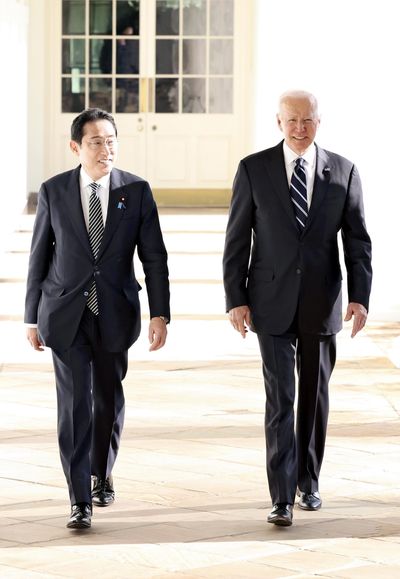
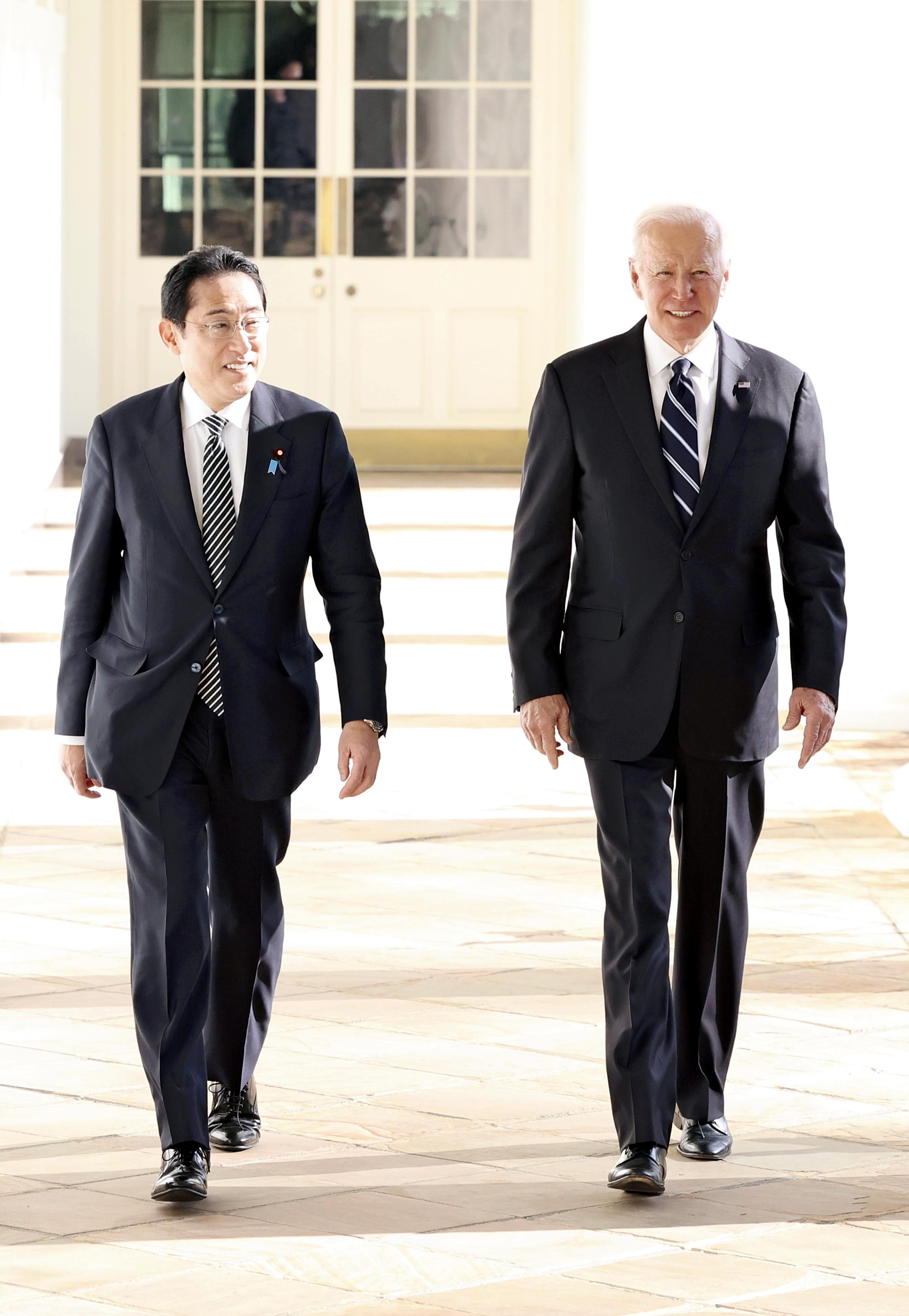
WASHINGTON - Prime Minister Fumio Kishida and U.S. President Biden confirmed their nations’ desire to enhance cooperation to realize the vision of a free and open Indo-Pacific, showing a united front toward China.
During their summit in Washington on Friday, the leaders paved the way to deepening the bilateral alliance and aim to reinforce deterrence through networks with allies, including fellow Group of Seven members.
“I intend to reinforce efforts to realize a free and open Indo-Pacific,” Kishida explained to Biden.
Biden replied that he supported Kishida. The two leaders reaffirmed their stances to promote the vision of a free and open Indo-Pacific.
The Japan-led free and open Indo-Pacific initiative is aimed at promoting peace, stability and prosperity in the region with the rule of law at its core.
After the Japanese government proposed the vision in 2016, an increasing number of nations in the Indo-Pacific region and Europe have agreed with it.
This spring the Japanese government will compile a new free and open Indo-Pacific plan. Based on that, Japan plans to provide air defense radar systems and other defense equipment to partner countries, which Foreign Minister Yoshimasa Hayashi described as “nations sharing with us purposes in diplomatic tasks.”
Myriad challenges
Behind these moves by Japan and the U.S. are China’s actions, from its highhanded advancements in the East and South China Seas to increasingly provocative military activities in its quest to achieve reunification with Taiwan.
Tokyo and Washington regard Beijing’s moves as challenges to the international order.
“China has some visions and claims on the international order that diverge from ours and that we can never accept,” Kishida said Friday in a speech in Washington.
Japan and the United States have been strengthening relations with Southeast Asian countries and island nations in the Pacific, among others, through cooperation under the free and open Indo-Pacific framework. At the same time, China has been expanding its influence in the region.
The Biden administration is seeking Japan’s involvement in U.S. competition with China in fields such as semiconductors, space development and artificial intelligence. By doing so, the Biden administration aims to strengthen U.S. competitiveness in the struggle for technological hegemony.
During the summit, Biden expressed his expectations for Japan, saying, “We’re working closely on tech and economic issues.”
Stronger networks
Japan and the United States are making efforts to strengthen networks with allied countries that share the same values, including fellow G-7 nations, Australia and India.
Washington regards the Japan-U.S. alliance as a base for cooperation over its responses to Beijing. It also wants to utilize the G-7 framework for cooperative ties among democracies over policies toward Russia and aid to Ukraine.
Prior to arriving in the United States, Kishida visited fellow G-7 nations Canada, France, Italy and the United Kingdom, and obtained each country’s commitment to enhance security cooperation.
Joint drills in the framework of the Quad, which comprises Japan, the United States, Australia and India, will also be conducted repeatedly.
Japan has been providing funds and technology to developing countries as development cooperation. With these approaches, can Japan extend the unity of the G-7 members to such countries? Many tasks await Kishida as this year’s head of the G-7.