
The U.S. wildfire season has been eerily quiet. That could soon change.
After a very slow start, fire season may be heating up in the United States. Meteorologists are warning of a potential jump in fire activity as heat waves combine with increased ignitions during the July Fourth holiday.
While Canada’s record-shattering fire season continues to pour smoke across borders, there has been little contribution from blazes in the Lower 48. About 675,000 acres have burned so far nationwide – the lowest number at this point in the season in the past 10 years.
Wet and cool weather has kept fire danger unusually low out West. Massive forest fires, which spew the most smoke, are less likely this summer thanks to all of the snow last winter. Still, hot and windy weather in late June led to a marked increase in fire activity in Colorado and the Southwest, including Texas, according to the National Interagency Fire Center.
Despite improved drought conditions out West, dense vegetation growth is still set to fuel wildfires this year, especially at lower elevations. That happens to be where most people live, and human-caused ignitions usually spike on the Fourth of July.
“We’re concerned, obviously, but the good thing is we’re so quiet to start that we’re in a much better position,” said Jim Wallmann, a meteorologist with the National Interagency Fire Center in Boise. “We have more resources available than we normally do at this time of year.”
In the short term, the highest wildfire risk is in the Southwestern United States, where some areas are under an excessive heat warning through the holiday, with temperatures soaring above 115 degrees.
“That’s where the fuels are driest right now, and they also have a lot of grass in the lower elevations from last year’s monsoon,” Wallmann said.
Last week, more than 1,100 people evacuated their homes near Scottsdale, Arizona, during a fast-moving brush fire.
Because this year’s monsoon is delayed and could be weak, the region could stay hot and dry well into the summer.
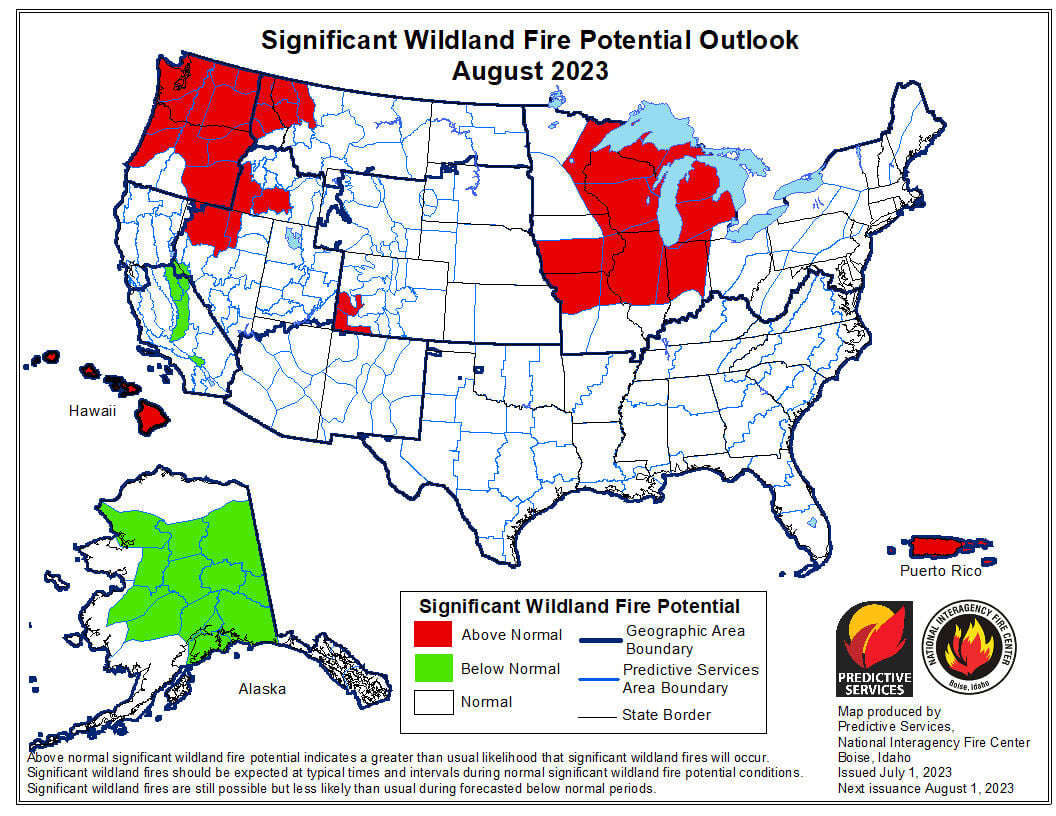
Another area of concern is the Pacific Northwest, which has already faced repeated heat waves that melted off mountain snow several weeks early. This week, Oregon is under heat advisories, while fire weather alerts have been issued for parts of Washington state.
“Portland is going to be well into the 90s,” Wallmann said. “And they really have had very little rainfall since May 1, even west of the Cascades in Seattle and the Olympic Peninsula.”
The Tunnel 5 Fire broke out about 30 miles east of Portland on Sunday, forcing evacuations and destroying several structures, according to the Skamania County sheriff’s office.
In California, where the Sacramento Valley topped 110 degrees over the weekend during summer’s first heat wave there, officials warned of potentially significant blazes despite the state’s wet winter.
“The abundant rain has produced tall grass and other vegetation that’s dried out already and is ready to burn,” said Joe Tyler, director and fire chief for Cal Fire, at a briefing on Thursday. “As the Fourth of July is quickly approaching us, I’m asking each of you to be mindful of how quickly a fire can have devastating consequences.”
A small but fast-moving grass fire destroyed two homes last week near the town of Perris, California, in Riverside County.
The heat combined with low humidity will keep fire conditions elevated this week, according to Matt Shameson, a meteorologist with the Southern California Geographic Area Coordination Center in Riverside. “We have an abundant grass crop, which is fully cured below 3,000 feet, so it’s going to be very susceptible to new ignitions,” he said.
While grass fires can be dangerous, they tend to be short-lived and more easily extinguished than fires in heavier vegetation. “They can burn quickly, but your total number of acres is usually much smaller than the bigger timber fires that we get up in the mountains,” Shameson said.
The good news is that heavier vegetation, like brush and forests, remain moist from the wet winter and will need more time, or a lot more heat, to dry out.
California is expected to see normal to below-normal fire danger through late summer. The highest fire risk is in the northern part of the country.
The Great Lakes region has been very dry, with worsening drought since early May. Although recent rains have dampened fire danger, forecasts suggest that relief won’t last through the summer.
“They’ve had a lot more fires than normal, but they haven’t gotten really big,” Wallmann said. “We could start having more problematic fires there as we head into late July and August.”