
Adam Swensen uses live variety show to unpack the ‘weird’ world of growing up religious
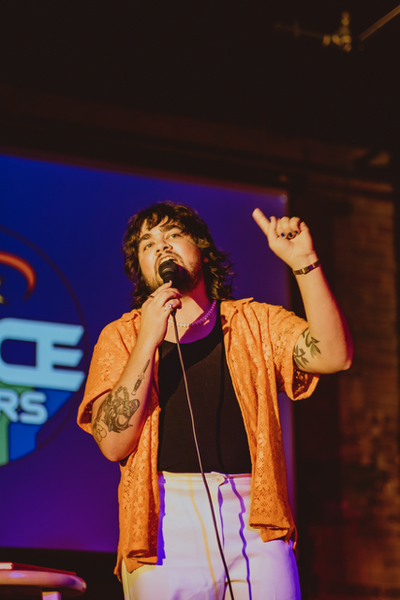
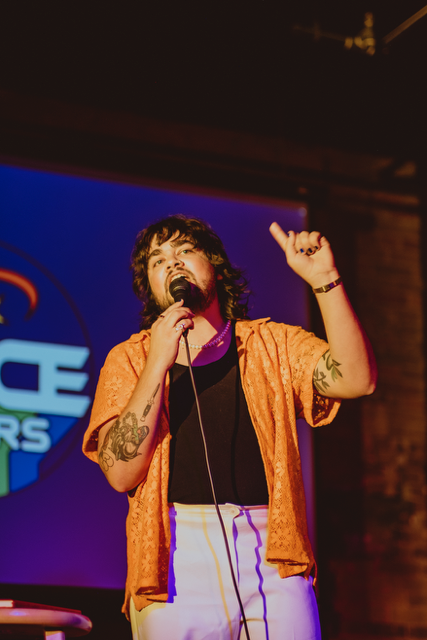
Adam Swensen was born on Easter Sunday. Born into a family that had been Baptist for generations, that felt significant.
While growing up in Ohio, Swensen attended a small church with his family, one he estimated had space for no more than 10 families. When he was 10, Swensen and his family moved to Michigan, where his dad got a job as a cook at a Christian summer camp.
The church the family attended in Michigan was a little bigger than their church in Ohio, but not by much. Swensen, who was homeschooled, would attend church three times a week.
Every summer, Swensen would work alongside his father in the kitchen. He’d get one week off each summer to attend the camp.
“Every summer I would basically rededicate my life to the Lord, and I always felt very passionate about what I was learning and hearing,” he said. “It was very real to me, and I started to feel in high school that God was calling me into ministry.”
Swensen started preaching at his local church, first at the evening services, then every now and then at the big Sunday morning service. He eventually started preaching at other churches as well.
Nearing graduation, Swensen began considering college. Attracted to their biblical exposition major, which focused on the art of preaching, Swensen applied to Moody Bible College and was accepted into the school’s Spokane campus. He traveled to Spokane from Michigan with a friend and her parents and immediately felt like he was in the right place.
Still, college was a bit challenging for Swensen, who said he’s not an academic.
“Before I decided to actually apply, I told my parents I just wanted to make a living loving people,” he said. “My dad, very supportively, was like ‘That’s not realistic.’ I was very passionate about hope and people finding that hope and that all I was focused on. Then I was focused on being done so I can finally make a difference. I was very future-based for a long time.”
While in his senior year, Swensen began to notice that he didn’t always align with the same things his classmates aligned with. In one class, the professor would present a current news item and ask the students how they felt about it.
One example Swensen remembers was the story of Kim Davis, a former county clerk from Kentucky who refused to issue marriage licenses to same-sex couples. Another was the Black Lives Matter movement.
Every time the class would discuss how they felt about the outcome of the event or what the person in question was saying, Swensen recalls always being on the progressive side of things.
“I started to notice, if we claim to have this good news, and we claim to love our neighbor as ourselves, it’s very important to me that we actually do that,” he said. “That was a big thing for me from high school on, and I started to feel like that wasn’t the objective of most of the people I was around.”
During his senior year, Swensen also completed an internship through Union Gospel Mission which had him leading Bible studies to young people in juvenile court. Through this work, Swensen realized “how much privilege it actually is to believe in the love of God.”
At one of those visits, a teen told Swenson he’d never been loved by his family and asked how he could believe that God could love him.
“That really threw me for a loop,” he said. “I remember being like ‘Of course, if you haven’t been shown love,’ it wouldn’t be easy to just be like ‘OK, God loves me. I’m going to change my whole life.’ ”
Around the same time, Swensen met the woman who would become his wife. She brought progressive Black and Brown people and queer people into his community, many of whom were people of faith, to some degree. As his community grew, he realized he no longer believed in the framework that condemns people he loves.
Swensen was nervous to tell his parents, and the community he grew up in, that he was “backsliding,” or turning away from the church, but his parents supported him then and now. They are still religious but have since left the Baptist church, and a few of his siblings have followed Swensen out to Spokane.
“I have three siblings still in Michigan, younger siblings still very much in the church, but they see the world very differently than I did at their age,” he said. “They’re much more open.”
Swensen’s backsliding happened gradually, and he attended a church that better aligned with his values until 2022. After a while though, he realized he was picking and choosing what to believe from the Bible. It got to a point where he found he no longer identified with what he was reading and, after a lot of therapy, decided to step away from the church.
Fast forward a few years, and Swensen is hosting a show called Religious Traumedy at the Chameleon on Friday which examines what it was like to grow up Christian and no longer be. The show features standup comedy from Kaley Alness and Wyatt Colombo, drag performances by Perri Twinkle Loveless and Polly Amethyst, who will perform to Christian songs, music from Caroline Fowler and a special performance by Camrynne Sullivan.
Swensen grew up listening to clean comedians like Jim Gaffigan and Brian Regan as well as Christian comedians. He has a core memory of making his friends laugh one day at the dinner table, and how good it felt to do so, and took influence from Mike Birbiglia’s storytelling variety of comedy when writing sermons in college.
Swensen was interested in giving open mic a try, but wasn’t sure where to start until he met Sullivan, who started a queer open mic at nYne Bar and Bistro. Swensen doesn’t identify as queer but said he felt more comfortable there because so much of his community is made up of queer people.
Swensen said his first set went just alright, but he knew right away that he wanted to continue performing. Swensen had his first proper set after Sullivan began a show called Space Queers.
“I crushed during that set, and in the next two days, I was on an adrenaline high,” he said.
From there he started performing at Openly Mic, started by friend Jared Lyons-Wolf, at Q Lounge, various shows hosted by Neva White under the company Pansy Productions, and at For You, a PowerPoint presentation show started by Wilma Dargen.
About a year ago, Swensen started thinking about creating his own show and began work on Religious Traumedy. Swensen doesn’t want the show to unearth actual trauma from the audience’s upbringing and is instead hoping everyone can share “inside baseball” jokes about being raised in the church.
“I’ve deconstructed and left my faith and when I meet other people who have the same background and who have also left, there’s a shared language, because we know what it was like to be raised in that way,” he said. “We know the same bands, the same references, we understand what it’s like to have weird youth pastors.”
Because the show sold out so quickly, Swensen is planning to host more Religious Traumedy shows in the future. He’s working on one about the Devil and Halloween, noting “it would be a harvest party because Christians aren’t allowed to do Halloween,” and wants to talk about purity culture and Christian music and movies as well.
Swensen hopes Religious Traumedy becomes a welcoming place for those in various stages of backsliding but also for those new to the stage, like the friendly spaces he found when he first started doing standup.
“I want to build that same safe space for everyone to get to laugh, like I said, at our experiences, and also get to highlight some of my favorite comedians,” he said.