
Then and Now: Officer Eslick
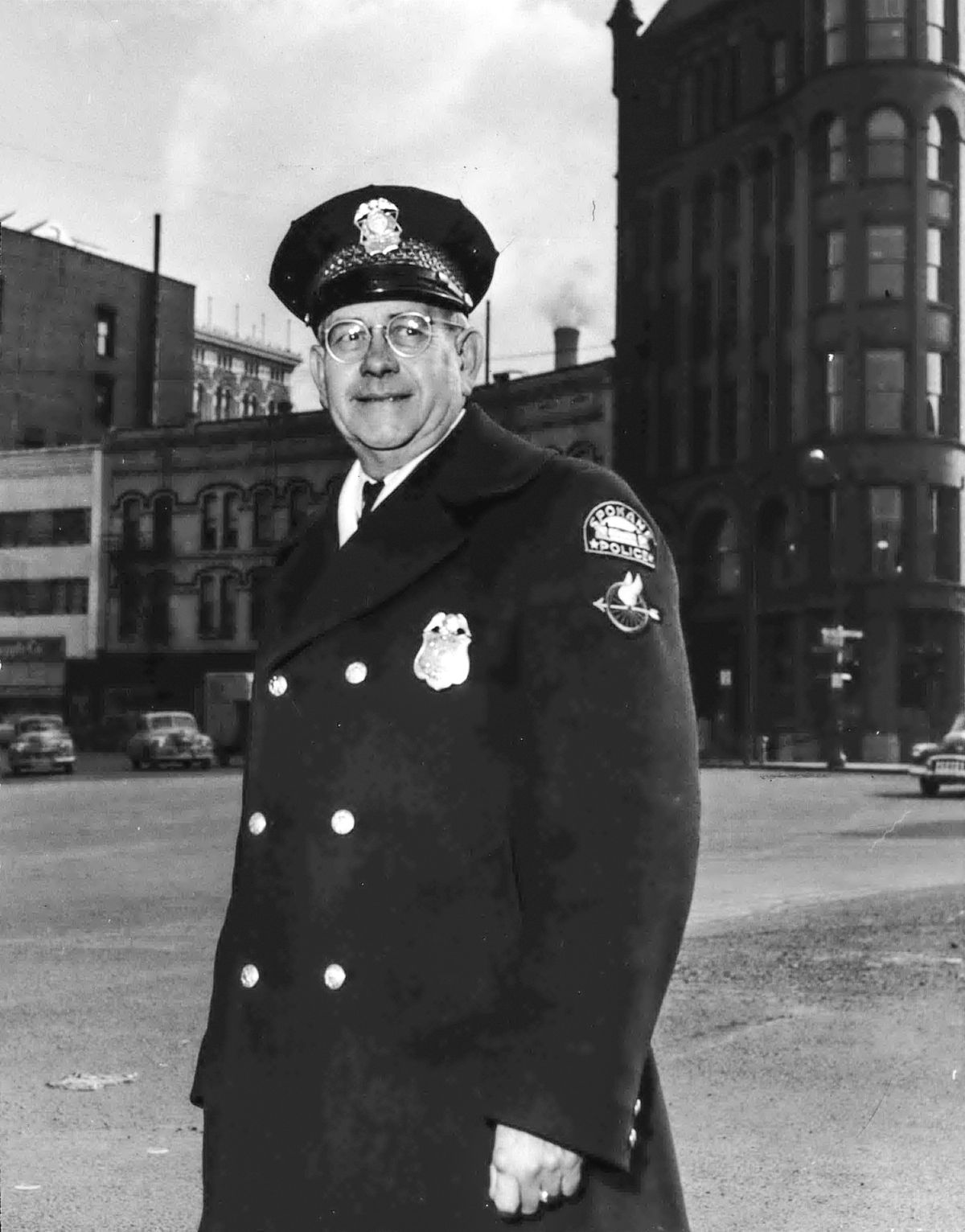
Arthur Franklin Eslick retired from the Spokane Police Department in 1952 and spent more than half of his 28-year career at what the newspaper called “Spokane’s toughest traffic spot,” the intersection of Monroe Street and Main and Riverside avenues.
There, Eslick operated the manual traffic signal mounted in the middle of the street while standing on a traffic island nearby. Despite the chaotic traffic, Eslick was known to smile and wave.
The thousands who passed daily felt they knew him. Postcards and birth announcements often arrived for him addressed only to “our cop at the Monaghan monument.”
Eslick, born in 1899, was from a pioneer family that moved to Spokane when he was very young. He went on the police force around 1924.
Outside of police work, Eslick was a scout leader and volunteer. Eslick served as auctioneer for unclaimed lost or stolen items recovered by the police. In May 1950, Eslick got word that an 11-year-old girl named Carol, who was hospitalized for rheumatic fever, was bringing $2 she had saved to bid on a bicycle, which her doctor had recommended she have during her recovery. As soon as she held up her hand to make the first bid, Eslick shouted “Sold!” A Spokane Chronicle editorial said, “Seldom has $2 ever bought so much.”
Eslick often showed up in the “Glimpses” column in the Chronicle, written by Myrtle Gaylord, who passed his duty station often. She complained in 1945 about how dangerous it was to cross Eslick’s complex intersection and he confronted her.
“Some time ago you wrote something about the traffic conditions on this corner,” he said. “Have you noticed that they have improved any in the last six years?”
“I have not,” Myrtle replied.
“Neither have I,” he replied dryly.
In 1946, Gaylord wrote that Eslick had whistled a warning at two women, loaded with shopping bags, who were trying to cross Riverside against the light. They went back to the curb, crossed farther down and walked back to him and smiled. “Well, at last I’ve found a way to make the boys whistle at me,” one woman told him.
At his retirement, a Spokane Chronicle editorial extolled his dedication, adding “what may have seemed like gruffness to some motorists at times was only his eagerness to do his work the best he could.”
Eslick died in 1963.