
Tariffs push small and midsize toy companies into survival mode
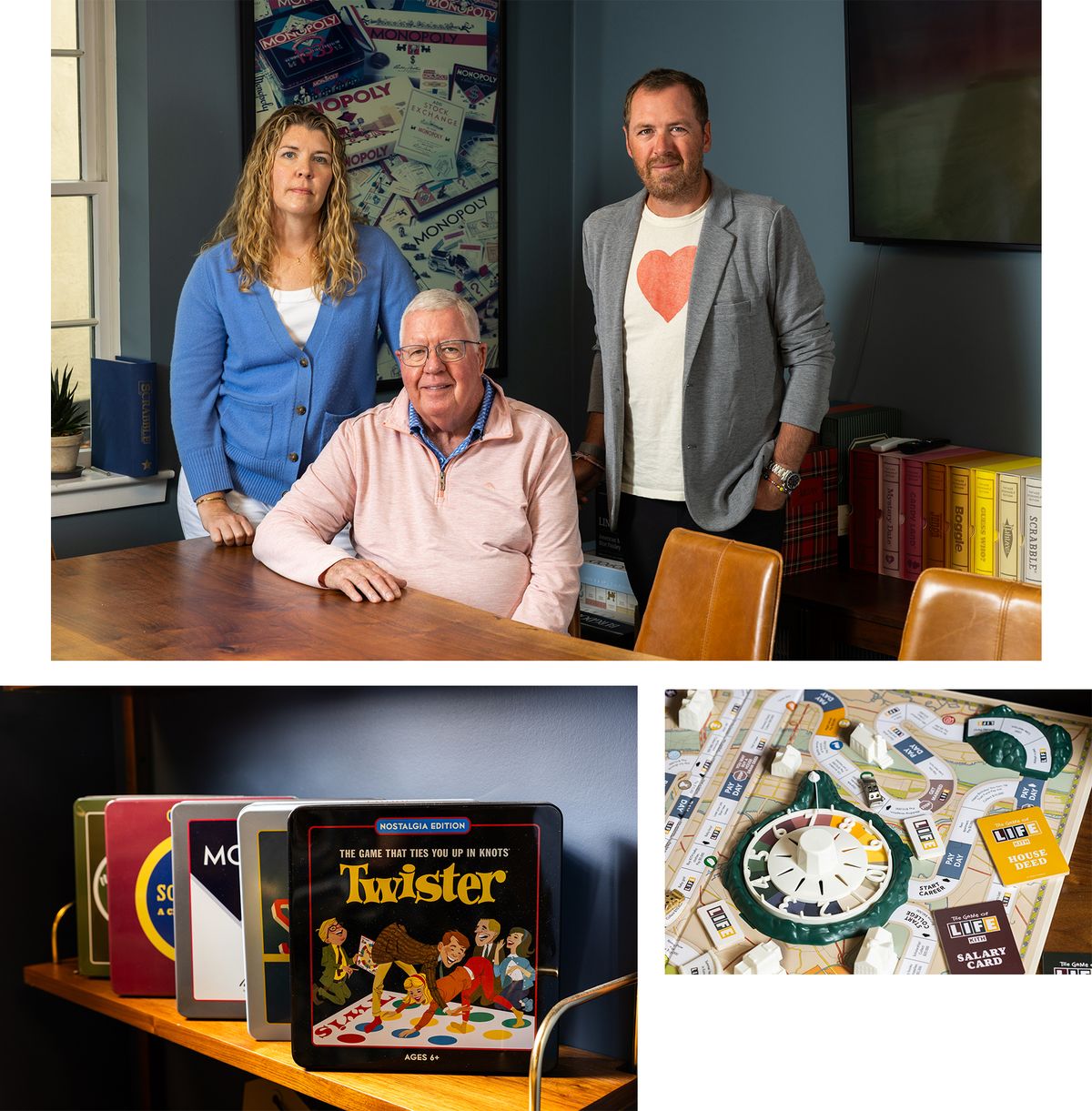
Kerry Addis and her father, Dana Silva, were in China visiting factories in April when they woke up to the news that threatened to devastate their family board game business: President Donald Trump announced that new tariffs on Chinese imports would hit 145%.
The panic set in over breakfast: “What just happened?” Kerry, the chief operating officer of WS Game Company, recalled asking Dana, who oversees manufacturing. “How do we move forward?”
Such a steep import tax would hammer the family-owned business, which licenses board games - such as Monopoly, Clue, Scrabble and Taboo - from Hasbro to produce upscale and collectible versions that are sold at 12,000 stores, including Target, Costco, Barnes & Noble, Anthropologie and thousands of small retailers.
“An absolute bomb dropped on us as a small business,” said Jonathan Silva, Kerry’s brother and the chief executive. Even though the levies have since been paused at 30 percent so trade talks can continue, he expects tariffs to cause an $8 million to $10 million loss - a 30 percent hit to the company’s gross revenue this year.
WS Game Company is among the thousands of small and midsize businesses weighing how to survive as the tariff shock sets in. There are more than 236,000 small business importers (defined as those with fewer than 500 employees) in the U.S., according to the latest Census Bureau data from 2023. These businesses often don’t have the financial safety net to weather unexpected expenses. And with less negotiating power than their Fortune 500 rivals to spread the costs across their supply chain, these firms say they have to pass the added expense on to their customers.
Small and midsize businesses make up 96% of the toy industry, which includes board games, said Greg Ahearn, president and chief executive of the Toy Association, a trade group. As a low-margin business that relies mostly on manufacturing in China, the toy industry was one of the first consumer goods sectors to increase prices on shoppers. Even publicly traded toy companies, such as Hasbro, Mattel, Spin Master and Jakks Pacific, have warned of price increases. In May alone, the jump in toy prices was six times higher than overall inflation, according to the Bureau of Labor Statistics.
“We’re the canary in the coal mine as an industry,” Ahearn said.
While Trump this month delayed the higher levies on Chinese imports another 90 days, Ahearn expects prices will continue rising. Among Toy Association members, 75 percent of small companies and 94% of midsize companies plan to raise prices this holiday season - when the bulk of sales occur - because of tariffs, he said.
In a statement, White House spokesman Kush Desai declined to address the specific impact on the toy business but said the president’s “trade deals have unlocked unprecedented market access for American exports.” Because of those agreements and the Trump tax cuts, he added, “American businesses and families alike have the certainty that the best is yet to come.”
Industry experts see a much bleaker picture. In particular, inventory for the holidays could be in jeopardy because companies held back with their ordering, fearing they couldn’t afford the steep levy, said James Zahn, editor in chief of the trade publication the Toy Book and senior editor at the Toy Insider. That pushed toy imports from China down by 45 percent in May year-over-year, according to a report published by economic research firm John Dunham & Associates, citing the U.S. Department of Commerce. Imports in June dropped 47%.
Jobs are also at stake: 55% of midsize and 45 percent of small businesses have laid off - or plan to lay off - staff as a result of tariffs, according to the Toy Association. Hasbro, Mattel, Funko, Spin Master and Jakks Pacific - the big five in publicly traded toy companies - all cut jobs, Zahn said.
“My entire LinkedIn feed is just loaded with green circles of ‘open to work,’” he said. “I’ve never seen this in my lifetime.”
‘Absolute survival’
Back in Manchester-by-the-Sea, Massachusetts, the family worked through how to manage the financial hit without laying off any of its 22 employees. Jonathan, Kerry and Dana stopped taking pay for five months; froze some retirement benefits; cut back on outside contractors; and pulled out of a toy show in Atlanta. They also raised prices twice this year, most recently in early July. Jonathan hopes it’s the final increase for the year.
“It’s been a year of absolute survival,” he said.
The volatility in Trump’s tariff policy has made it almost impossible to plan, he added. Jonathan was looking at manufacturers in Vietnam, India, Thailand, Malaysia and Brazil. But in the past few months, Trump has slapped steep levies on those countries, too.
“You just can’t operate a business when on any given Tuesday your price changes,” Jonathan said.
“It’s like whack-a-mole,” Kerry added.
China’s dominance is another factor. When they were hit with tariffs in Trump’s first term, many apparel and consumer goods industries moved production to emerging manufacturing hubs in Southeast Asia. But toy-making mostly stayed in China, in part because that sector wasn’t subject to those levies. To this day, about 77% of toys and games sold in the U.S. are still manufactured there.
China offers particular “manufacturing expertise and the ethical manufacturing process at the factories,” as well as cheaper labor, Ahearn said. Everything from final packaging to materials like springs, motors and plastic parts “can’t be replicated here in the U.S.”
WS Game has worked with its manufacturers in China for decades, Jonathan said, estimating that his father has spent about 100 days every year in the country building relationships with factories. Still, the company is looking for manufacturing opportunities in the U.S., including a factory in East Longmeadow, Massachusetts. But it would make only one of its 110 products domestically.
And the price of the game - a large coffee table and bookshelf-style Monopoly that will be released next year - will be “quite high,” Jonathan said. “I don’t know if the quality will be as good as overseas production, but we’re giving it an earnest shot.”
It’s been about 50 years since the U.S. had a meaningful toy manufacturing industry, Zahn said. Many toys, including the classics, have never been made in the U.S. But every other aspect of toy making - including invention, design, research and development and marketing - happens in the U.S. By imposing tariffs on American companies, the administration is putting those jobs at risk, Zahn said.
“When you put this unexpected tax on the business, people end up being the first to go,” Zahn added. “The concept of this big boom in American jobs for the toy industry is essentially a myth because those production lines will be robots.”
‘The dream is being crushed’
It felt inevitable that Dana’s children would wind up in the toy industry - it’s all they knew growing up. Dana started working at Parker Brothers in 1979. The toy and game company, acquired by Hasbro in 1991, invented some of the most enduring board games: Monopoly, Sorry!, Risk, Trivial Pursuit, Scrabble and more.
In 2000, Dana, along with his colleague Mike Doyle, left to start their own business, Winning Solutions. The company partnered with Hasbro to make special editions of its games, such as a travel version of Scrabble, as well as fresh designs exclusive to retailers.
After Mike’s retirement in 2023, Kerry and Jonathan took over as co-owners. Dana continues to have some ownership stake. In all, six family members work at WS Game.
The business has evolved into high-end and collectible version of the games. The current assortment includes a collection of pastel-hued game boxes that resembles books; a vintage tin collection; and wall-mounted, wood and glass versions of Scrabble, Monopoly and Clue. WS Game also made a limited-edition LeBron James Monopoly board and partnered with Target on an exclusive collection with Hearth & Hand, the brand from former HGTV stars Chip and Joanna Gaines.
Jonathan isn’t too concerned that price increases will deter his usual mid- to high-income customer who’s less likely to blink at an average price increase of 10 to 12 percent - the company’s rough estimate of expected hikes. Hurting the company’s bottom line, rather, is inventory management and planning. The toy industry plans between 9 and 18 months in advance, he said, making it “absolutely impossible to make any type of deals, to set any type of pricing, to manage what projections will be” when trade policy continually changes. As of now, he doesn’t expect to have enough inventory to meet demand for some of his most popular items in the second half of the year. And with less to sell, revenue will take a hit.
It’s an issue most small and midsize toy companies are facing, because the majority of toys sold during the holidays are manufactured from April to August, Zahn said. Trump’s April announcement essentially meant a “full stop” for the industry, which restarted production and shipments in May only after the administration announced a tariff pause, Zahn said.
Jonathan took a similar approach this month, when the administration announced another tariff pause. He immediately placed orders with the hopes of the products being made and shipped before Nov. 10. But to ensure the quick turnover, he ordered less than he would need to meet demand and focused instead on their most popular games.
He still expects that arrival on shelves by Christmas will be tight, given that the usual cycle of manufacturing to delivery requires 75 to 90 days.
Even with products in motion, Jonathan said the uncertainty over inventory and delivery commitments to retail partners is keeping him up at night.
“We are a success story. We were started with a folding table in the living room with $5,000 and a dream,” Jonathan said. “That dream is being crushed right now.”