
Washington’s hop farmers, a vital part of the world’s beer industry, are feeling the pinch of federal policies, a volatile market and environmental challenges
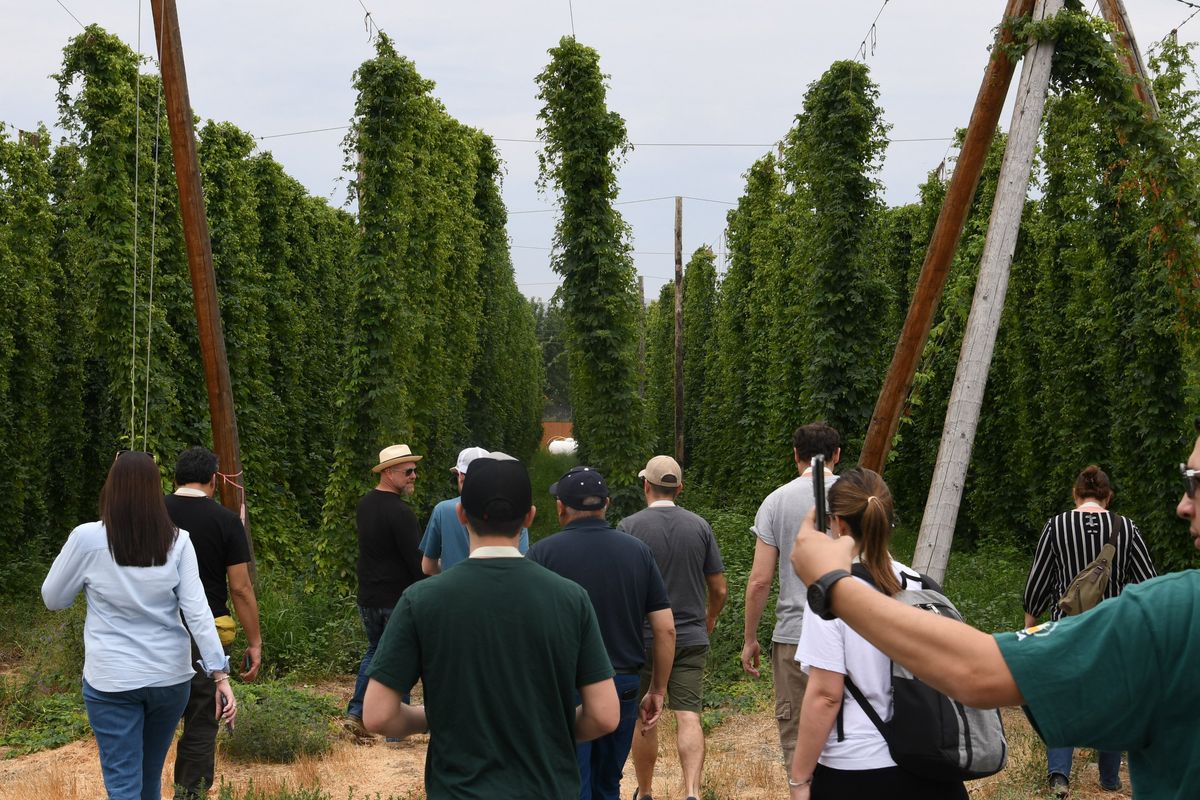
YAKIMA VALLEY – The challenges facing the Washington hop farmer are aplenty, mused Jeff Perrault, while staring out at several hundred acres of lush trellises on his family farm a few miles west of Toppenish.
There are perennial challenges, like those bothersome spider mites that can chew through rows of hop vines 20 feet tall, ruining a harvest’s quality and quantity.
There are also more immediate concerns: persistent drought conditions and a federal crackdown on immigration that has reignited calls to safeguard the workforce fueling Washington state’s and the broader nation’s agricultural economy.
Then there’s the business of hops: a decadelong boon fueled by the explosion of the craft beer industry is coming to an end as consumer tastes change.
“The challenges are broad,” Perrault said. “We are dealing with so many variables in agriculture.”
Washington hop farmers, centralized in the Yakima Valley, are intimately connected to the global beer market. Nearly 75% of the nation’s hops were planted, grown and harvested in the 75-by-22-mile area encompassing the valley, according to data from the U.S. Department of Agriculture. America’s 44,793 acres harvested last year was second only to Germany’s, and more specifically the Bavarian region’s roughly 50,000 acres harvested.
“You have these two areas, these two distinct growing regions that together supply just the vast majority of the world’s hops,” said Maggie Elliot, director of science and communications for the Hop Growers of Washington. “It’s incredible to think about, really, but it also means that it’s always been historically a highly volatile market. If anything happens in either of those two growing areas, it just fluctuates the entire supply chain.”
The declining demand globally has worked its way back through the supply chain to those Washington farmers, Elliot said. The year 2024 marked the first time Germany outpaced U.S. production in nine years – a sign of the market conditions. The value, and the acreage dedicated to Washington hops, has contracted dramatically as the global industry grapples with an oversupply.
Elliot said that oversupply has led to a roughly 30% reduction in hop production in the Yakima Valley over the last three years. In 2022, Washington state farmers harvested 42,762 acres for a total value of $434.5 million. Those figures fell to 33,361 acres for a total of $320.7 million in 2024, and current USDA projections expect at least another 5% drop when all is said and done in October.
Hops have a relatively long shelf life, compared to other commodities. Brewers are after a fine yellow powder contained in the hop cones called lupulin, a concentrate of the oils and resins that give hoppy beers their characteristic flavors and aroma. After being dried at temperatures as high as 140 degrees to remove most water content, whole cones are processed into pellets and extracts and sold to breweries around the world. Pellets can last three to five years if stored properly, while extracts can last up to 10.
“We are just navigating the perils of an oversupply, and we’re kind of waiting it out,” Elliot said. “The demand will come back. I think that there’s a lot of concern out there about craft beer shrinking, and while it’s certainly plateaued and might be shrinking a little bit, it’s not like falling off a cliff. We have to work through this surplus, and then we’ll be back at a better homeostasis.”
The acreage reduction can be easily seen on any drive through Yakima Valley lately. Expansive trellis networks lay empty, while others are being used to grow corn and other crops.
“It’s certainly a sign of the times,” Elliot said, noting hops are not a rotation crop.
The drastic cuts should help “right size” the supply chain, Elliot said. As for the remaining obstacles, Washington hop farmers, merchants and industry advocates are attempting to rise to the task by targeting new markets, developing more efficient and sustainable practices, and tapping federal delegates to spur change.
“We’re not out of the woods yet, but I do think we’re working our way there,” Elliot said.
Pests, drought and new markets
Perrault is the fourth generation to tend his family’s land since his great-grandfather founded the bison, blueberry and hop operation back in 1903. It’s grown tremendously from the 13 acres it started at in the decades since, now encompassing several hundred acres.
On Wednesday, Perrault welcomed a group of 18 craft brewers and beer -industry representatives from businesses across South America to his family’s operation as part of a tour of Washington’s industry organized by the hops commission. Greeting the large tour bus with a smile, Perrault proceeded with a walk through a few acres of the farm’s organic hops section as he discussed his strategies for contending with drought and spider mites.
The hops commission hosts a litany of tours through the Yakima Valley for domestic and international industry leaders throughout the year, Elliot said. The delegates from South America represent a growing market on which Washington farmers hope to capitalize in the years to come, as the craft brew boom the U.S. and Europe saw 10 years ago is starting to spread. Nearly 50% of all U.S. hops are exported each year, so establishing and maintaining international relations is vital to Perrault and the other Yakima growers for whom the commission advocates, Elliot said.
With child-like glee, the group clambered into the trellises draped with lush green vines behind Perrault. They broke fresh cones off, splitting them in half to reveal the limelight inside and release its aromas. As they did so, Perrault highlighted some of the holes chewed through the leaves of the vines by two-spotted spider mites, a well-established pest that thrives in the area’s arid climate.
Perrault is a data guy, he said, and he uses that in his role as vice president of resources and compliance to combat the mites and the drought conditions that have plagued the Yakima Valley. The Washington Department of Ecology issued a third drought declaration for the region this year as snowpack and precipitation up north continues to decline. The five reservoirs that feed the Yakima River – Keechelus, Kachess, Cle Elum, Bumping and Rimrock – are at 59% of normal, the fifth-lowest levels since 1971, as reported by the Yakima-Herald Republic.
Hops prefer to stay moist, but that water also assists in pest control, Perrault said. The more dust there is, the harder it is for his tiniest employees to do their work. In order to avoid spraying and jeopardizing his organic classification on roughly 100 acres, Perrault introduces and cultivates a breed of beetles that feed on the mites. The dustier the vines are, the harder it is for the beetles to get around. His top-down irrigation system washes the dirt away while also allowing cover plants between the trellis to grow, keeping the dust down.
The strategy has worked thus far: Wednesday evening marked the first time this year he had to spray any of his several hundred acres. His counterparts in the industry have sprayed pesticides every few weeks on areas with high mite levels, which he likened to playing Whack-A-Mole.
Under the conventional method, Perrault spent $385,000 on mite spray in 2022. This year’s costs are around only $4,000.
“The way I look at it is, I’m gonna let those levels rise, and then I’m gonna let my beneficial insects rise,” Perrault said. “And if I have a problem, we’re gonna get the B-52s out and we’re gonna nuke them.”
Perrault said pest management is just one of the lessons he’s taken from the organics section and then applied to his broader hop operation. The drip-down irrigation and soil moisture monitors is another; the drought conditions forced the company to examine its practices to make the most of its allotment. Drip-down irrigation reduced their footprint by up to 75%, he said.
“As time goes on and we get better data, and we get better at calibrating, because those are only as good as how well you calibrate them for that soil type, I think that’s really starting to save us in a lot of ways,” Perrault said.
Perrault said the drought conditions are still a paramount concern regionally, however. While tip-toeing around discussions of climate change, he said the region’s growers will likely need to become more efficient, as one more drought year would be “a big deal” with sweeping impacts.
“So we shall see,” Perrault said. “Hopefully, Mother Nature will be in our favor, and our reservoirs will fill up.”
Washington’s agricultural workforce
As Washington hop farmers contend with environmental, labor and market challenges, it can’t hurt to have a congressman in the fight alongside you.
Of the state’s roughly 31,000 hop acres planted this year, about 400 belong to U.S. Rep. Dan Newhouse, of Sunnyside. The Republican third-generation rancher and farmer spent much of August speaking directly with growers in the district about their concerns, several of which tie back to the federal government.
Whether it was a town hall with farmers in Prosser or a roundtable discussion with the company heads of some of the world’s largest hop processors at a Yakima bar, immigration reform peppered Newhouse’s interactions during his visit home.
“This is among the top three, and in many people‘s minds, the top issue facing farmers,” Newhouse said.
Like most agricultural industries, Washington’s hop production relies heavily on immigrant labor, and only for a few weeks out of the year. All farms bring on employees around harvest time, but most hop growers load up on staff in the spring, when more hands are needed to hang the lines on the trellises that the vines will climb and twist their way around throughout the summer.
“We might need 300 people for that six weeks of work, but for harvest, we’re down to 150 people,” Perrault said.
Most Americans won’t take those roles, which leads the country’s agricultural economy to turn to neighboring countries for a workforce, Perrault said. The most common legal avenue to bring in those immigrant staffers is the H2A program, but for years, farmers have raised issues with its stringent requirements, which include expansive paperwork and costs, including providing housing and travel.
Newhouse hopes to address those concerns through legislation, and he believes the current environment surrounding the topic of immigration may yield some success.
Earlier this year, Newhouse was part of a bipartisan coalition that reintroduced a bill aimed at overhauling the H2A program. The Farm Workforce Modernization Act would give unauthorized agricultural workers a path to legal status and overhaul the guest-worker visa program while requiring employers to check their workers’ legal status with the e-Verify program.
The bill would let unauthorized farmworkers earn legal status – along with their spouses and children – following a background check. After working at least eight years in agriculture and paying a $1,000 fine, they could earn permanent resident status, often called a “green card,” and later become eligible for citizenship.
The overhaul of the H-2A visa process would streamline the application process for farmers by allowing the employers to file a single petition for staggered seasonal needs and providing federal assistance in meeting housing needs. It also establishes a new classification of visa that would allow authorized workers to move from farm to farm without those growers needing to apply each time.
Newhouse said one of the most important roles he plays in the other Washington is to help his colleagues in the Capitol understand the plight of the farmer. He believes now, amid the Trump administration’s nationwide crackdown on illegal immigration, provides the opportunity to get reforms for legal avenues to immigration across the finish line. First floated in 2019, the bill passed the House that same year, and again in 2021, before stalling in the Senate each time.
“The biggest excuse, rationale, for not being able to support legislation that would allow more people into the country was because our southern border had thousands of people coming in illegally,” Newhouse said. “It was very difficult to get many of my colleagues to sign on to legislation, let alone vote yes on something that could allow any more.”
Newhouse believes the tide is turning among his Republican colleagues, including President Donald Trump, after they’ve heard from farmers in their own districts across the nation.
Leon Loza Jr., who co-owns and operates Loza Farms with his father, Leon Sr., near Wapato, cited a path to citizenship for farm workers as one of the top issues he’d like to see Newhouse champion. When the tour of South American delegates arrived at Loza Farms on Wednesday, Loza Jr. welcomed them in fluent Spanish to the only Mexican American-owned hop farm in the country.
At 260 acres of hops this year, down 90 from their average, the Lozas represent one of the smaller operations in Yakima Valley. The senior Loza purchased the farm in 2006 after decades of working the land as an employee of a French Canadian family. He first immigrated from Mexico as a 16-year-old to work in the valley’s hops fields in 1976, and his wife, Mimi, immigrated at 14 years old.
In 1987, the Reagan administration’s amnesty policy allowed Loza Jr.’s parents a path to citizenship, and eventually to be the business owners they are now. He said he would like to see those avenues now extended to others.
“There’s people that have been here forever,” Loza Jr. said. “They have families here. They have businesses here sometimes, and they have been paying taxes. If you’ve been paying taxes and you haven’t done nothing illegal, besides coming here, I think you should have the opportunity to become a resident.”
Loza Jr. said he didn’t have any issue filling his staffing needs this year, and neither did Perrault. However, their neighbors with more labor-intensive tree fruit crops may have some issues as their fruit comes into season in the coming weeks.
“I think it’ll be more telling when you have the fruit growers starting up, and you have multiple farms starting up,” Perrault said. “Right now, we’re kind of in the calm before the storm.”
The storm arrives
The Washington hop commission found a fitting end for the South American delegates on a tour of Yakima Valley: a 2,200-acre farm outside of Moxee in the midst of harvest.
CLS Farms, now in operation under a fifth generation of Desmarais family ownership, was abuzz with activity.
A steady stream of box tracks carrying freshly clipped vines flowed through the operation’s processing facility, where workers in neon orange vests hung the strands by hand on hooks. Those hooks carried the vines through spiked walls that pluck the cones before rattling conveyor belts moved the green buds through a series of fans and tumblers to remove any excess plant material.
At the end, two steady streams of plant material and cleaned hops flowed out of the building and onto their respective next stages. The former will become compost, while the latter is headed to expansive multistory kilns to dry the hops before they’re bailed into 200-pound bricks for further processing.
Some large breweries, like CLS Farms client Sierra Nevada of California, will take those bails in whole for their brewing needs. Others look for the broken-down products, pellets and extracts. The lengthy harvest process requires huge structures and complicated systems, all of which are only operational for less than two months a year.
The CLS operation, while bigger than many, is reflective of the overhead now needed to make strides in the industry. The craft beer boom meant an explosion of acreage, and in turn, improved processing systems and workforces. With all of those costs now on the rise, the tariff wars waged by the Trump administration threatens to burden hops farmers, processors and merchants with additional costs at a time when returns are declining.
Claire Desmarais, representing the “C” in her company’s name, said CLS Farms is one of few operations that can go from field to pellet in-house; most Yakima Valley farmers sell their products to merchants, who then process the dry cones and sell them abroad and domestically. As a result, CLS is seeing the impacts of the back and forth over the Trump administration’s import and export policies more immediately than their farming peers.
“The unfortunate thing is that, given the current supply, there’s an oversupply, so market prices are already pretty depressed,” Desmarais said. “For the most part, we’ve either had to just kind of incorporate the tariffs cost ourselves versus passing that on to the customer, because it would just make it not competitive.”
A volatile global market is particularly concerning for hops growers, where beer is essentially the sole product for which the specialty crop is used. Around half of the Yakima Valley’s production winds up overseas each year, and while there have been gains in other products like hop water and nonalcoholic beer, it pales in comparison to what breweries consume.
“There’s not a ton of other outlets for us,” Desmarais said. “Whereas, people who are pear farmers can go to the fresh market versus canning, or other farmers who maybe have more outlets.”
What would be most helpful, given the current landscape, is certainty in the markets, Desmarais said. That’s a sentiment shared by the CEOs of many of the large international merchants that operate out of Yakima, several of which joined Newhouse at the Thursday roundtable discussion.
Tom Davis, CEO of John I. Haas, said he and his peers have a strong desire for an understanding of what the international markets will be like under the Trump administration. The on-again, off-again trade wars can make it hard to lead a business over the long term.
“If I can advocate for something, it’d be predictability in the regulatory environment, so we can make decisions in the long term,” Davis said. “… If we have that, no matter what the trade policy is, we can design our business around this.”
The merchants, and farmers, have been unable to do so thus far. Brian Crawford, president and CEO of the D.C.-based advocacy group the Beer Institute, called the uncertainty “the biggest challenge that we’re facing in Washington right now.”
“The tariffs are on, tariffs are off, tariffs are increased,” Crawford said. “And President Trump, he is, in my opinion, trying to reset the global trade market, and he’s using trade deals as leverage.”
Desmarais said some clarity on the direction the Trump administration is headed with global trade would not only benefit the industry’s businesses, but also the surrounding communities. The unique nature of hops as a commodity means limited uses, but it also means the money spent on the end product of a cold pint does flow back down to the farms where those hops were grown, leading to more jobs and local investments.
Ensuring a healthy global market, and hops industry, ensures a healthy Yakima Valley, she said.
“We’re all a bunch of families,” Desmarais said. “And, really, every dollar spent on a beer is a dollar that gets put back to a grower. It makes an impact on the community, and the next generation to be able to come back and farm.”